Ballast Water Testing and Sampling at the Port of Houston
Updated
The Port of Houston is a high-volume US Gulf hub where ballast water management is governed by the USCG ballast water discharge standard and the EPA Vessel General Permit transitioning into the VIDA framework. This guide explains the regulatory picture in US waters, how sampling is arranged along the Houston Ship Channel, and how Sea Clean AS supports sampling and BWMS commissioning testing in cooperation with accredited laboratories and authorised parties rather than acting as a test body itself.
Key takeaways
- Houston ballast discharges fall under USCG ballast water rules and the EPA VGP transitioning into the VIDA framework.
- Commissioning testing under MEPC.325(75) confirms an installed BWMS meets the D-2 standard using representative samples.
- Sampling is planned along the Ship Channel around ballast operations and terminal access at container and petrochemical docks.
- Indicative analysis gives rapid on-board screening; accredited laboratories provide certified detailed analysis.
- Sea Clean is not a testing laboratory; it coordinates sampling with accredited labs and authorised parties and supplies kits and reagents.
- Houston attendance is by arrangement, with mobilisation and reagent supply timed around flights, visas and terminal access.
Houston in the US Regulatory Picture
The Port of Houston spans the Houston Ship Channel from Galveston Bay to the inner terminals, handling crude, chemicals, containers and project cargo across both public and private docks. Vessels discharging ballast in US waters fall under two overlapping regimes: the United States Coast Guard ballast water management regulations, which set the type-approval and discharge requirements, and the Environmental Protection Agency permit framework covering incidental discharges.
Under the USCG rules a vessel must manage ballast water to the numeric discharge standard, normally by operating a USCG type-approved ballast water management system, and must hold the supporting documentation. The EPA Vessel General Permit historically added monitoring and reporting conditions, and these are being carried into the Vessel Incidental Discharge Act framework as new national standards and enforcement arrangements are finalised.
For a vessel calling Houston, the practical implication is that both the equipment performance and the records must withstand inspection. Sampling activity here therefore tends to focus on demonstrating that an installed system performs to standard, supporting commissioning testing on newly fitted systems, and resolving questions raised during a Coast Guard examination.
Commissioning Testing and Self-Monitoring
IMO BWMS Code commissioning testing under MEPC.325(75) applies to vessels whose flag administration requires it after installation or major repair, and is increasingly expected at delivery and retrofit. The test confirms that the system, as installed on the specific vessel, produces treated water meeting the D-2 standard, using representative samples taken during a real ballast operation.
Beyond commissioning, operators sample and self-monitor to confirm a system keeps performing between port calls. This includes routine TRO measurement on electrochlorination and chemical-injection systems, neutralisation checks before discharge, and indicative screening to flag a developing problem before it becomes a discharge violation in a port like Houston where examinations are common.
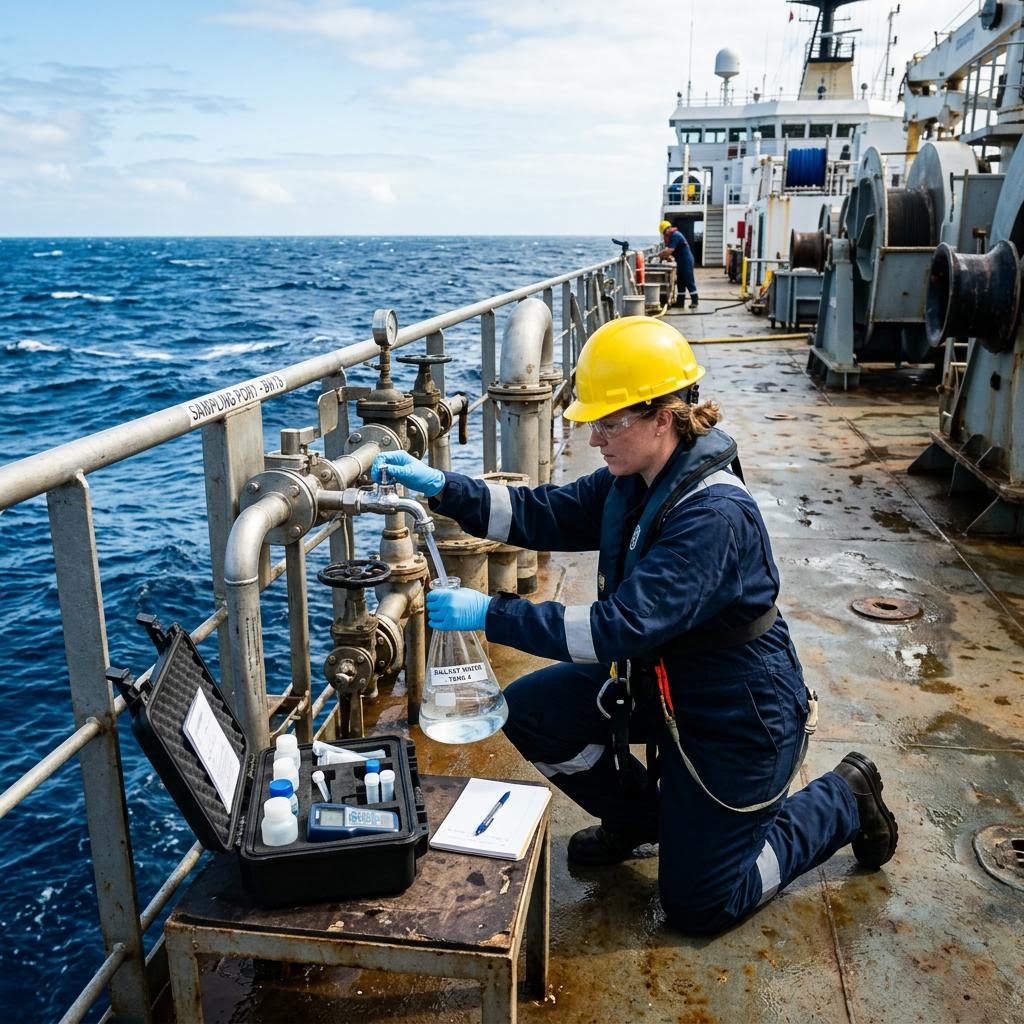
Sampling for these purposes is planned around the ballast or deballast operation, because organisms and residual oxidant must be measured in water that has actually passed through the treatment train. The timing, sample points and handling are agreed with the chief engineer so the result reflects normal operation rather than a stagnant tank.
Sampling Along the Ship Channel
Houston berths are spread along a long channel, from the Bayport and Barbours Cut container terminals to the petrochemical docks at Bayport, Pasadena and the upper channel. Sample access depends on the berth, the cargo operation and terminal safety rules, which at chemical and crude docks can be strict about who boards and when.
Representative sampling needs a defined point in the ballast system, usually a sample tap on the treated discharge line, and a window during active ballasting. At Houston this means coordinating with the vessel's agent and the terminal so the sampling attendance fits the cargo schedule without interrupting tight tanker turnarounds.
Where alongside access is constrained, sampling is planned for the part of the call when ballast operations align with the cargo plan. The agent confirms terminal induction, gangway access and any escort requirements before the attending party boards.
Indicative Versus Detailed Analysis
Indicative analysis is rapid, on-board screening that gives a quick indication of whether treated water is broadly within the D-2 limits. Methods such as fluorometry and ATP or stain-based viability checks, together with TRO measurement, let a crew or attending technician form an early view during the port call without waiting for a laboratory.
Detailed analysis is the definitive route: samples are analysed by an accredited laboratory using methods able to count and size living organisms in the regulated classes. Detailed results carry the evidential weight needed for commissioning certification and for answering a formal compliance question, and they take longer because of culturing and microscopy.
In Houston both routes have a place. Indicative screening supports day-to-day confidence and quick troubleshooting, while detailed analysis through an accredited lab provides the certified result when a system is being commissioned or when an authority requires documented proof.
How Sea Clean Supports a Houston Call
Sea Clean is not an accredited testing laboratory and does not certify ballast water analysis. What Sea Clean provides is coordination and practical support: arranging sampling attendance in cooperation with accredited laboratories and parties authorised by the flag administration or class, supplying TRO test kits and reagents, and helping the crew prepare the system and documentation for the test.
For a Houston call, attendance is arranged by prior agreement, with mobilisation depending on flights, visas and terminal access. TRO test kits, sodium thiosulfate neutraliser and consumables are supplied via courier and forwarding, coordinated with the vessel's local agent so they reach the ship before the sampling window.
The accredited laboratory or authorised party performs and certifies the analysis; Sea Clean's role is to make the sampling happen smoothly and to keep the vessel supplied with in-date reagents and kits. This division of responsibility keeps the certification with the body qualified to issue it.
Planning the Call and Lead Times
Effective Houston planning starts with early notice of the vessel name, IMO number, ETA, berth and the reason for sampling, whether commissioning, routine verification or a response to an examination. Because terminal access and tanker schedules drive the available window, the sooner the requirement is known, the more reliably attendance and lab coordination can be arranged.
Reagent and kit consignments should be ordered with enough lead time to clear inbound logistics and reach the agent before arrival. Where a detailed laboratory result is needed, the laboratory's turnaround should be built into the plan, since culturing-based methods are not instant.
Send the vessel details and requirement to post@seaclean.no to begin coordination. Aligning the agent, the attending party and the laboratory in advance is the main factor in completing sampling within a Houston port window.
Frequently asked questions
Which rules govern ballast water at the Port of Houston?
Vessels discharging in US waters must meet the USCG ballast water management regulations, normally by operating a USCG type-approved system with supporting records. The EPA Vessel General Permit framework, now transitioning into the VIDA national standards, adds monitoring and reporting conditions.
Does Sea Clean carry out the ballast water analysis in Houston?
No. Sea Clean is not an accredited testing laboratory. It coordinates and supports sampling and commissioning testing in cooperation with accredited laboratories and parties authorised by the flag administration or class, and supplies TRO test kits and reagents. The accredited party performs and certifies the analysis.
What is the difference between indicative and detailed analysis?
Indicative analysis is rapid on-board screening, using methods such as fluorometry, viability stains and TRO measurement, to give an early indication during the call. Detailed analysis is carried out by an accredited laboratory using methods that count living organisms in the regulated size classes, and it carries the evidential weight for certification.
How much notice does sampling at Houston need?
As much as possible. Houston attendance is arranged by agreement and depends on flights, visas and terminal access, while reagent and kit consignments must clear inbound logistics and reach the agent before arrival. Early notice of the ETA, berth and reason for sampling is the main factor in fitting the work into the port window.
Sources
Related articles
- USCG Ballast Water Compliance for Ships Calling the United States
- The US EPA VGP and VIDA Framework for Ballast Water
- Indicative vs Detailed Ballast Water Analysis
- BWTS Service Coverage: Norway, North Sea and Worldwide
- Ballast Water Testing and Sampling at Dubai and Jebel Ali
- Ballast Water Compliance in the European Union