Ballast Water Testing and Sampling at the Port of Fujairah
Updated
Fujairah on the Gulf of Oman is one of the world's largest bunkering and anchorage hubs, where many vessels call for fuel, stores and crew changes without a long alongside stay. This guide explains how the IMO Ballast Water Management Convention applies to vessels calling Fujairah, how sampling can be arranged at the anchorage, and how Sea Clean AS supports sampling and BWMS commissioning testing in cooperation with accredited laboratories rather than certifying results itself.
Key takeaways
- Fujairah is a major bunkering and anchorage hub where most vessels are served by launch rather than alongside.
- The UAE is a party to the IMO Convention, so vessels must meet D-2 and hold a record book and management plan.
- Commissioning testing under MEPC.325(75) uses representative samples taken during an actual ballast operation.
- Anchorage sampling depends on a launch transfer and a timing window matched to ballasting, coordinated by the agent.
- Indicative screening gives results during the call; accredited labs provide certified detailed analysis.
- Sea Clean coordinates sampling with accredited labs and supplies kits and reagents, but does not certify results itself.
Fujairah as an Anchorage Hub
Fujairah sits outside the Strait of Hormuz on the Gulf of Oman, giving it a strategic position for vessels that want to take bunkers and stores without entering the Arabian Gulf. The port is dominated by one of the largest bunkering anchorages in the world, with a container and general cargo terminal alongside an extensive oil terminal and storage complex.
Many vessels at Fujairah never go alongside; they drift or anchor offshore for bunkering, stores and crew changes handled by launch. This pattern shapes any sampling plan, because attendance and equipment usually have to reach the vessel by boat during a short anchorage stay rather than at a fixed berth.
The United Arab Emirates is a party to the IMO Ballast Water Management Convention, so vessels are expected to manage ballast water to the convention standards and to hold the supporting documentation that port state control may examine. Sampling activity at Fujairah therefore centres on confirming performance, supporting commissioning testing and answering documentation questions during a busy turnaround.
The Convention and Commissioning Testing
Under the IMO Convention a vessel must meet the D-2 discharge standard, normally by operating a type-approved ballast water management system, and must keep a ballast water record book and management plan. Port state control in the region checks these documents and the system's apparent condition, and may escalate to sampling where there is doubt.
BWMS Code commissioning testing under MEPC.325(75) applies where the flag administration requires it after installation or major repair. The test uses representative samples taken during an actual ballast operation to confirm that the installed system delivers water meeting the D-2 limits on that specific vessel.
Because Fujairah is a common point to take stores and crew, it is also used as a place to arrange supporting sampling work when a vessel's schedule allows. The key constraint is that meaningful samples must be taken while ballast water is actually being processed, which has to be matched to the vessel's operational plan at anchor.
Sampling at Anchorage
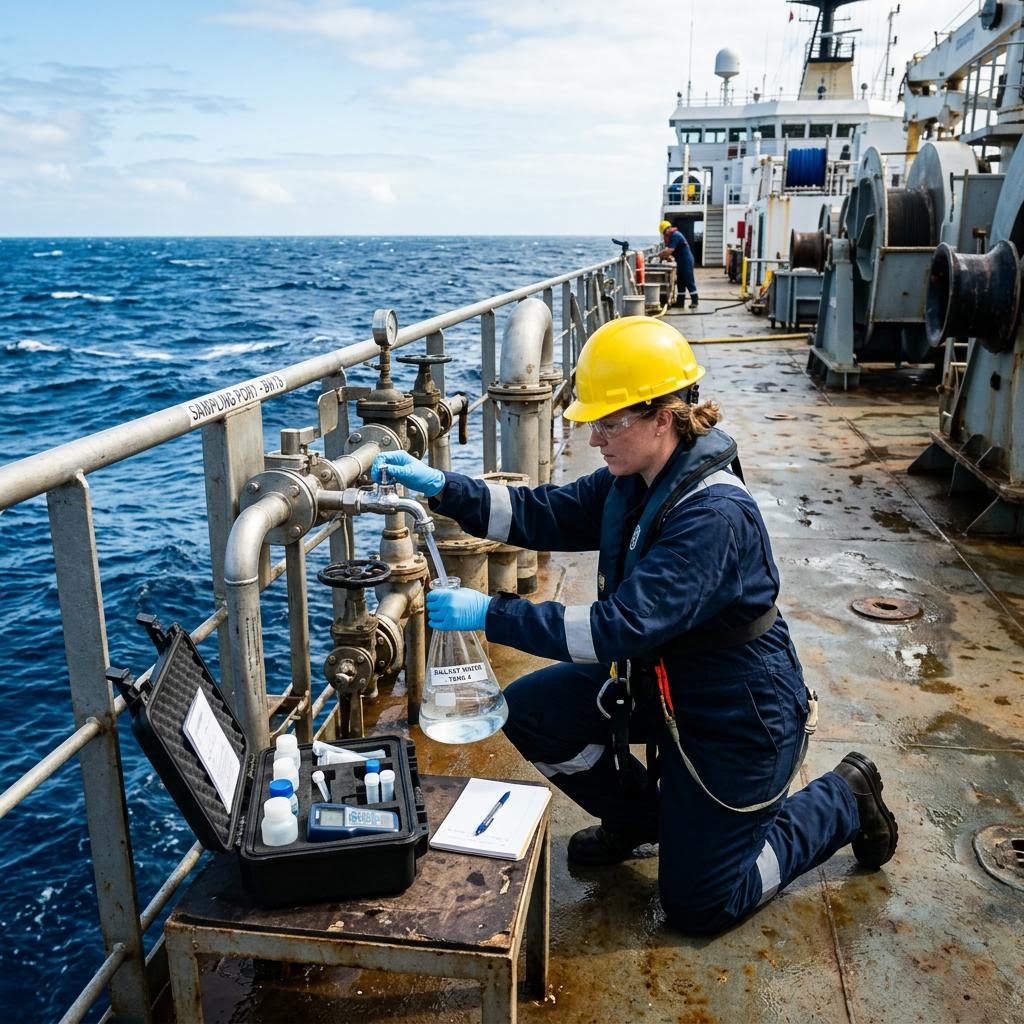
Sampling at Fujairah usually means a launch transfer to the vessel at anchor, arranged through the local agent and a boat operator. The attending party boards with sampling equipment and TRO test kits, takes samples at the designated point on the treated line during a ballast operation, and then handles the samples according to whether indicative or detailed analysis is intended.
Weather and sea state on the Gulf of Oman are generally workable, but launch operations still depend on a clear transfer plan and the agent's coordination of timing. For a short anchorage call, the sampling window is agreed in advance so the boat trip coincides with the ballast operation rather than a static tank.
Detailed analysis samples that must reach an accredited laboratory require careful handling and prompt forwarding, which adds logistics that have to be planned before the launch. Indicative screening can be completed at the vessel, giving an immediate read during the same attendance.
Indicative and Detailed Routes
Indicative analysis provides a rapid on-board indication of whether treated water is broadly within the D-2 limits, using fluorometry, viability checks and TRO measurement. At a fast-turnaround anchorage like Fujairah, indicative screening is often the practical way to get an answer within the call.
Detailed analysis through an accredited laboratory gives the certified, evidential result needed for commissioning and for any formal compliance question. It requires culturing and microscopy and therefore a longer turnaround, plus reliable forwarding of samples from the anchorage to the laboratory.
The two approaches are complementary. Indicative methods support troubleshooting and operational confidence during the call, while accredited detailed analysis supplies the documented proof when an installed system is being certified or a TRO sensor and treatment performance are formally questioned.
How Sea Clean Supports Fujairah
Sea Clean is not an accredited laboratory and does not certify ballast water results. It coordinates and supports sampling and commissioning testing in cooperation with accredited laboratories and parties authorised by the flag administration or class, supplies TRO test kits, sodium thiosulfate neutraliser and reagents, and helps the crew prepare the system and records for the test.
For Fujairah, attendance is arranged by prior agreement, with mobilisation depending on flights, visas and anchorage access, and equipment supplied via courier and forwarding coordinated through the vessel's local agent. There is no fabricated standing office; the support is organised for the specific call.
The accredited laboratory or authorised party performs and certifies the analysis, while Sea Clean keeps the vessel supplied with in-date reagents and kits and helps the sampling attendance fit the anchorage schedule. This keeps certification with the qualified body and the logistics with a supplier used to the region.
Planning a Fujairah Attendance
Planning starts with the vessel name, IMO number, ETA, expected anchorage time and the reason for sampling. Because most Fujairah calls are at anchor and short, the launch booking, the ballast operation timing and the attending party's mobilisation all have to be lined up before arrival.
Reagent and kit consignments are ordered with lead time to clear inbound logistics and reach the agent. Where detailed laboratory analysis is required, the laboratory turnaround and sample forwarding are built into the plan so results are not delayed by transport.
Send the vessel details and requirement to post@seaclean.no to begin coordination. Early engagement with the agent and the laboratory is what makes a short Fujairah anchorage stay enough time to complete representative sampling.
Frequently asked questions
Can ballast water sampling be done at the Fujairah anchorage?
Yes, by arrangement. Most Fujairah calls are at anchor, so sampling involves a launch transfer through the local agent and a boat operator, with samples taken during a ballast operation. The timing and transfer plan are agreed in advance to fit a short anchorage stay.
Does the IMO Ballast Water Convention apply at Fujairah?
Yes. The United Arab Emirates is a party to the convention, so vessels must manage ballast water to the D-2 standard, normally with a type-approved system, and keep a ballast water record book and management plan. Port state control may examine these and escalate to sampling where there is doubt.
What does Sea Clean provide for a Fujairah call?
Sea Clean coordinates and supports sampling and commissioning testing in cooperation with accredited laboratories and authorised parties, supplies TRO test kits, neutraliser and reagents, and helps prepare the system and records. It is not an accredited laboratory and does not certify the analysis.
How quickly can detailed results be obtained from Fujairah?
Detailed analysis through an accredited laboratory takes longer because it relies on culturing and microscopy, and samples must be forwarded from the anchorage to the laboratory. Indicative screening can be completed on board during the same attendance for an immediate operational read.
Sources
Related articles
- Ballast Water Testing and Sampling at Dubai and Jebel Ali
- Ballast Water Commissioning Testing: What Happens On Board
- Total Residual Oxidant (TRO) Monitoring and Neutralisation
- BWTS Service and Engineer Attendance at the Port of Fujairah
- Ballast Water Testing and Sampling at the Port of Kristiansand
- USCG Ballast Water Compliance for Ships Calling the United States