Ballast Water Testing and Sampling at the Port of Kristiansand
Updated
Kristiansand on Norway's south coast is a ferry, cargo and cruise port on the Skagerrak, close to the shipping lanes between Norway, Denmark and the continent. This guide explains how Norwegian and IMO ballast water rules apply, how sampling fits the ferry and cargo schedule, and how Sea Clean AS provides direct sampling support and BWMS commissioning testing coordination in cooperation with accredited laboratories from its Norwegian base.
Key takeaways
- Kristiansand is a south-coast ferry, cargo and cruise port on the Skagerrak with frequent fixed-schedule services.
- Norway applies the IMO Convention nationally, with attention to discharges in sensitive coastal waters.
- Commissioning testing under MEPC.325(75) confirms an installed system meets D-2 using representative samples.
- Ferry sampling windows are narrow and must be agreed precisely; cargo and cruise calls allow more flexibility.
- Kristiansand is within Sea Clean's region of direct attendance, so sampling and service can be combined.
- Sea Clean coordinates sampling with accredited labs and supplies kits and reagents, without certifying results.
Kristiansand on the Skagerrak
Kristiansand is the largest town on Norway's south coast and a key ferry gateway to Denmark, with regular Ro-Ro and passenger services, container and general cargo handling, and a growing cruise call. Its position on the Skagerrak places it on the routes between the Norwegian coast, the Baltic approaches and the North Sea.
Norway is a party to the IMO Ballast Water Management Convention and applies it through national maritime regulation, with additional attention to discharges in sensitive coastal and fjord waters. Vessels must meet the D-2 standard, operate a type-approved system and hold the supporting documentation.
Kristiansand is within Sea Clean's region of direct attendance from the Norwegian west coast base, so sampling support and any ballast system service can be arranged without depending on inbound logistics for locally available items.
Norwegian and IMO Requirements
Under the IMO Convention a vessel must meet the D-2 discharge standard, normally with a type-approved ballast water management system, and keep a ballast water record book and approved management plan. Norwegian authorities apply the convention through national rules and pay particular attention to discharges in coastal and environmentally sensitive areas.
Commissioning testing under MEPC.325(75) applies where the flag administration requires it after installation or major repair, using representative samples from an actual ballast operation to confirm the installed system meets D-2 on the specific vessel. Norwegian-flagged and Norway-trading vessels frequently arrange such testing.
Ferries and short-sea vessels on fixed Kristiansand routes have predictable ballast patterns, which helps in planning representative sampling around a real ballast operation within their tight schedules.
Sampling Around the Ferry Schedule
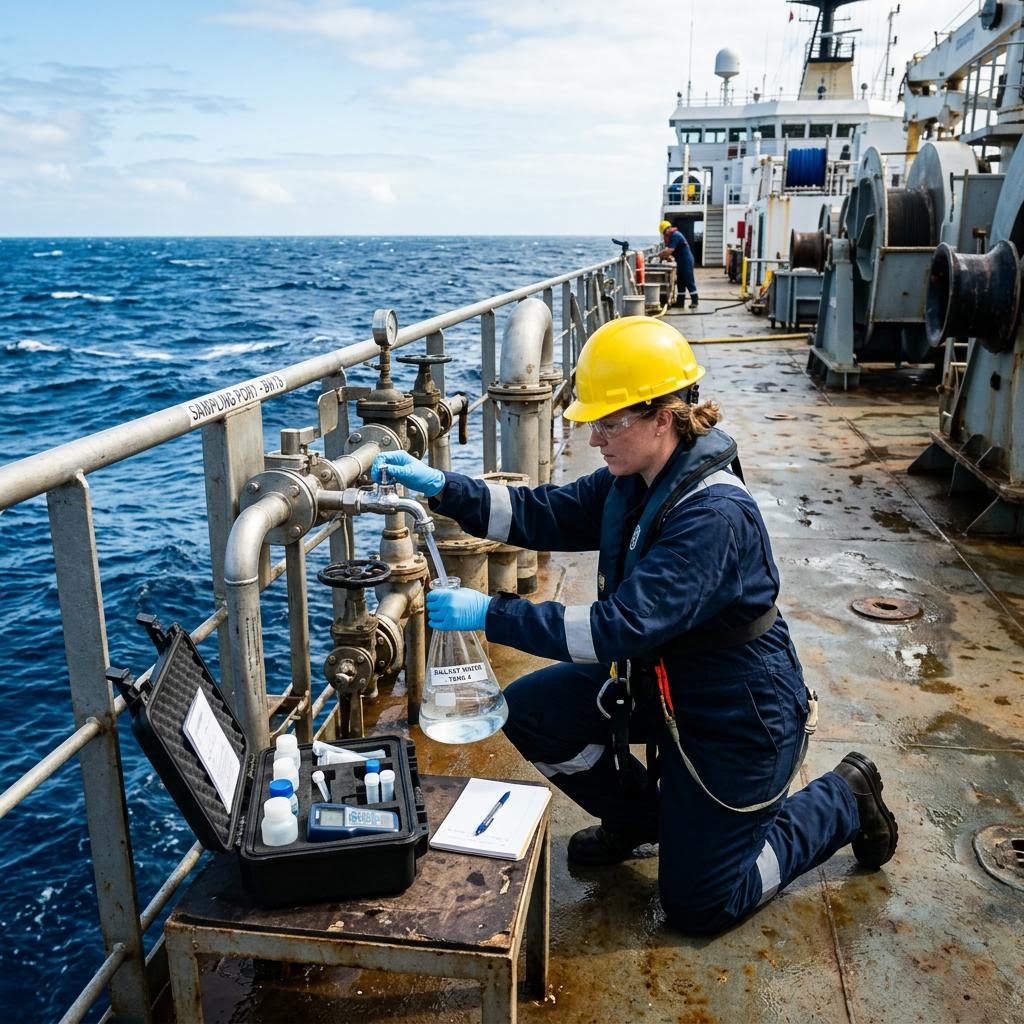
Ferry and Ro-Ro services at Kristiansand run frequent fixed schedules, so the sampling window is narrow and has to be agreed precisely with the agent and the ship's staff. The attending party boards during a confirmed ballast operation, with terminal access arranged in advance.
For cargo and cruise calls there is usually more flexibility, but the sampling still needs to be matched to a period when ballast water is being processed. Representative samples are taken at a defined point on the treated line so the result reflects normal operation.
Direct road access from the Norwegian base means Sea Clean can plan attendance at Kristiansand as part of its domestic coverage, coordinating timing with the agent and the chief engineer before the call.
Indicative and Detailed Analysis
Indicative analysis gives rapid on-board screening of whether treated water is broadly within D-2 limits, using fluorometry, viability checks and TRO measurement. It suits the tight turnarounds of ferry and short-sea services where a result is needed quickly.
Detailed analysis through an accredited laboratory provides the certified result for commissioning and formal compliance questions, using methods that count living organisms in the regulated classes. It requires culturing, microscopy and proper sample handling, so it takes longer.
Both routes are useful at Kristiansand: indicative screening supports operational confidence and troubleshooting, while accredited detailed analysis supplies the documented proof when a system is being certified or an authority requires it.
How Sea Clean Supports Kristiansand
Sea Clean is not an accredited laboratory and does not certify ballast water results. It coordinates and supports sampling and commissioning testing in cooperation with accredited laboratories and parties authorised by the flag administration or class, supplies TRO test kits, sodium thiosulfate neutraliser and reagents, and helps the crew prepare the system and records.
Kristiansand lies within Sea Clean's region of direct attendance from the Norwegian base, so sampling support can be combined with ballast system service during the same call, and locally held reagents and kits can often be delivered quickly. Reagents are supplied with attention to shelf life and labelled for the receiving vessel.
The accredited laboratory or authorised party performs and certifies the analysis, while Sea Clean makes the sampling and any service attendance fit the schedule. Combining the two in one visit reduces the number of separate calls a vessel needs.
Planning a Kristiansand Call
Begin with the vessel name, IMO number, ETA, berth and the reason for sampling, whether commissioning, routine verification or preparation for port state control. For ferries the narrow fixed schedule makes advance agreement of the window essential.
Reagents and kits held in or near Norway can often reach a Kristiansand quay quickly, while any detailed laboratory turnaround is built into the plan. Where service attendance is combined with sampling, the scope is agreed with the chief engineer in advance.
Send the vessel details and requirement to post@seaclean.no to begin coordination. Early engagement with the agent and, where needed, the laboratory is the main factor in completing sampling within a Kristiansand call.
Frequently asked questions
Which ballast water rules apply at Kristiansand?
Norway applies the IMO Ballast Water Management Convention through national maritime regulation, with particular attention to discharges in coastal and sensitive waters. Vessels must meet the D-2 standard with a type-approved system and keep a record book and management plan.
Can Sea Clean attend Kristiansand directly?
Yes. Kristiansand is within Sea Clean's region of direct attendance from the Norwegian base, so sampling support can be combined with ballast system service during the same call, and locally held reagents and kits can often be delivered quickly via road.
Does Sea Clean certify the ballast water analysis?
No. Sea Clean is not an accredited laboratory. It coordinates and supports sampling and commissioning testing with accredited laboratories and authorised parties, and supplies TRO test kits, neutraliser and reagents. The accredited party performs and certifies the analysis.
How is sampling arranged for ferries at Kristiansand?
Ferry and Ro-Ro services run frequent fixed schedules, so the sampling window is narrow and must be agreed precisely with the agent and ship's staff. The attending party boards during a confirmed ballast operation, with terminal access arranged in advance.
Sources
Related articles
- Ballast Water Compliance in Norwegian Waters
- Ballast Water Testing and Sampling at the Port of Oslo
- Ballast Water Testing and Sampling at the Port of Bergen
- BWTS Service and Engineer Attendance on the Norwegian West Coast
- Ballast Water Testing and Sampling at the Port of Houston
- USCG Ballast Water Compliance for Ships Calling the United States