Ballast Water Sampling Points and Sample Collection
Updated
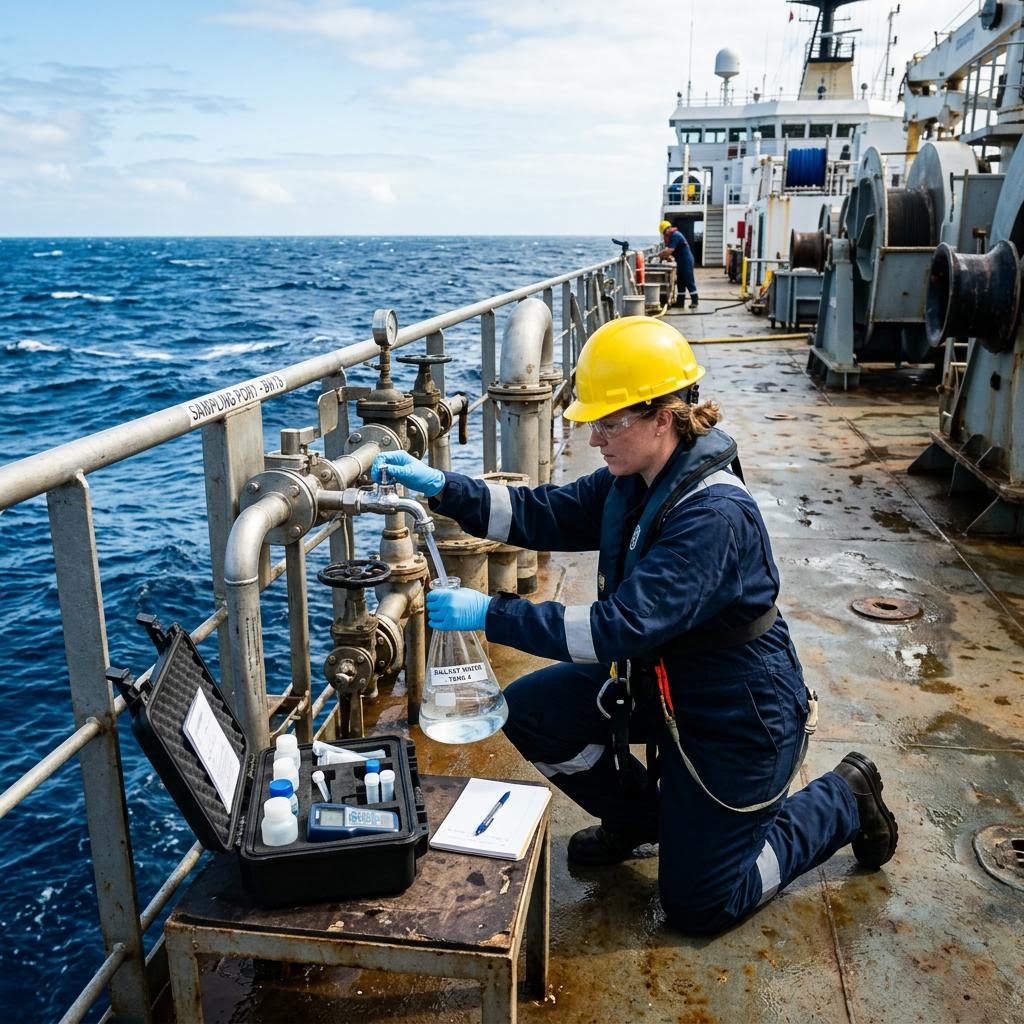
A ballast water sample is only useful if it represents what the vessel actually discharges, which depends on where and how it is taken. This article explains the in-line and in-tank sampling points used on board, the principle of representative and isokinetic collection, and how samples are handled after collection. It also sets out how Sea Clean AS supplies sampling support, TRO test kits and reagents and coordinates attendance with accredited laboratories and authorised parties who perform and certify the analysis.
Key takeaways
- The discharge-line (in-line) sampling point determines whether a sample represents what the vessel actually discharges.
- Isokinetic sampling matches probe and pipe velocity so larger organisms and particles are not mis-counted.
- Indicative samples are small and measured quickly; detailed-analysis samples need larger volumes and gentle handling.
- Sampling is spread across the stable middle of a discharge, with time, tank and flow recorded for each sample.
- Samples are labelled with vessel, IMO, time and point, with chain of custody used for laboratory analysis.
- Sea Clean supplies kits and reagents and supports sampling; an accredited lab or authorised party certifies results.
Why the Sampling Point Determines the Result
Ballast water analysis answers a narrow question: does the water being discharged meet the D-2 standard at the point it leaves the ship. The answer depends heavily on where the sample is drawn, because organism concentration and residual oxidant levels vary through a discharge and between tanks. A sample taken from the wrong place, or at the wrong moment, can misrepresent the discharge in either direction.
For this reason the IMO and the BWMS Code distinguish between in-line sampling from the discharge line and in-tank sampling from the ballast tanks themselves. In-line sampling captures the water as treated and pumped overboard, which is what regulators care about; in-tank sampling can support troubleshooting and self-monitoring but is not a direct measure of the overboard discharge.
The practical consequence is that a vessel designed and fitted with a usable sampling arrangement is far easier to test than one where the only access is awkward or unrepresentative. Sampling point design is therefore part of compliance planning, not an afterthought left to the day of the test.
In-Line Sampling Points and Sampling Facilities
The IMO guidance on ballast water sampling (G2) describes a sampling facility on the discharge line that allows a representative sample to be taken without disturbing the flow. In practice this is a sample probe or tapping fitted into the overboard line, with an isolating valve and a sample cock that the crew or attending party can open during discharge.
An isokinetic sample probe is designed so the velocity of water entering the probe matches the velocity in the pipe, which prevents larger organisms and particles from being under- or over-represented. Where a full isokinetic arrangement is not fitted, the sample is drawn as representatively as the existing fitting allows, and the limitation is recorded so the analysing party can interpret the result correctly.
Position matters: the sampling point should be on a straight run of pipe, away from bends, valves and pumps that create turbulence or settle solids, and downstream of the treatment equipment so the sample reflects fully treated water. Many newer installations include a dedicated sampling manifold, while older retrofits may need a temporary or improvised tapping agreed with the attending party.
Indicative and Detailed Samples Are Collected Differently
For indicative analysis, a smaller volume of water is usually enough because the methods give a rapid screening result on board. The sample is drawn into a clean container, and oxidant residual is often measured almost immediately because TRO and similar parameters change with time after collection.
Detailed analysis for organism counts requires larger, carefully handled volumes so the accredited laboratory has enough water to concentrate and examine the relevant size classes. The greater than or equal to 50 micrometre and 10 to 50 micrometre fractions are handled to avoid damaging or killing organisms before they are assessed, which means gentle collection, appropriate containers and controlled transport.
Because the two approaches have different volume, handling and timing needs, the sampling plan is agreed before the discharge starts. Sea Clean supplies the TRO test kits and reagents used for on-board indicative checks and coordinates with the accredited laboratory on container, volume and chain-of-custody requirements when detailed analysis is involved.
Timing, Duration and Number of Samples
A single grab sample at one instant rarely characterises a whole discharge, so sampling is normally spread across the discharge event. Guidance favours sampling during the representative middle portion of the discharge once flow has stabilised, and where practical taking multiple samples or a composite to even out variation.
The duration of the discharge and the pump rate influence how the sample is timed. For commissioning testing, the test is planned around a real ballast operation so the system runs under normal conditions, and samples are taken while the system is treating and discharging as it would in service rather than during start-up transients.
Recording the time, tank, flow rate and treatment status against each sample lets the analysing party tie the result back to actual operating conditions. These notes are part of the documentation retained on board and presented to a surveyor if the result is queried.
Sample Handling, Labelling and Chain of Custody
Once collected, a sample begins to change: organisms can die or settle, and oxidant residual decays, so handling is time-sensitive. Indicative measurements such as TRO are taken quickly, while samples destined for a laboratory are kept cool, out of direct sunlight and transported within the time the laboratory specifies.
Each container is labelled with the vessel name and IMO number, date and time, sampling point, tank and any neutralisation applied. For detailed analysis a chain-of-custody form records who took the sample, when it was handed over, and the condition on receipt, which protects the integrity of the result if it is ever scrutinised.
Sea Clean's role at this stage is supportive: we attend to help draw and handle samples correctly, supply the reagents and consumables needed, and pass laboratory-bound samples to the accredited laboratory or authorised party who carries out and certifies the analysis. Sea Clean does not itself certify the analytical result.
How Sea Clean Supports On-Board Sampling
Sea Clean coordinates and supports ballast water sampling in cooperation with accredited laboratories and parties authorised by the flag administration or class. We supply TRO test kits, sodium thiosulfate neutraliser and the sampling consumables a vessel needs, and we attend during a port call to help the crew take representative samples from the discharge line.
Before the call we confirm the sampling arrangement with the chief engineer: where the sampling point is, whether it is isokinetic, the expected discharge and any limitations of the fitting. This lets us bring the right equipment and brief the laboratory or authorised party on what to expect, reducing surprises on the day.
Where a vessel lacks a usable sampling point, we flag it early so a fitting can be arranged before testing is needed. To plan support, send the vessel name, IMO number, ETA, port and BWMS type to post@seaclean.no.
Frequently asked questions
What is the difference between in-line and in-tank sampling?
In-line sampling draws water from the discharge line and reflects what the vessel actually pumps overboard, which is what regulators assess. In-tank sampling is taken from the ballast tanks and is useful for troubleshooting and self-monitoring but is not a direct measure of the overboard discharge.
What does isokinetic sampling mean?
Isokinetic sampling means the velocity of water entering the sample probe matches the velocity of flow in the pipe. This prevents larger organisms and particles from being over- or under-represented, giving a more representative sample of the discharge.
Does Sea Clean analyse the ballast water samples?
No. Sea Clean supplies TRO test kits and reagents and supports on-board sampling, including rapid indicative checks. Detailed analysis and certification of the result are carried out by an accredited laboratory (ISO/IEC 17025) or a party authorised by the flag administration or class.
What happens if a vessel has no usable sampling point?
Sampling becomes difficult and the result may not be representative. Sea Clean flags the issue early so a suitable sampling fitting can be arranged on the discharge line before testing is required, and notes any limitations of an existing fitting so the analysing party can interpret the sample correctly.
Sources
Related articles
- Indicative vs Detailed Ballast Water Analysis
- Total Residual Oxidant (TRO) Monitoring and Neutralisation
- Ballast Water Commissioning Testing: What Happens On Board
- BWTS TRO Sensor Calibration and Verification
- Ballast Water Sampling Points and Access Arrangements
- USCG Ballast Water Compliance for Ships Calling the United States