California Ballast Water and Biofouling Rules
Updated
California operates one of the strictest ballast water and biofouling regimes in the world, administered by the State Lands Commission Marine Invasive Species Program in addition to federal USCG and EPA requirements. This article explains California's reporting, sampling and biofouling management duties, how they overlap with national rules, and how Sea Clean AS supports sampling coordination, BWMS commissioning testing and reagent supply for vessels calling Californian ports.
Key takeaways
- California adds state ballast water and biofouling duties on top of federal USCG and EPA requirements.
- The State Lands Commission Marine Invasive Species Program administers reporting, fees and inspections.
- Vessels must submit Ballast Water Management and Hull Husbandry forms and pay the Marine Invasive Species Fee.
- A USCG type-approved system operated to D-2 is the working baseline for ballast water discharge.
- Biofouling rules require a management plan and record book covering hull and niche-area maintenance.
- Sea Clean coordinates sampling and commissioning testing with accredited labs and is not itself an accredited laboratory.
Why California Has Its Own Regime
California regulates ballast water and biofouling under state law in addition to the federal United States Coast Guard ballast water regulations and the EPA Vessel General Permit framework. The programme is run by the California State Lands Commission through its Marine Invasive Species Program, which was created in response to repeated introductions of non-indigenous species into San Francisco Bay and other Californian waters.
A vessel calling California must therefore satisfy both the federal regime and California's state-specific requirements at the same time. The state requirements are not a substitute for USCG type approval or EPA conditions; they add reporting, recordkeeping, sampling access and biofouling management duties on top of them.
The practical consequence for operators is that a ship which is fully compliant federally can still fall short of California rules if state reporting forms are missing or if biofouling management documentation is incomplete. Treating California as a separate compliance checklist, rather than assuming federal compliance covers it, avoids problems on arrival.
Reporting and Fees
California requires a Ballast Water Management Report and a Hull Husbandry Reporting Form, submitted through the State Lands Commission's reporting channels within the timeframes set in the regulations. These forms record ballast operations, the management method used, tank-by-tank details and biofouling maintenance history for the vessel.
A Marine Invasive Species Fee applies to qualifying vessel arrivals and funds the monitoring and enforcement programme. The vessel's agent normally handles fee payment and form submission, but the master and company remain responsible for the accuracy of the data supplied.
Inaccurate or late reporting is a frequent source of findings during inspections, independent of whether the treatment system itself performed correctly. Keeping the ballast water record book, the treatment system logs and the California forms consistent with one another is the simplest way to withstand scrutiny.
Discharge Standards and Treatment
Vessels meet California's discharge expectations primarily by operating a USCG type-approved ballast water management system to the IMO D-2 / USCG numeric discharge standard, or by using an approved alternative such as discharge to a reception facility where available. California has historically signalled interest in standards stricter than D-2, but in practice operation of a compliant treatment system to the federal standard is the working baseline for most arrivals.
Where a system cannot be operated for a given voyage, contingency options are limited and must be agreed in advance; unmanaged discharge into Californian waters is not an acceptable default. Operators should plan ballast operations so that treated water, not untreated water, is what reaches a Californian port.
Sea Clean supplies ballast water treatment reagents, TRO test kits and sodium thiosulfate neutraliser, and supports BWMS commissioning and self-monitoring so that the operating record demonstrates the system was run as intended. We are not an accredited testing laboratory; where analytical confirmation is required it is performed by an accredited laboratory.
Biofouling Management
California's biofouling regulations require vessels to manage hull and niche-area fouling and to maintain a Biofouling Management Plan and Biofouling Record Book covering cleaning, coatings and inspection history. This goes beyond ballast water and reflects the recognition that hull fouling is itself a major vector for invasive species.
The rules set expectations on managing wetted surfaces, niche areas and the timing of in-water cleaning, with documentation that must be available for inspection. A vessel arriving with poor records or visible heavy fouling can attract attention even if its ballast water management is sound.
Although biofouling cleaning is outside Sea Clean's scope, the documentation discipline that supports biofouling compliance mirrors what is needed for ballast water: complete plans, current records and consistent logs. Operators benefit from treating both record sets with the same rigour.
Sampling, Inspection and Commissioning Testing
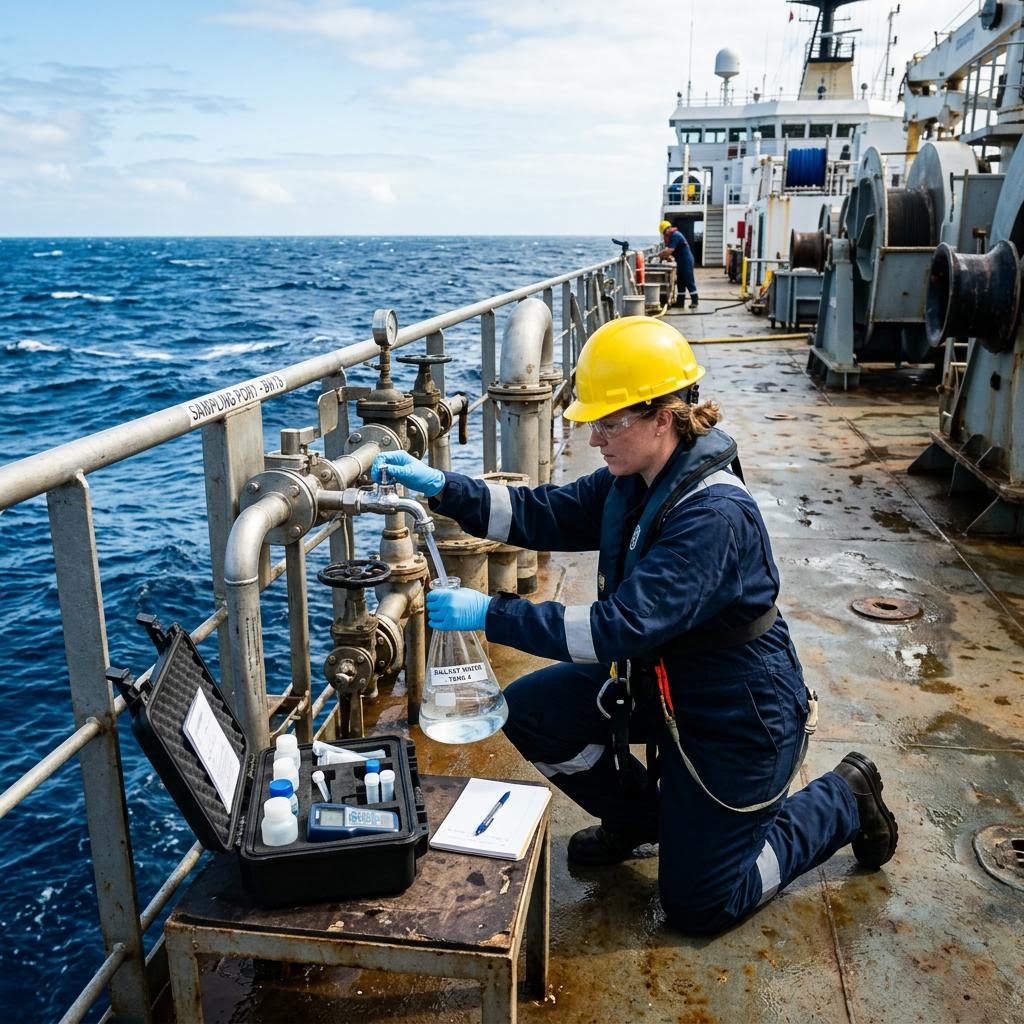
California inspectors may board to verify documentation and, where warranted, take ballast water samples to check compliance. Sampling access points, the treatment system control panel and the ballast records all come under examination, so the crew should be familiar with where representative samples can be drawn.
For newly installed systems, IMO BWMS Code commissioning testing under MEPC.325(75) is carried out by parties authorised by the flag administration or class, with analysis by an accredited laboratory. This commissioning test is distinct from California's recurring inspection regime but produces documentation that supports the vessel's overall compliance file.
Sea Clean coordinates and supports representative sampling and commissioning attendance in cooperation with accredited laboratories and authorised parties. We provide sampling support, in-date reagents and on-board attendance; the accredited laboratory or authorised party performs and certifies the analysis.
Planning a Californian Call
A vessel scheduled for a Californian port should confirm well ahead that its USCG type-approved system is operable, its EPA VGP conditions are met, the California Ballast Water Management and Hull Husbandry forms are prepared, and the Marine Invasive Species Fee arrangement is in place with the agent. Biofouling plans and records should be reviewed at the same time.
Because California enforces actively, gaps tend to surface during the call rather than being overlooked. Aligning the ballast water record book, treatment logs, state reporting forms and biofouling records before arrival removes the most common reasons for delay.
Sea Clean can supply reagents and BWMS spare parts ahead of or during a call and coordinate commissioning or verification sampling with accredited parties. Send the vessel name, IMO number, ETA and requirement to post@seaclean.no to begin coordination.
Frequently asked questions
Does federal USCG compliance cover California's rules?
No. California's state requirements run in addition to the federal USCG and EPA regimes. A vessel can be federally compliant yet still fall short of California rules if state reporting forms, fees or biofouling documentation are incomplete.
What does California require for biofouling?
Vessels must maintain a Biofouling Management Plan and Biofouling Record Book covering hull and niche-area cleaning, coatings and inspections. The records must be available for inspection, and heavy visible fouling can attract attention even where ballast water management is sound.
Can Sea Clean certify ballast water compliance in California?
Sea Clean is not an accredited testing laboratory and does not certify analysis itself. We coordinate and support sampling and BWMS commissioning testing with accredited laboratories and authorised parties, and supply reagents, test kits and spare parts.
Who submits the California reporting forms and fee?
The vessel's agent normally submits the Ballast Water Management Report and Hull Husbandry Reporting Form and arranges the Marine Invasive Species Fee. The master and company remain responsible for the accuracy of the data provided.