How Do Transport and Holding Time Affect Ballast Biological Samples?
Updated
Biological condition can change between collection and analysis. Arrange method-specific transport before sampling so the report reflects a defensible sample history rather than an unexplained time in a bottle.
Request BWTS spare parts, annual calibration or ballast-water testing
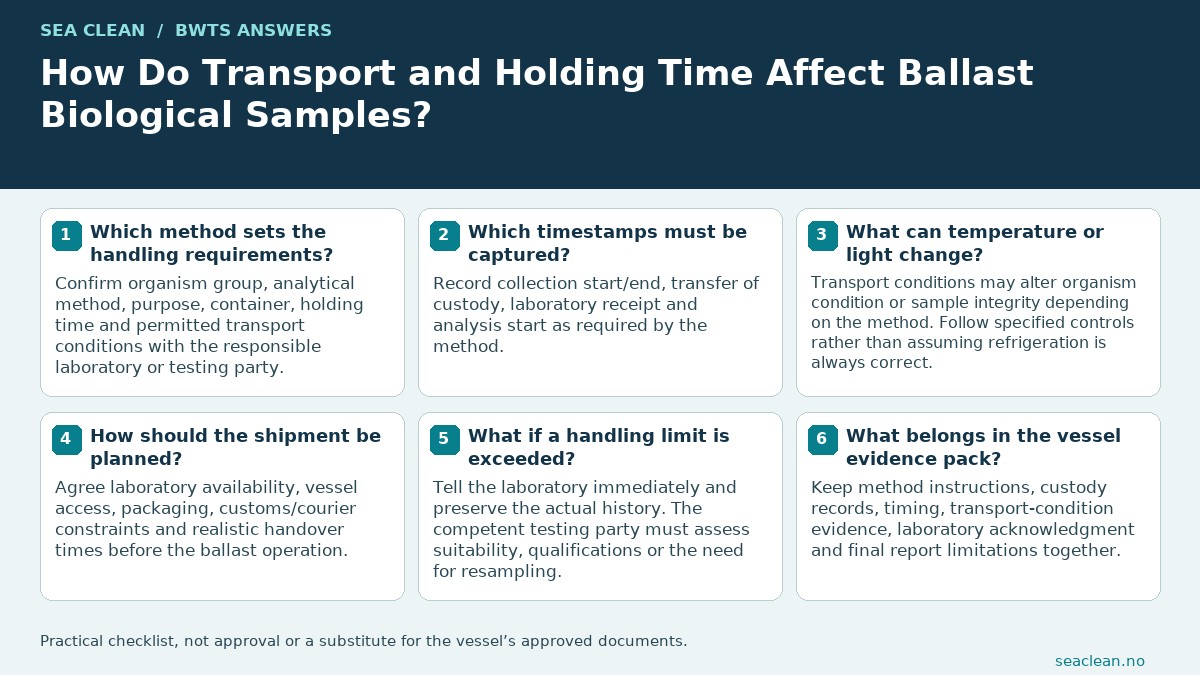
Key takeaways
- Agree method-specific limits first.
- Record collection-to-analysis timing.
- Use instructed transport conditions.
- Plan actual vessel-to-lab logistics.
- Disclose excursions and delays.
- Keep suitability separate from the count.
Which method sets the handling requirements?
Confirm organism group, analytical method, purpose, container, holding time and permitted transport conditions with the responsible laboratory or testing party.
Different analyses may require different handling. There is no single universal allowable delay for all D-2-related biological and microbial measurements.
Which timestamps must be captured?
Record collection start/end, transfer of custody, laboratory receipt and analysis start as required by the method.
Include timezone convention and any delay. A receipt date without collection time cannot establish elapsed holding time.
Related guidance: BWTS Sampling Plan for Troubleshooting a Disputed Result
What can temperature or light change?
Transport conditions may alter organism condition or sample integrity depending on the method. Follow specified controls rather than assuming refrigeration is always correct.
Do not freeze, heat, expose or chemically preserve the sample without instructions. Improvised 'preservation' can make it unsuitable for the intended analysis.
How should the shipment be planned?
Agree laboratory availability, vessel access, packaging, customs/courier constraints and realistic handover times before the ballast operation.
A standard next-day courier promise may be incompatible with the method. Confirm the actual collection-to-analysis route, not merely an airport booking.
What if a handling limit is exceeded?
Tell the laboratory immediately and preserve the actual history. The competent testing party must assess suitability, qualifications or the need for resampling.
Do not omit a temperature excursion or rewrite collection time to fit the method. A qualified result may be necessary rather than a clean-looking certificate.
Related guidance: Does Passing BWMS Commissioning Prove Every Future Discharge?
What belongs in the vessel evidence pack?
Keep method instructions, custody records, timing, transport-condition evidence, laboratory acknowledgment and final report limitations together.
Separate logistics validity from the result itself. A low reported count does not erase an unsuitable or undocumented sample history.
Frequently asked questions
Can every sample be refrigerated?
No. Follow the specific method and laboratory instructions.
Does courier tracking prove sample validity?
No. It supports logistics but not every required condition or analytical limitation.
What if the sample arrives late?
Disclose the full history and obtain a competent suitability assessment.
Can a low count override handling problems?
No. The reliability and scope of the evidence must be assessed separately.
Sources
- IMO — BWMS Code, MEPC.300(72) — Approval framework, monitoring, system design limitations and biological performance; not a universal maker procedure.
- IMO — BWM Convention and implementation guidelines
- IMO — G2 sampling guidelines, MEPC.173(58)
Related articles
- How Much Should a Ballast Sample Line Be Flushed Before Testing?
- Does Passing BWMS Commissioning Prove Every Future Discharge?
- BWTS Sampling Plan for Troubleshooting a Disputed Result
- Biological Ballast-Water Compliance Testing
- Does a Ballast Sample Tap Represent the Actual Discharge?
- Why Can Two Ballast-Water Test Results Disagree?
Request spares, calibration or ballast-water testing
Include BWMS brand/model, vessel/IMO number, port/terminal, date/ETA and scope or part numbers. These links prepare an email draft; you must send it yourself.
- Request a parts quote — Sensors, TRO reagents, calibration kits and replacement parts. Confirm compatibility, availability and delivery for your installed system.
- Request a calibration booking — Annual instrument calibration with a calibration certificate for the work completed. OEM instructions, drift or applicable rules may require earlier work.
- Request testing coordination — Arrange sampling and testing with an appropriately qualified party for your IMO D-2, commissioning or other stated purpose.
Authorised Headway agent. Other-brand enquiries are independently reviewed; no OEM authorisation is claimed. Sea Clean is not an accredited laboratory or approving authority. Calibration does not demonstrate biological D-2 compliance. Attendance, testing scope and parts delivery are confirmed per enquiry.