BWTS Sampling Plan for Troubleshooting a Disputed Result
Updated
When a ballast-water result is disputed, a disciplined sampling plan is more useful than a second opportunistic sample. This guide helps the master, chief engineer and shore team preserve the operating record, define representative samples and separate an equipment fault from sampling or laboratory error.
Request BWTS spare parts, annual calibration or ballast-water testing
Key takeaways
- Preserve raw controller data and the original chronology before resetting equipment.
- Define the question and approved sample point before collecting water.
- Representative timing, flushing and stable flow matter as much as container choice.
- Chain-of-custody records must identify every handover and limitation.
- Correlate results with tank history, treatment variables and calibration status.
- Authority direction controls any alternative discharge or repeat test.
Start with a protected event record
Record the vessel position, date and time, operation, tank or line, flow, treatment mode, alarms, sensor values, valve status and relevant water conditions before resetting equipment or changing a setpoint. Export controller history where possible and retain the original file rather than relying on a screenshot.
The master should open one controlled event record with names, time zones and document revisions. Attach the Ballast Water Record Book entry, work orders, calibration status, sample-point diagram, weather and port instructions. A clear chronology prevents later arguments about whether the sample represents the disputed discharge or a subsequent condition.
Define the question before taking water
Decide whether the question concerns biological performance, a residual or neutralisation value, an instrument indication, a sampling process, or the legality of a proposed discharge. Those are different questions requiring different samples and competence. Do not describe a convenient operational check as a D-2 compliance test.
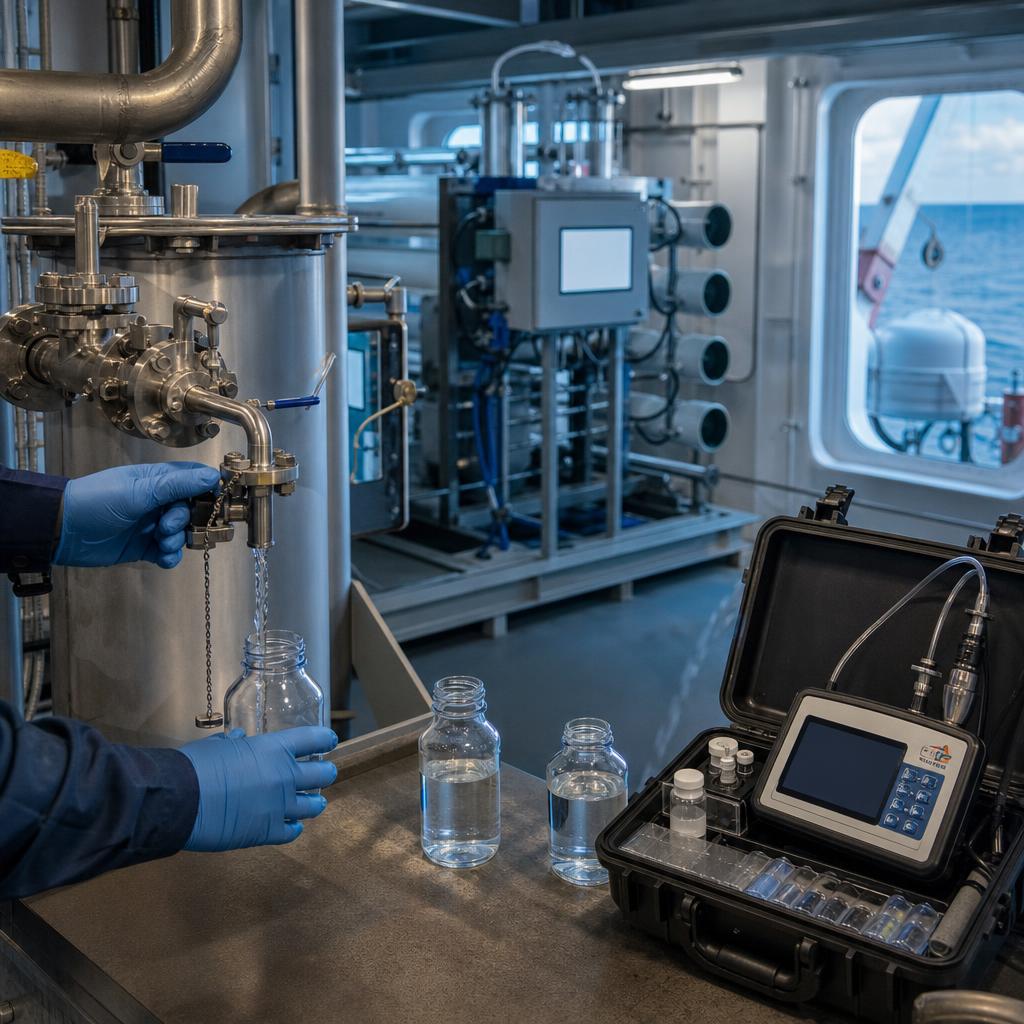
Identify the approved sample location and the actual discharge path. Note whether the sample is taken upstream or downstream of treatment, from a dedicated point or a temporary hose, and whether flow was stable. The sample plan should state the purpose, method, volume, containers, preservation, timing and responsible person before collection starts.
Choose representative timing and points
A representative discharge sample normally requires the ballast operation to be at the relevant steady condition, with flow and treatment stable long enough for the line to be flushed according to the approved arrangement. Capture start-up, stable operation and any change that could explain the result rather than selecting only the most convenient minute.
Where permitted by the applicable instructions, pair a primary sample with a field duplicate and a process sample for diagnosis. Keep samples from distinct points separate and label them unambiguously. A duplicate does not cure a wrong location, an unflushed line, a leaking valve or an unrecorded interruption in treatment.
Control handling and chain of custody
Use clean, suitable containers and the preservation, temperature and holding-time requirements specified by the competent laboratory or authority method. Log collector, witness, seal number, collection time, container identity, condition and transfer time. Never backfill missing details from memory after the vessel has sailed.
The receiving laboratory should confirm what it is qualified and instructed to measure, the method used, detection or reporting limits and any sample rejection criteria. A laboratory result remains evidence for the authority process, not a substitute for that process.
Correlate the result with system evidence
Compare the sample record with pump flow, filter differential pressure, UV intensity or transmittance, residual and neutralisation values, cell current, valve feedback and alarm history as applicable to the installed system. Check sensor calibration, sample-line condition, reagent age and data gaps before concluding that the treatment train failed.
Review the actual tank history and preceding uptake operation. A discharge result may reflect storage, cross-connection, tank sediment, untreated top-up water or an incorrect line-up rather than the final treatment step alone. The investigation should test each credible pathway against time-stamped evidence.
Escalate without prejudging the outcome
If the result remains disputed, preserve the equipment in its as-found condition where safe, notify the company contingency contact and ask flag, port or coastal-state authorities what further sample or operational action they require. Avoid discharge, bypass or exchange decisions based solely on an informal interpretation.
Close the investigation with a finding, limitations and corrective actions: confirmed failure, sampling deficiency, instrument issue, inconclusive evidence or another documented cause. Assign owners and due dates, and state what evidence would reopen the conclusion. A transparent limitation is safer than an unsupported claim of compliance.
Frequently asked questions
Does a second sample automatically overturn the first result?
No. Its value depends on the authorised point, representative timing, method, handling and custody. A repeat sample should answer a defined question and be accepted by the relevant authority or competent laboratory.
Can the crew use a handheld test as proof of D-2 performance?
No. A handheld reading may help diagnose a process condition, but it is not by itself a biological D-2 assessment or an authority decision.
What should be preserved after a disputed result?
Preserve the sample record, controller export, alarms, operating parameters, valve and tank history, calibration evidence, photos, work orders and all communications, while protecting people and equipment.
Who decides whether discharge may continue?
The applicable flag, port or coastal-state authority, informed by the master and company contingency process, decides what action is acceptable in that jurisdiction.
Sources
- IMO — BWM Convention and Guidelines — Convention obligations and associated guidance.
- IMO — BWMS Code, resolution MEPC.300(72) — Code framework for approval and testing of ballast-water management systems.
- IMO — compilation of BWM guidance — Compilation identifying BWM.2/Circ.62 contingency and BWM.2/Circ.42/Rev.2 sampling guidance.
- IMO — commissioning resolution MEPC.325(75) — Commissioning testing and documentation context.
Related articles
- BWTS Contingency Notification Pack: What to Send Flag and Port
- IMO D-2 Ballast Water Standard Explained
- Ballast Water Record Book: Entries, Format and PSC Expectations
- BWTS Alarm Troubleshooting: Common Sensor Faults
- How to Plan BWTS Commissioning Sampling
- What Is a Ballast Water Treatment System? Explained
Request spares, calibration or ballast-water testing
Include BWMS brand/model, vessel/IMO number, port/terminal, date/ETA and scope or part numbers. These links prepare an email draft; you must send it yourself.
- Request a parts quote — Sensors, TRO reagents, calibration kits and replacement parts. Confirm compatibility, availability and delivery for your installed system.
- Request a calibration booking — Annual instrument calibration with a calibration certificate for the work completed. OEM instructions, drift or applicable rules may require earlier work.
- Request testing coordination — Arrange sampling and testing with an appropriately qualified party for your IMO D-2, commissioning or other stated purpose.
Authorised Headway agent. Other-brand enquiries are independently reviewed; no OEM authorisation is claimed. Sea Clean is not an accredited laboratory or approving authority. Calibration does not demonstrate biological D-2 compliance. Attendance, testing scope and parts delivery are confirmed per enquiry.