How Much Should a Ballast Sample Line Be Flushed Before Testing?
Updated
There is no defensible universal 'flush for five minutes' rule for every sample arrangement. The line’s volume, actual flow, stagnant branches and analytical purpose determine how representative water is established.
Request BWTS spare parts, annual calibration or ballast-water testing
Key takeaways
- Avoid a universal flush duration.
- Identify the full sample-route volume.
- Verify actual sample flow.
- Distinguish transport from method readiness.
- Follow analysis-specific handling rules.
- Record flushing and route changes.
Why is flushing needed?
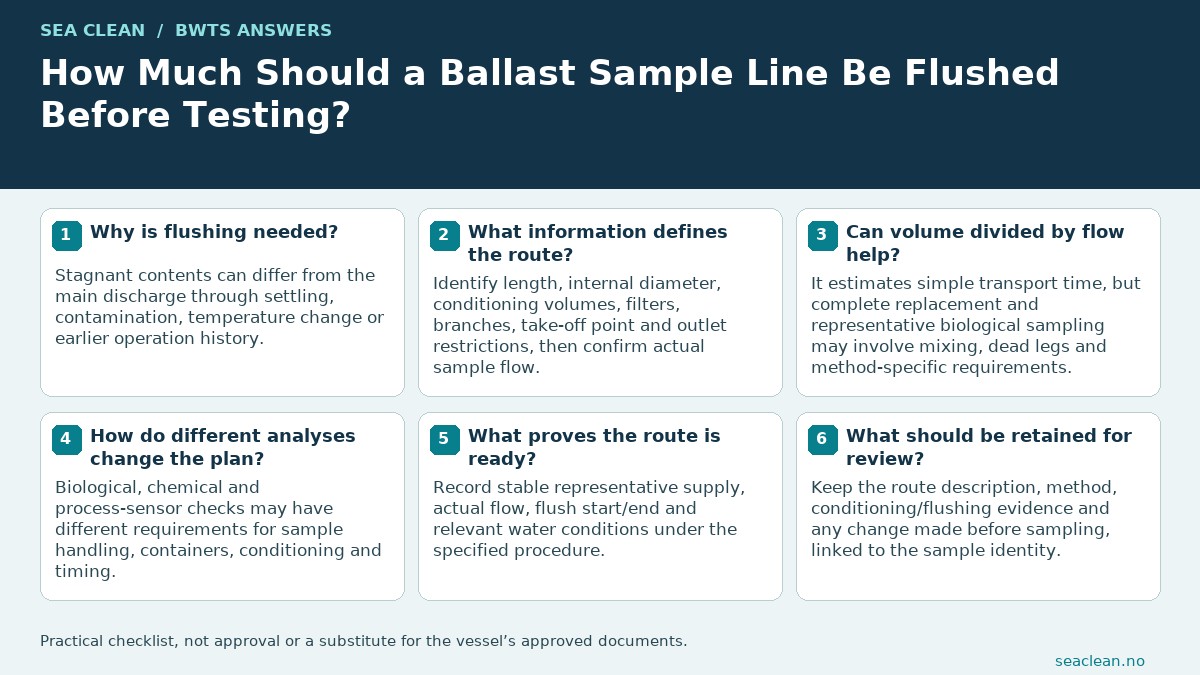
Stagnant contents can differ from the main discharge through settling, contamination, temperature change or earlier operation history.
Flushing aims to establish the intended sample stream under the agreed method; it is not a way to selectively remove an unfavourable sample.
What information defines the route?
Identify length, internal diameter, conditioning volumes, filters, branches, take-off point and outlet restrictions, then confirm actual sample flow.
A nominal pump capacity does not establish flow through a partially blocked or throttled sample route. Measure or verify it using the approved method.
Related guidance: BWTS Sampling Plan for Troubleshooting a Disputed Result
Can volume divided by flow help?
It estimates simple transport time, but complete replacement and representative biological sampling may involve mixing, dead legs and method-specific requirements.
For example, a two-litre route at one litre per minute has roughly two minutes of transport time; that is not automatically the required flushing period.
How do different analyses change the plan?
Biological, chemical and process-sensor checks may have different requirements for sample handling, containers, conditioning and timing.
Agree the method with the responsible testing party. Do not add preservatives, neutralisers or treatment to a biological sample without method-specific instructions.
What proves the route is ready?
Record stable representative supply, actual flow, flush start/end and relevant water conditions under the specified procedure.
If there is no reliable flow or the route contains unexplained stagnant branches, document the limitation rather than relying on elapsed time alone.
Related guidance: How Do Transport and Holding Time Affect Ballast Biological Samples?
What should be retained for review?
Keep the route description, method, conditioning/flushing evidence and any change made before sampling, linked to the sample identity.
If comparison results differ, this record helps distinguish sampling-route effects from genuine changes in treatment performance.
Frequently asked questions
Is five minutes always enough?
No. Route volume, actual flow and the agreed method determine readiness.
Does one line volume guarantee complete replacement?
Not necessarily. Mixing and stagnant branches can affect replacement.
Can chemicals be added to speed sample preparation?
Only if required by the applicable analytical method and responsible sampling instructions.
Should flushing be documented?
Yes. It supports the sample’s timing, identity and representativeness.
Sources
- IMO — BWMS Code, MEPC.300(72) — Approval framework, monitoring, system design limitations and biological performance; not a universal maker procedure.
- IMO — BWM Convention and implementation guidelines
- IMO — G2 sampling guidelines, MEPC.173(58)
Related articles
- Does a Ballast Sample Tap Represent the Actual Discharge?
- How Do Transport and Holding Time Affect Ballast Biological Samples?
- BWTS Sampling Plan for Troubleshooting a Disputed Result
- Biological Ballast-Water Compliance Testing
- Why Does CLX-XT Show nOnE When Calibration Is Attempted?
- What Is a Ballast Water Treatment System? Explained
Request spares, calibration or ballast-water testing
Include BWMS brand/model, vessel/IMO number, port/terminal, date/ETA and scope or part numbers. These links prepare an email draft; you must send it yourself.
- Request a parts quote — Sensors, TRO reagents, calibration kits and replacement parts. Confirm compatibility, availability and delivery for your installed system.
- Request a calibration booking — Annual instrument calibration with a calibration certificate for the work completed. OEM instructions, drift or applicable rules may require earlier work.
- Request testing coordination — Arrange sampling and testing with an appropriately qualified party for your IMO D-2, commissioning or other stated purpose.
Authorised Headway agent. Other-brand enquiries are independently reviewed; no OEM authorisation is claimed. Sea Clean is not an accredited laboratory or approving authority. Calibration does not demonstrate biological D-2 compliance. Attendance, testing scope and parts delivery are confirmed per enquiry.