Does Passing BWMS Commissioning Prove Every Future Discharge?
Updated
Commissioning evidence relates to the installed system under the documented test conditions and scope. It is not a lifetime guarantee that every later ballast operation will meet the required discharge standard.
Request BWTS spare parts, annual calibration or ballast-water testing
Key takeaways
- Read the full commissioning scope.
- Separate installation test from type approval.
- Compare later operating conditions.
- Control subsequent modifications.
- Maintain ongoing operational evidence.
- Do not claim a lifetime discharge guarantee.
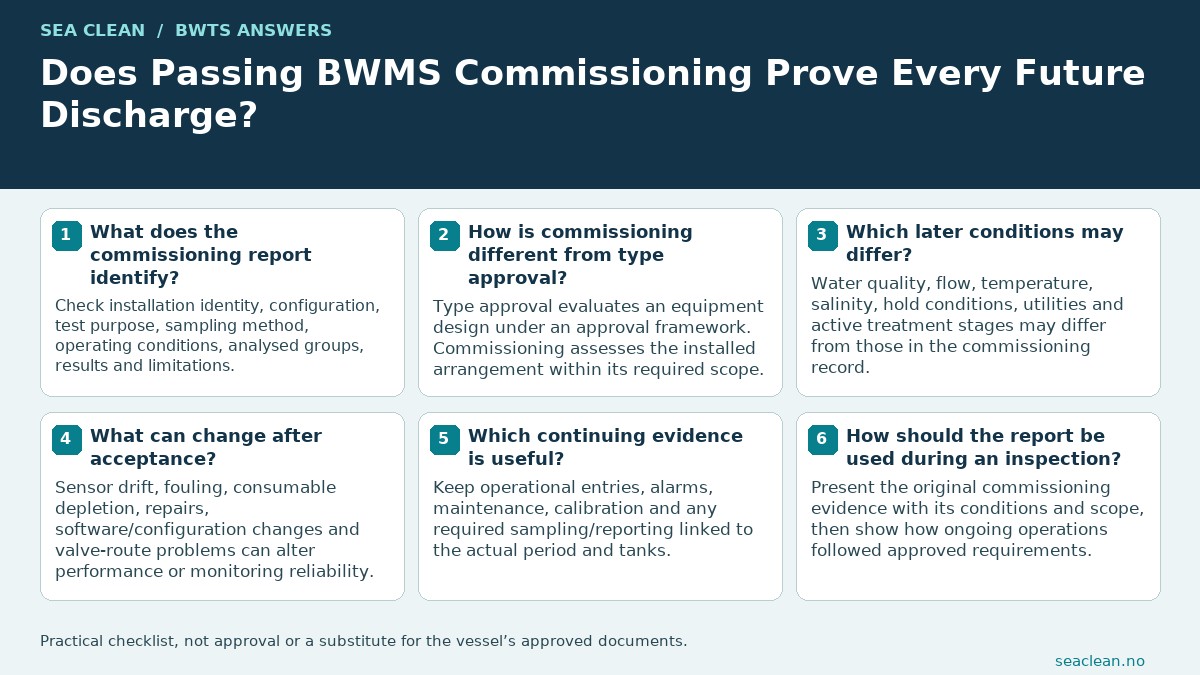
What does the commissioning report identify?
Check installation identity, configuration, test purpose, sampling method, operating conditions, analysed groups, results and limitations.
A cover page saying 'passed' is incomplete evidence if the underlying scope and applicable acceptance basis are not available.
How is commissioning different from type approval?
Type approval evaluates an equipment design under an approval framework. Commissioning assesses the installed arrangement within its required scope.
Neither should be confused with evidence for every subsequent discharge. The BWMS Code explicitly recognises that approval cannot guarantee performance in all situations.
Related guidance: BWTS Sampling Plan for Troubleshooting a Disputed Result
Which later conditions may differ?
Water quality, flow, temperature, salinity, hold conditions, utilities and active treatment stages may differ from those in the commissioning record.
Compare actual operation with the installed system’s approved limitations. A successful test in one condition does not remove those boundaries.
What can change after acceptance?
Sensor drift, fouling, consumable depletion, repairs, software/configuration changes and valve-route problems can alter performance or monitoring reliability.
Maintain document control and review modifications through the necessary OEM/Administration route. A historic test must not be used to approve later alterations.
Which continuing evidence is useful?
Keep operational entries, alarms, maintenance, calibration and any required sampling/reporting linked to the actual period and tanks.
These records serve different purposes. A service report can support readiness without becoming a biological test or a regulatory permission.
Related guidance: Does 'Not Detected' Mean a Ballast Sample Contains Zero Organisms?
How should the report be used during an inspection?
Present the original commissioning evidence with its conditions and scope, then show how ongoing operations followed approved requirements.
State limitations honestly. Do not imply that one commissioning sample exempts the vessel from later discharge duties or separate jurisdiction-specific monitoring.
Frequently asked questions
Can commissioning replace annual maintenance?
No. They have different purposes and continuing requirements.
Does a pass remove design limitations?
No. Approved operating boundaries remain applicable.
Can a later software change rely on the old test?
Not automatically. Review its approval and operational implications.
Does commissioning replace VGP monitoring?
No. Check the independent US requirements applicable to the voyage.
Sources
- IMO — BWMS Code, MEPC.300(72) — Approval framework, monitoring, system design limitations and biological performance; not a universal maker procedure.
- IMO — BWM Convention and implementation guidelines
- IMO — G2 sampling guidelines, MEPC.173(58)
Related articles
- How Do Transport and Holding Time Affect Ballast Biological Samples?
- Does 'Not Detected' Mean a Ballast Sample Contains Zero Organisms?
- BWTS Sampling Plan for Troubleshooting a Disputed Result
- Biological Ballast-Water Compliance Testing
- What Is a Ballast Water Treatment System? Explained
- How Does BWTS Installation Work? Step by Step
Request spares, calibration or ballast-water testing
Include BWMS brand/model, vessel/IMO number, port/terminal, date/ETA and scope or part numbers. These links prepare an email draft; you must send it yourself.
- Request a parts quote — Sensors, TRO reagents, calibration kits and replacement parts. Confirm compatibility, availability and delivery for your installed system.
- Request a calibration booking — Annual instrument calibration with a calibration certificate for the work completed. OEM instructions, drift or applicable rules may require earlier work.
- Request testing coordination — Arrange sampling and testing with an appropriately qualified party for your IMO D-2, commissioning or other stated purpose.
Authorised Headway agent. Other-brand enquiries are independently reviewed; no OEM authorisation is claimed. Sea Clean is not an accredited laboratory or approving authority. Calibration does not demonstrate biological D-2 compliance. Attendance, testing scope and parts delivery are confirmed per enquiry.