Why Can Two Ballast-Water Test Results Disagree?
Updated
Two reports can disagree because they tested different water, different targets or different analytical definitions. Establish comparability before treating the difference as proof that a laboratory or treatment system failed.
Request BWTS spare parts, annual calibration or ballast-water testing
Key takeaways
- Match water, tank and time.
- Compare identical analytical targets.
- Check concentration bases and units.
- Review handling and method limitations.
- Do not select only the favourable result.
- Retain a transparent comparison record.
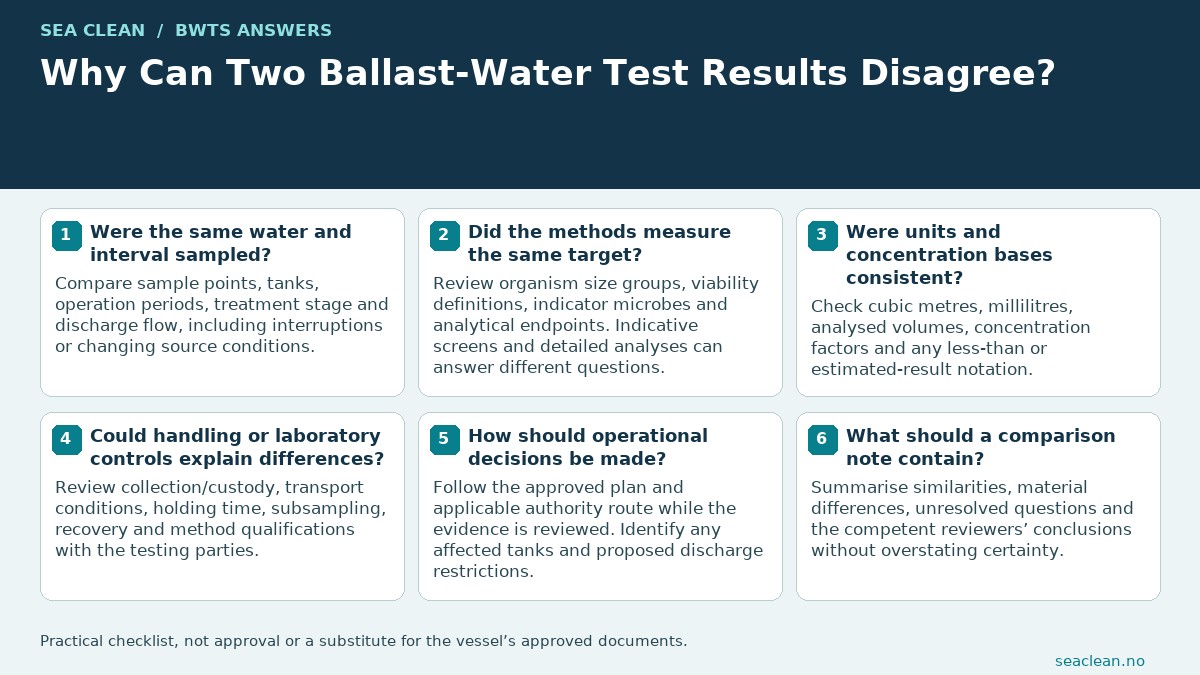
Were the same water and interval sampled?
Compare sample points, tanks, operation periods, treatment stage and discharge flow, including interruptions or changing source conditions.
Samples minutes apart can represent different water where tank switching, dosing changes or sample-line transport delays occurred.
Did the methods measure the same target?
Review organism size groups, viability definitions, indicator microbes and analytical endpoints. Indicative screens and detailed analyses can answer different questions.
Do not compare an instrument’s proxy signal directly with a laboratory organism count as though both were the same measurement.
Related guidance: BWTS Sampling Plan for Troubleshooting a Disputed Result
Were units and concentration bases consistent?
Check cubic metres, millilitres, analysed volumes, concentration factors and any less-than or estimated-result notation.
A numerical comparison without unit and method review can create a false discrepancy even when both reports are internally consistent.
Could handling or laboratory controls explain differences?
Review collection/custody, transport conditions, holding time, subsampling, recovery and method qualifications with the testing parties.
Preserve original records and seek explanations. Do not assume a different outcome automatically proves misconduct or a defective instrument.
How should operational decisions be made?
Follow the approved plan and applicable authority route while the evidence is reviewed. Identify any affected tanks and proposed discharge restrictions.
Do not discard an unfavourable result merely because another is lower. Retesting must have a defined purpose and transparent relationship to the original event.
Related guidance: Does a Ballast Sample Tap Represent the Actual Discharge?
What should a comparison note contain?
Summarise similarities, material differences, unresolved questions and the competent reviewers’ conclusions without overstating certainty.
Keep the original reports and subsequent clarifications. A comparison matrix helps identify what can be reconciled and what remains genuinely uncertain.
Frequently asked questions
Does disagreement prove a failed BWMS?
Not by itself. Compare method, sample and operational scope first.
Can an indicative screen replace detailed counts?
Not automatically. Their purposes, targets and applicable acceptance differ.
Should the lower result always be used?
No. Follow the evidence review and relevant authority requirements.
Is retesting enough to erase the first result?
No. Preserve and address the original result and any associated operational issue.
Sources
- IMO — BWMS Code, MEPC.300(72) — Approval framework, monitoring, system design limitations and biological performance; not a universal maker procedure.
- IMO — BWM Convention and implementation guidelines
- IMO — G2 sampling guidelines, MEPC.173(58)
Related articles
- Does 'Not Detected' Mean a Ballast Sample Contains Zero Organisms?
- Does a Ballast Sample Tap Represent the Actual Discharge?
- BWTS Sampling Plan for Troubleshooting a Disputed Result
- Biological Ballast-Water Compliance Testing
- How Much Should a Ballast Sample Line Be Flushed Before Testing?
- What Is a Ballast Water Treatment System? Explained
Request spares, calibration or ballast-water testing
Include BWMS brand/model, vessel/IMO number, port/terminal, date/ETA and scope or part numbers. These links prepare an email draft; you must send it yourself.
- Request a parts quote — Sensors, TRO reagents, calibration kits and replacement parts. Confirm compatibility, availability and delivery for your installed system.
- Request a calibration booking — Annual instrument calibration with a calibration certificate for the work completed. OEM instructions, drift or applicable rules may require earlier work.
- Request testing coordination — Arrange sampling and testing with an appropriately qualified party for your IMO D-2, commissioning or other stated purpose.
Authorised Headway agent. Other-brand enquiries are independently reviewed; no OEM authorisation is claimed. Sea Clean is not an accredited laboratory or approving authority. Calibration does not demonstrate biological D-2 compliance. Attendance, testing scope and parts delivery are confirmed per enquiry.