Does a Ballast Sample Tap Represent the Actual Discharge?
Updated
A convenient tap is not necessarily a representative compliance sampling point. Confirm what water it receives, which treatment stages it follows and how the agreed method relates the sample to the actual discharge.
Request BWTS spare parts, annual calibration or ballast-water testing
Key takeaways
- Define the discharge being assessed.
- Trace the actual sample route.
- Check all relevant treatment stages.
- Use the agreed representative method.
- Record changing operational conditions.
- Do not choose taps for favourable results.
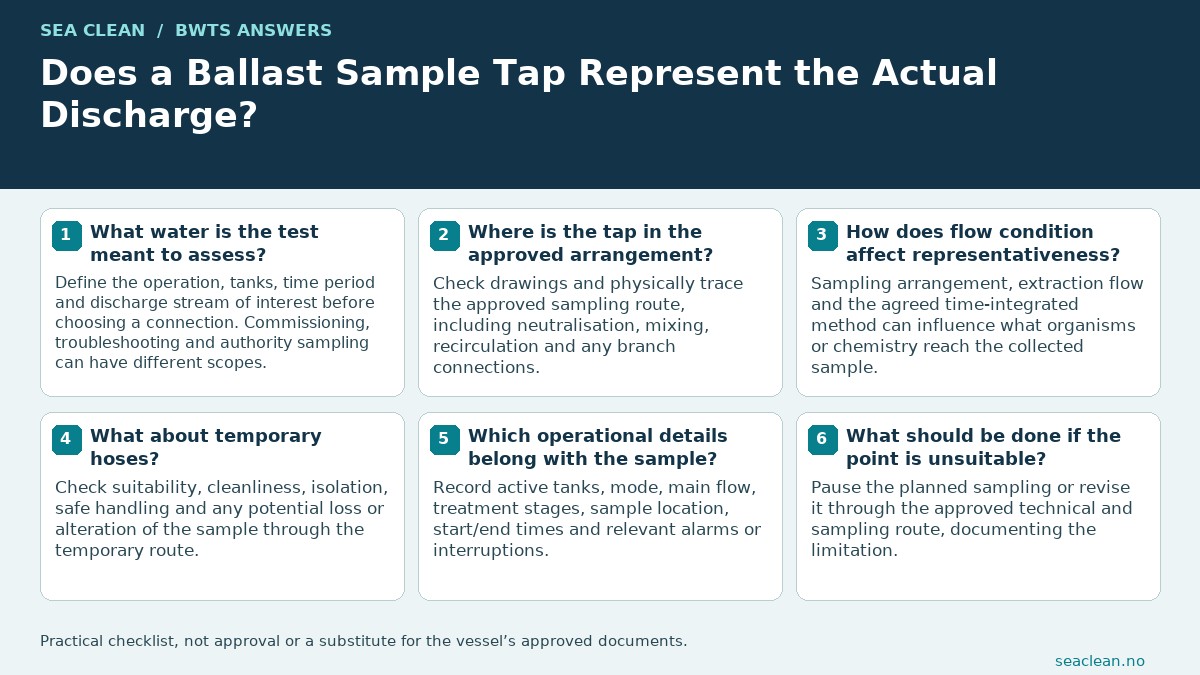
What water is the test meant to assess?
Define the operation, tanks, time period and discharge stream of interest before choosing a connection. Commissioning, troubleshooting and authority sampling can have different scopes.
A sample from upstream untreated water answers a different question from a representative sample after all relevant treatment stages.
Where is the tap in the approved arrangement?
Check drawings and physically trace the approved sampling route, including neutralisation, mixing, recirculation and any branch connections.
A label saying 'BWTS sample' is not enough. Confirm that the valve actually supplies the stated stream under the planned operating mode.
Related guidance: BWTS Sampling Plan for Troubleshooting a Disputed Result
How does flow condition affect representativeness?
Sampling arrangement, extraction flow and the agreed time-integrated method can influence what organisms or chemistry reach the collected sample.
Use the responsible sampling party’s method and appropriate guidance. Do not prescribe a universal tap flow or geometry for every system.
What about temporary hoses?
Check suitability, cleanliness, isolation, safe handling and any potential loss or alteration of the sample through the temporary route.
A long improvised hose may introduce delay, contamination or method bias. Obtain the relevant technical/sampling review instead of assuming it is equivalent.
Which operational details belong with the sample?
Record active tanks, mode, main flow, treatment stages, sample location, start/end times and relevant alarms or interruptions.
If conditions change during collection, tell the sampling party immediately. The report must not describe an uninterrupted representative operation that did not occur.
Related guidance: How Much Should a Ballast Sample Line Be Flushed Before Testing?
What should be done if the point is unsuitable?
Pause the planned sampling or revise it through the approved technical and sampling route, documenting the limitation.
Do not move to another tap solely to obtain a more favourable result. Sampling suitability and authority acceptance are separate from convenience.
Frequently asked questions
Is any tap after the filter suitable?
Not automatically. Its position relative to all relevant treatment stages and the sampling method matters.
Can a tank sample replace discharge sampling?
Only if the agreed purpose and applicable method permit it; they need not represent the same volume.
Are temporary hoses always unacceptable?
Not necessarily, but suitability and method effects must be assessed.
What if an alarm occurs during collection?
Preserve the evidence and inform the sampling party so the event is reflected in the scope and interpretation.
Sources
- IMO — BWMS Code, MEPC.300(72) — Approval framework, monitoring, system design limitations and biological performance; not a universal maker procedure.
- IMO — BWM Convention and implementation guidelines
- IMO — G2 sampling guidelines, MEPC.173(58)
Related articles
- Why Can Two Ballast-Water Test Results Disagree?
- How Much Should a Ballast Sample Line Be Flushed Before Testing?
- BWTS Sampling Plan for Troubleshooting a Disputed Result
- Biological Ballast-Water Compliance Testing
- How Do Transport and Holding Time Affect Ballast Biological Samples?
- What Is a Ballast Water Treatment System? Explained
Request spares, calibration or ballast-water testing
Include BWMS brand/model, vessel/IMO number, port/terminal, date/ETA and scope or part numbers. These links prepare an email draft; you must send it yourself.
- Request a parts quote — Sensors, TRO reagents, calibration kits and replacement parts. Confirm compatibility, availability and delivery for your installed system.
- Request a calibration booking — Annual instrument calibration with a calibration certificate for the work completed. OEM instructions, drift or applicable rules may require earlier work.
- Request testing coordination — Arrange sampling and testing with an appropriately qualified party for your IMO D-2, commissioning or other stated purpose.
Authorised Headway agent. Other-brand enquiries are independently reviewed; no OEM authorisation is claimed. Sea Clean is not an accredited laboratory or approving authority. Calibration does not demonstrate biological D-2 compliance. Attendance, testing scope and parts delivery are confirmed per enquiry.