Sunrui BalClor Spare Parts
Updated
The Sunrui BalClor ballast water management system is a side-stream electrochlorination design widely fitted on Chinese-built tonnage. This article details the main wear and consumable parts of a BalClor system, how to identify the correct components, and how Sea Clean AS sources and supplies BalClor spare parts as an independent service and parts provider.
Key takeaways
- BalClor is a Sunrui side-stream electrochlorination BWMS using a filter, electrolyser and TRO-controlled dosing.
- Electrolyser cells are coated-titanium wear items; scaling is often reversible by acid cleaning before replacement is needed.
- Most TRO analyser faults trace to expired reagent, fouled sample lines or worn pump cartridges rather than sensor failure.
- Filter elements, dosing pump diaphragms and actuated valves are routine wear items worth stocking on board.
- Sea Clean provides independent BalClor parts support and does not claim Sunrui OEM authorization.
- Accurate model, electrolyser type and serial data are essential to source the correct BalClor part first time.
How the BalClor System Is Built
BalClor, made by Qingdao Sunrui (CSIC), is a side-stream electrochlorination ballast water management system. During ballasting a small slipstream of seawater is drawn off, passed through an electrolyser that generates sodium hypochlorite, and that disinfectant is dosed back into the main ballast line to achieve the required total residual oxidant (TRO) concentration. A self-cleaning filter removes larger particles and organisms ahead of the treatment stage.
On deballasting the system measures residual oxidant and, if it exceeds the discharge limit, doses sodium bisulphite or sodium thiosulphate neutraliser to bring TRO below the threshold before overboard discharge. The control system, TRO analysers, dosing pumps and the electrolyser are therefore the components that see the most duty and the most wear.
Understanding which subsystem a fault sits in is the first step to ordering the right part. A filter differential-pressure problem, an electrolyser output problem and a TRO measurement problem each point to a different set of consumables and spares, and ordering against the wrong subsystem is a common cause of wasted lead time.
Electrolyser Cells and Electrodes
The electrolyser is the heart of a BalClor unit and its electrodes are coated titanium that degrade slowly with operating hours and current load. Falling hypochlorite output at a given current, rising cell voltage, or an inability to reach the TRO setpoint during ballasting are typical signs that the cell stack is approaching the end of its service life or needs cleaning.
Scaling from calcium and magnesium deposits is the most common reversible cause of poor electrolyser performance, and acid cleaning often restores output. Where the coating itself is worn, the cell or electrode assembly must be replaced, and the correct part depends on the specific BalClor model and electrolyser size fitted to the vessel.
Sea Clean identifies the cell type from the system nameplate, electrolyser model and the vessel's BWMS documentation, then sources the matching electrolyser components. Because cell replacement is a significant cost and lead-time item, we confirm the part against the unit's data before any order is placed.
TRO Analysers, Sensors and Reagents
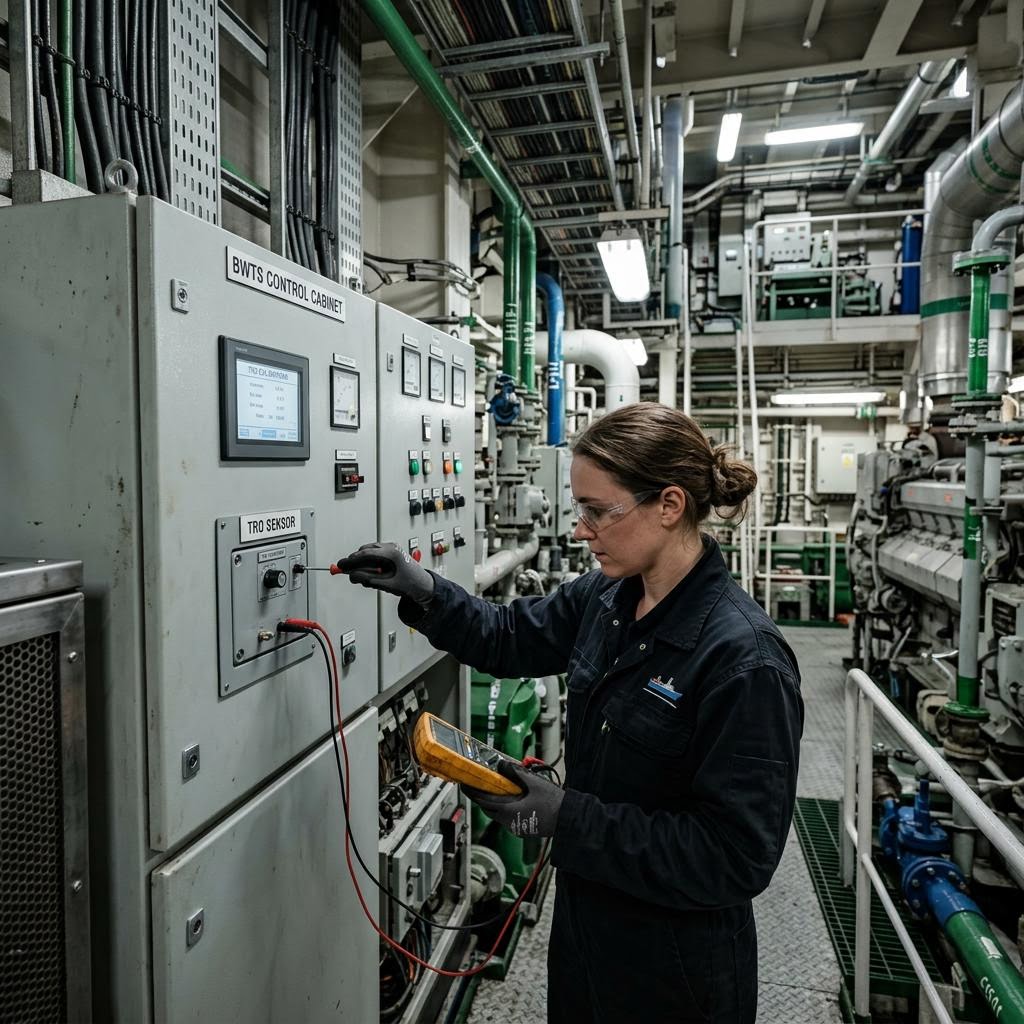
BalClor relies on TRO analysers at the dosing and discharge points to control disinfectant dosing and to confirm the neutralised discharge is within limits. These colorimetric or amperometric analysers use consumable reagents, tubing, pump cartridges and optical or membrane components that need periodic replacement to keep readings accurate.
Drifting TRO readings, blocked sample lines or analyser alarms frequently trace back to expired reagent, fouled sample tubing or a worn peristaltic cartridge rather than a failed sensor. Keeping analyser consumables in date is the cheapest way to avoid spurious dosing alarms and to keep the system available during a port call.
Sea Clean supplies TRO analyser consumables and reagents alongside general ballast water reagents such as sodium thiosulphate neutraliser. Reagents are dispatched with attention to shelf life and labelled for the receiving vessel so the engineer fits stock that is in date.
Filters, Dosing Pumps and Valves
The pre-treatment filter protects the treatment stage and is a routine maintenance item: filter elements or screen segments, seals and the backflush mechanism wear over time and a rising differential pressure is the usual indicator. Replacing the correct element and seal kit restores flow and prevents the system from tripping on high filter pressure during ballasting.
Dosing pumps for hypochlorite and neutraliser, along with their diaphragms, valves and dosing lines, are wear items that affect the system's ability to hit and hold the TRO setpoint. Actuated valves on the side-stream and neutralisation circuits also need seat and actuator spares to maintain reliable sequencing.
Sea Clean supplies filter elements and seal kits, dosing pump spares and valve components for BalClor systems, matching each part to the model fitted. Stocking a small set of filter and dosing consumables on board reduces the chance that a routine wear item stops the system mid-voyage.
Sourcing BalClor Parts Independently
Sea Clean provides independent service and parts support for Sunrui BalClor systems. We are not an authorised Sunrui agent and do not claim OEM approval; instead we source genuine and compatible BalClor components through our supplier network and supply them with the documentation a vessel and class need.
For owners, the practical benefit of an independent route is faster sourcing and a single point of contact who can combine BalClor parts with reagents and general ship spares in one delivery. Where a genuine OEM part is essential, such as an electrolyser cell, we say so clearly and source accordingly.
Accurate identification is the key to a clean order. Sending the BWMS model, electrolyser type, serial numbers and photographs of nameplates lets us confirm the correct part before dispatch and avoids the delay of a wrong-part return from a vessel under a compliance deadline.
Planning Parts Supply for a Port Call
The most reliable BalClor parts supply starts with early notice of the vessel's next port, ETA and the failed or worn component. For Norwegian and North Sea calls, locally held consumables can often reach the vessel within a day; electrolyser cells and other long-lead items depend on sourcing time and should be planned well ahead.
For worldwide calls, parts are routed by courier or air freight to the agent, with local coordination for delivery to the quay. Combining a parts delivery with an engineer attendance, where the fault needs hands-on diagnosis, avoids a second port call and shortens the time the system is offline.
Send the vessel name, IMO number, BalClor model and the requirement to post@seaclean.no to begin sourcing. Early engagement is the single biggest factor in getting the correct BalClor part to the vessel inside its schedule.
Frequently asked questions
Is Sea Clean an authorised Sunrui agent?
No. Sea Clean provides independent service and parts support for Sunrui BalClor systems. We are an authorized agent only for Headway. For BalClor we source genuine and compatible parts through our supplier network and supply them with the documentation a vessel and class require.
When does a BalClor electrolyser cell need replacing?
Falling hypochlorite output at a given current, rising cell voltage or an inability to reach the TRO setpoint suggest the cell is worn or scaled. Scaling is often reversible by acid cleaning; where the electrode coating itself is worn, the cell or electrode assembly must be replaced against the specific model fitted.
Why are my BalClor TRO readings drifting?
Drifting TRO readings usually trace to expired reagent, fouled sample tubing or a worn peristaltic pump cartridge rather than a failed sensor. Replacing analyser consumables and keeping reagent in date resolves most spurious dosing alarms before a sensor is suspected.
How quickly can BalClor parts be supplied?
Locally held consumables can often reach a Norwegian or North Sea call within a day. Electrolyser cells and other long-lead items depend on sourcing time and should be planned ahead. For worldwide calls, parts are routed by courier or air freight to the agent with local delivery coordination.