CLX-XT cooling chamber: investigate shortened reagent life safely
Updated
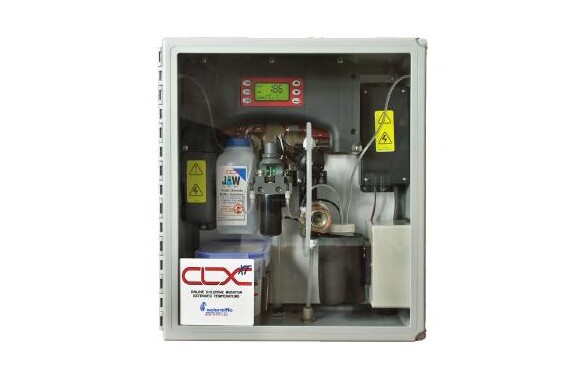
Shortened reagent life requires a review of cooling, temperature, reagent history and operating duty. The XT's extended-life claim is conditional; it is not proof that every installed bottle remains valid for three months.
Key takeaways
- Record actual temperature and ventilation conditions.
- Supply preparation and storage history.
- Verify cooling after repair and assess existing reagent separately.
Identify which temperature claim applies
The XT manual describes a thermoelectric chamber intended to keep indicator below 25°C within the stated operating range, while the engineering sheet conditions its three-month claim on cycle time and ambient conditions. The family guide uses another temperature formulation. Record the actual document revision and installed unit, and ask the supplier to resolve any discrepancy before setting a maintenance interval.
Inspect the surrounding installation without bypassing protection
Record ambient conditions and whether nearby equipment, obstructed ventilation or cabinet placement could affect heat rejection. Follow the manual and vessel isolation procedure for any internal inspection. Do not defeat an electrical cover, run equipment with improvised ventilation changes or treat a fan rating as evidence that water spray is harmless. Cooling and instrument power arrangements must be checked by competent personnel.
Keep chemistry history in the diagnosis
A cooling concern does not exclude an incorrectly prepared, aged or mismatched indicator. Record batch, preparation/activation date, installation date and storage conditions. Separate the buffer and indicator histories where their instructions differ. Supply cycle settings and operating duty as well: consumption and chemical life can create different reasons for replacing a bottle.
Request a service outcome, not only a fan
If a cooling component is suspected, identify its installed reference and the complete assembly before ordering. Ask the service scope to cover the diagnosed cause and the checks needed to demonstrate suitable operation after repair. Replace compromised reagent according to the applicable instructions; restoring cooling does not reverse prior reagent deterioration.
Illustrative procurement scenario
A monitor begins needing indicator changes sooner after adjacent machinery is installed. The service enquiry includes ambient observations and installation photographs, allowing heat-rejection conditions and reagent history to be assessed together.
Request a matched CLX quotation
Sea Clean is a Watts distributor. We source, supply and repair all CLX variants and supply normal, zig-zag and J.A.W. TRO reagent kits competitively. Stocked products are ready for delivery; confirm the exact item and quantity. Estimated DHL Express transit is 1–4 days on suitable routes, subject to dispatch, customs and final vessel handover.
For this enquiry, include: XT serial; cooling symptoms; ambient observations; ventilation photographs; reagent preparation/installation dates; cycle and operating duty; requested parts or service.
Equipment enquiries: CLX monitor supply
Consumables: TRO reagent kits
Service support: BWTS service and calibration
Frequently asked questions
Does repairing cooling restore an overheated reagent bottle?
No. Assess and replace reagent according to its instructions; restoring the chamber does not undo chemical degradation.
Manufacturer PDFs & direct enquiries
Original manufacturer documents hosted directly by Sea Clean. Match the model and revision before use.
- CLX-XT engineering specification (PDF)
- CLX-XT installation, operation and maintenance manual (PDF)
- HF scientific ballast-water monitor product guide (PDF)
Email CLX enquiry to post@seaclean.no
Opens an email draft. Attach nameplate and bottle photographs, add your requirements, then send. No website form.
Explore all 15 CLX buying and service guides
- HF scientific CLX family: select the model and generation before buying
- CLX-XT 28030 datasheet: what an engineering purchase specification needs
- OEM-labelled CLX and MU units: identifying the monitor behind the BWMS label
- CLX-Ex and Ex2 supply and repair: verify the hazardous-area assembly
- CLX-XT versus XT2: enclosure and retrofit checks before replacement
- Techcross zig-zag TRO reagent kits: match the installed bottle arrangement
- J.A.W. powder reagent kits: distilled-water preparation and purchase checks
- Compare normal, zig-zag and J.A.W. TRO kits on delivered usable cost
- HF scientific CLX spare parts: avoid a near-match service kit
- CLX stock and DHL Express delivery: plan the final handover to the vessel
- CLX-XT repair or replacement: make the decision from the fault evidence
- CLX-XT cooling chamber: investigate shortened reagent life safely
- Legacy CLX to current CLX: USB-C, Modbus and analogue-output upgrade checks
- CLX DPD accuracy: turn a datasheet tolerance into an acceptance requirement
- Watts distributor CLX support: one enquiry for supply, repair and service
Sources
- CLX-XT engineering specification — ES-HF-CLX-XT; ordering information and operating limits. Manufacturer PDF hosted by Sea Clean; reviewed 9 November 2026.
- CLX-XT installation, operation and maintenance manual — Watts-hosted 28652 revision 5 file; match the installed serial number and software. Manufacturer PDF hosted by Sea Clean; reviewed 9 November 2026.
- HF scientific ballast-water monitor product guide — CLX-XT, XT2, Ex and Ex2 comparisons; confirm individual certificates and revisions. Manufacturer PDF hosted by Sea Clean; reviewed 9 November 2026.
Related articles
- Legacy CLX to current CLX: USB-C, Modbus and analogue-output upgrade checks
- CLX DPD accuracy: turn a datasheet tolerance into an acceptance requirement
- Watts distributor CLX support: one enquiry for supply, repair and service
- HF scientific CLX family: select the model and generation before buying
- CLX-XT 28030 datasheet: what an engineering purchase specification needs
- OEM-labelled CLX and MU units: identifying the monitor behind the BWMS label