Maintaining UV vs Electrochlorination BWTS
Updated
The two dominant ballast water treatment technologies, UV irradiation and electrochlorination, demand very different maintenance even though both share a pre-treatment filter. This article compares the upkeep, consumables and fault patterns of each approach and explains how Sea Clean AS supports both as an independent multi-brand service provider.
Key takeaways
- UV and electrochlorination BWTS share a filter but otherwise need very different maintenance.
- UV upkeep centres on lamps, quartz sleeves and UV sensors, and is chemical-free but transmittance-sensitive.
- EC upkeep centres on the electrolyser, TRO analysers, dosing and neutralisation, and is salinity-sensitive.
- The pre-treatment filter is the most common interruption point on either technology.
- Spares and crew skills should be planned around each technology's dominant failure modes.
- Sea Clean supports both families independently, authorized for Headway only and never for other brands.
Two Treatment Approaches, Different Upkeep
Most installed ballast water management systems use one of two core technologies after the filter: ultraviolet (UV) irradiation, which inactivates organisms with UV light, or electrochlorination (EC), which generates a chlorine-based disinfectant from seawater and doses it into the ballast line. The treatment physics differ, and so do the consumables, the failure modes and the maintenance routine.
Understanding which family a system belongs to shapes the whole maintenance plan: the spares to carry, the skills the crew needs, the alarms to expect and the way a port-call service is scoped. A superintendent managing a mixed fleet will hold two quite different parts and procedure sets.
Both families share the pre-treatment filter, which means filter care is common ground. Beyond the filter, the two diverge sharply, and the rest of this article works through where the maintenance effort actually falls in each case.
Maintaining a UV System
UV systems centre on lamps, quartz sleeves and UV intensity sensors. Lamps are the primary consumable, replaced on rated operating hours before output falls too far to maintain the required dose. Quartz sleeves must stay clean and intact, since fouling or cracks block UV even with healthy lamps, and a cleaning routine or manual cleaning keeps them clear.
UV systems are chemical-free, so there is no disinfectant generation or neutralisation to maintain, which simplifies consumable logistics. The trade-off is sensitivity to water transmittance: in turbid or low-transmittance water the controller reduces flow to hold dose, which can limit ballasting rate as a normal designed behaviour rather than a fault.
Typical UV faults are low-UV alarms from aged lamps or fouled sleeves, lamp-driver and power-supply faults that take lamps offline, and sensor drift. The spares set is dominated by lamps, sleeves, filter parts and sensors, and the crew skills centre on safe lamp and sleeve handling.
Maintaining an Electrochlorination System
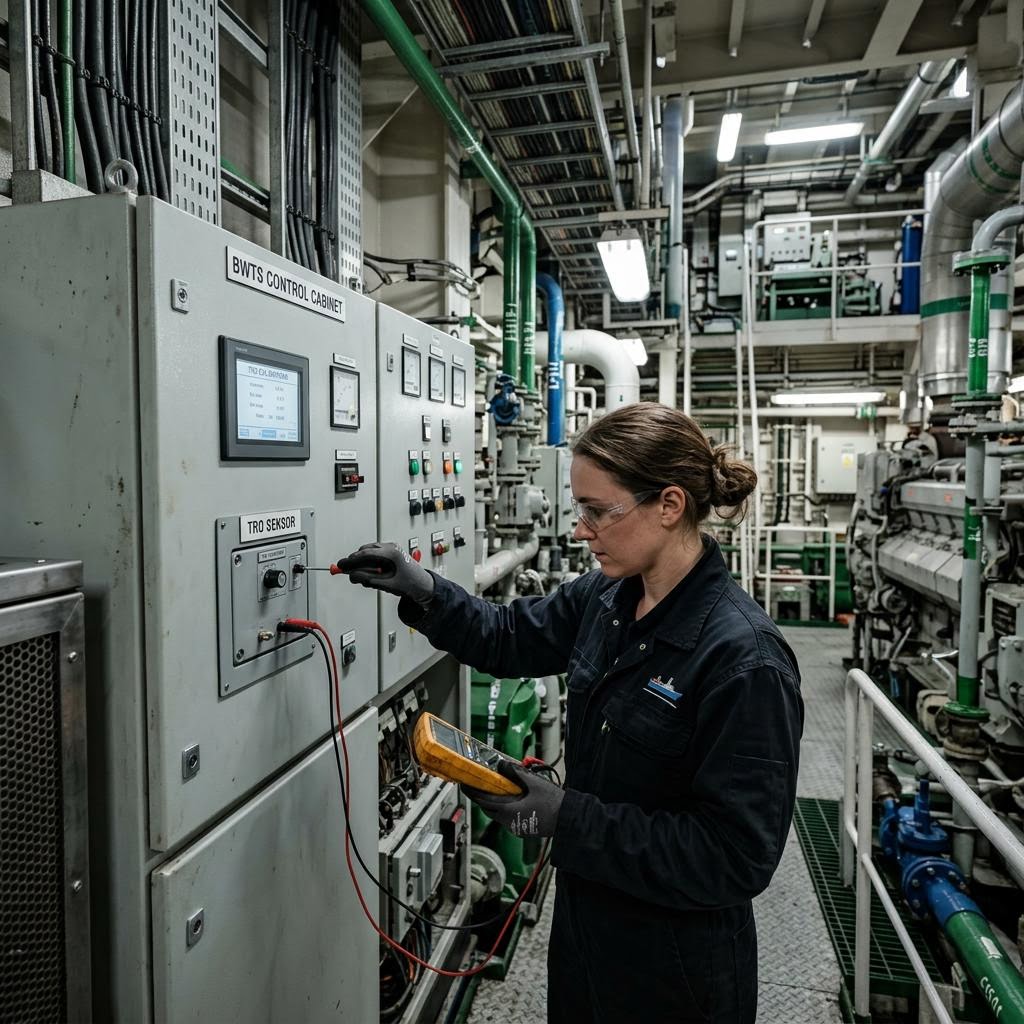
Electrochlorination systems centre on the electrolyser, the TRO analysers, the dosing pumps and the neutralisation circuit. The electrolyser electrodes are coated-titanium wear items whose output falls with scaling and age; scaling is usually reversible by acid cleaning, while a worn coating eventually needs cell replacement, a significant cost and lead-time item.
Because EC systems generate and dose a chemical and then neutralise the residual before discharge, TRO measurement accuracy and neutraliser supply are central. Many apparent dosing faults trace to analyser consumables, sample lines or pump cartridges rather than the electrolyser, so methodical checking saves unnecessary part changes.
EC systems are less sensitive to water clarity than UV but more sensitive to seawater salinity, since low salinity reduces electrochlorination efficiency. The spares set is dominated by electrolyser components, analyser consumables, dosing-pump parts, valves, neutraliser and filter parts, and the crew needs comfort with chemical handling and TRO testing.
Shared Ground: the Filter
Both technologies rely on a pre-treatment filter to remove larger particles and organisms, and the filter is the most common single point of interruption on either system. Elements, seals and the backflush mechanism are routine wear items, and a rising differential pressure is the usual warning.
In turbid or sediment-laden water a filter high-pressure trip can halt ballasting on either a UV or an EC system, and the response is the same: check the backflush sequence and pump, inspect or replace the element, and consider a slower ballasting rate to stay within the filter's capacity.
Because filter care is common ground, carrying the correct filter element and seal kit is worthwhile regardless of treatment technology. It is often the cheapest spare to hold against the most frequent interruption.
Choosing Spares and Crew Skills
A practical maintenance plan stocks against each system's dominant failure modes. For UV, that means lamps, sleeves, filter parts and sensors, plus the cleaning consumables the system uses. For EC, that means electrolyser cleaning chemicals and, on a planned basis, cells, plus analyser consumables, dosing-pump spares, valves, neutraliser and filter parts.
Crew skills differ too: UV upkeep is largely mechanical and electrical with careful component handling, while EC upkeep adds chemical handling, electrolyser cleaning and TRO testing. On a mixed fleet, training and spares planning should reflect both, not just the more numerous system type.
Sea Clean advises owners on the spares set and consumable supply appropriate to each system and can combine items for several systems across a fleet into coordinated deliveries.
Independent Support for Both Families
Sea Clean provides independent service and parts support across both UV and electrochlorination systems and many brands. We are an authorized agent for Headway only; for all other makers we provide independent service, parts sourcing, troubleshooting and engineer attendance without claiming OEM approval.
For a mixed fleet this means a single contact who understands the different maintenance logics and can supply lamps and sleeves for the UV systems and electrolyser and analyser parts for the EC systems, alongside reagents and general spares. Engineer attendance is scoped to the specific technology and fault.
For Norwegian and North Sea port calls an engineer typically reaches the vessel within 0-24 hours; for worldwide calls mobilisation is as fast as flights, visas and port access allow. Send the vessel name, IMO number, the system type and the requirement to post@seaclean.no to plan support.
Frequently asked questions
What is the main maintenance difference between UV and EC ballast systems?
UV systems centre on replacing lamps and keeping quartz sleeves and sensors clean, with no chemicals to manage. Electrochlorination systems centre on the electrolyser, TRO measurement, dosing and neutralisation, which adds chemical handling and electrolyser cleaning. Both share a pre-treatment filter as common ground.
Which technology is affected by water quality?
UV systems are sensitive to water transmittance: in turbid water the controller reduces flow to maintain dose, limiting ballasting rate. Electrochlorination systems are less affected by clarity but sensitive to salinity, since low salinity reduces electrochlorination efficiency. Both can be interrupted by filter high pressure in sediment-laden water.
What spares should I carry for each system type?
For UV, carry lamps, quartz sleeves, filter elements and seals, sensors and cleaning consumables. For electrochlorination, carry electrolyser cleaning chemicals and, on a planned basis, cells, plus analyser consumables, dosing-pump spares, valves, neutraliser and filter parts. The filter element and seal kit are worthwhile on both.
Can Sea Clean support a mixed fleet of UV and EC systems?
Yes. Sea Clean provides independent service and parts for both UV and electrochlorination systems across many brands, authorized for Headway only. A single contact can supply lamps and sleeves for UV systems and electrolyser and analyser parts for EC systems, with engineer attendance scoped to the specific technology.