BWTS Fault Diagnosis and Emergency Engineer Attendance
Updated
When a ballast water treatment system alarms and stops, the vessel loses the ability to ballast or deballast compliantly — and in a regulated port that can hold cargo operations and expose the ship to enforcement. Fault diagnosis is about finding the true cause quickly, not just clearing the alarm, and then correcting it with the right parts. This article explains how Sea Clean approaches BWTS fault diagnosis and breakdown attendance across brands, from remote analysis through on-site repair and parts supply.
Key takeaways
- A BWTS fault is a compliance and commercial problem — without a working system the ship cannot ballast compliantly, and downtime cost dwarfs the repair.
- The trap is treating the alarm as the fault; accurate diagnosis finds the root cause so the repair holds rather than recurring.
- Remote analysis of alarm logs, fault codes and history narrows the cause and identifies parts before travel, turning attendance into repair.
- Sensor and reagent faults frequently masquerade as treatment faults, so methodical elimination across fault categories is essential.
- Sea Clean provides Headway agent repair and independent diagnosis for Techcross, Erma First, Sunrui and other brands, supplying parts through one contact.
- Engineers attend Norway and the North Sea commonly within 24 hours; worldwide attendance is by arrangement as travel and port access allow.
Why Fast, Accurate Diagnosis Matters
A BWTS fault is not just an equipment problem; it is a compliance and commercial problem. Without a working system the vessel cannot produce D-2-compliant ballast, which can prevent it from deballasting cargo-critical tanks in a regulated port, delay cargo operations and, if the ship discharges non-compliant water, expose it to port State control action. The cost of downtime usually dwarfs the cost of the repair.
The trap in fault-finding is treating the alarm as the fault. A high-differential-pressure alarm on the filter, a low-TRO alarm on the electrolyser or a UV-dose alarm each has several possible root causes, and clearing the alarm without finding the cause simply defers the breakdown. Accurate diagnosis identifies the root cause so the repair holds rather than recurring on the next ballast operation.
Speed and accuracy together are what matter: a fast but wrong diagnosis wastes an attendance and leaves the ship non-compliant, while a slow but correct one lets downtime accumulate. Effective breakdown response combines remote analysis to narrow the cause before boarding with an engineer arriving equipped to complete the likely repair in one visit.
Remote Analysis Before Attendance
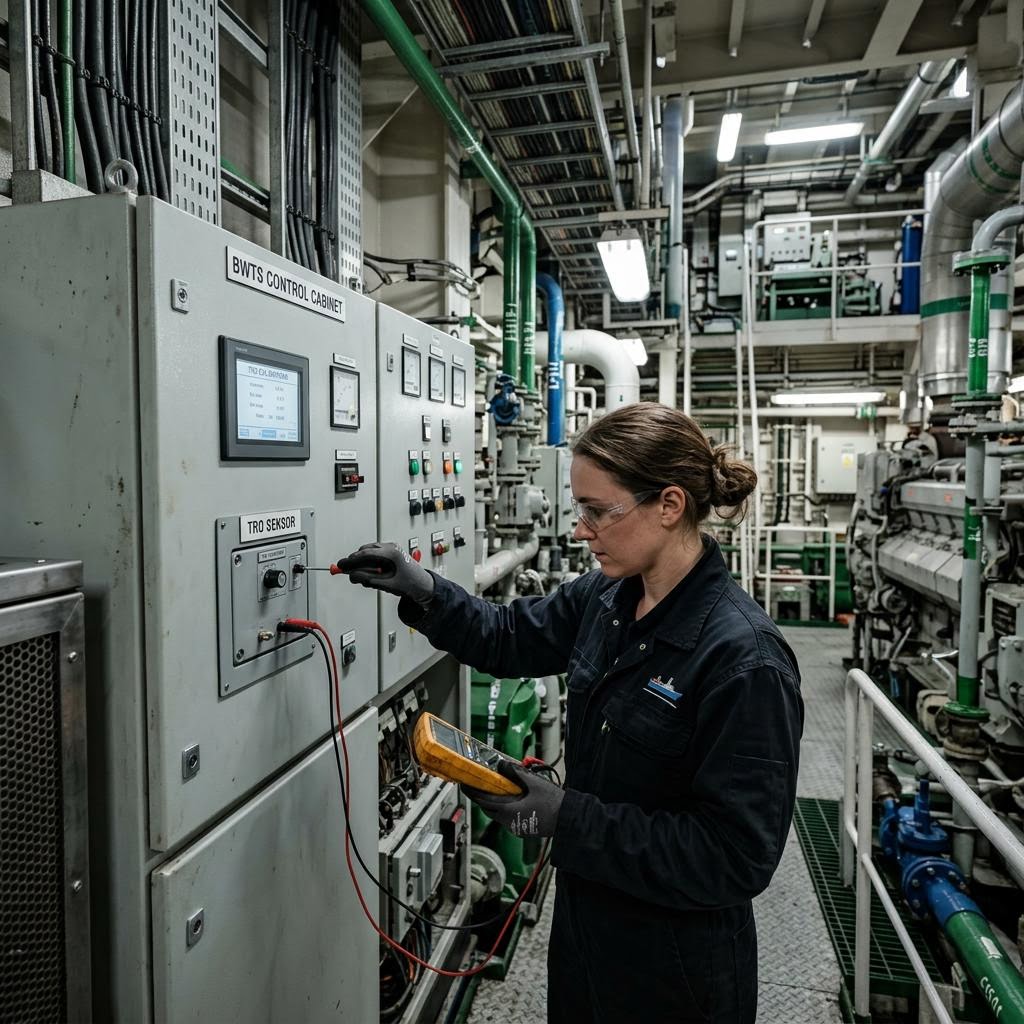
Much diagnosis can begin before an engineer boards. Alarm logs, fault codes, recent operating history and photographs of the panel and installation let Sea Clean narrow the probable cause and identify the parts likely needed. This pre-boarding analysis is the difference between an engineer arriving with the right spares and one arriving to diagnose and then wait for parts.
The crew can often provide the decisive information: which alarm, when it started, what changed before it, and whether the fault is constant or intermittent. Intermittent faults that appear only under load or in certain waters point toward different causes than constant faults present from start-up, and eliciting that distinction remotely focuses the attendance.
For systems with remote-connectivity or exportable logs, more detailed data can be reviewed to distinguish a sensor fault from a treatment fault from a control fault. The aim of remote analysis is a well-founded hypothesis and a parts list before travel, so the on-site visit is a repair rather than an open-ended investigation.
Common Fault Categories
Filtration faults — high differential pressure, failed backflush, blocked or damaged screens — are among the most common and often trace to sediment loading or a backflush-control problem rather than the filter itself. For electrochlorination systems, low oxidant output usually points to electrode wear or scaling, a power-supply fault or a flow or salinity condition outside the cell's operating envelope.
UV systems commonly alarm on low dose from aged lamps, fouled quartz sleeves, a failed lamp driver or low water clarity, and distinguishing genuine end-of-life from a cleaning or ballast issue avoids needless lamp replacement. Sensor and measurement faults — a drifted TRO analyser, a fouled sample line, expired reagent — masquerade as treatment faults and are a frequent source of misdiagnosis.
Control-system faults span PLC and software issues, communication failures between subsystems, valve and actuator faults, and undocumented parameter changes that trigger nuisance alarms. Because the same alarm can arise from mechanical, electrical, chemical or software causes, methodical elimination across these categories is what separates a lasting repair from a temporary reset.
On-Site Repair and Parts
The attending engineer boards with the tools, consumables and the likely spares identified from remote analysis, aiming to restore the system to compliant operation in a single visit. Where the diagnosis is confirmed on board, the repair proceeds; where it reveals a different cause, the engineer works to the same goal of restoring operability and documents any part that must follow.
Sea Clean supplies genuine Headway OceanGuard parts and sources multi-brand components and reagents, so the parts side of a repair is handled through the same contact as the attendance. For urgent breakdowns, critical spares can be routed to the port to meet the engineer, and where a part is not in regional stock it is sourced through Sea Clean's supplier network by the fastest viable route.
After the repair the engineer confirms the system runs correctly through its operating sequence — treats, neutralises and alarms as designed — before signing off, so the vessel leaves with a working system rather than a cleared alarm. Post-repair verification is what proves the root cause was actually addressed.
Multi-Brand Capability and Honest Scope
Sea Clean is an authorized Headway Technology agent, so for OceanGuard systems fault diagnosis and repair are carried out with manufacturer backing and genuine parts. For Techcross, Erma First, Sunrui BalClor, Alfa Laval PureBallast, Optimarin, Wärtsilä, JFE BallastAce, Panasia, De Nora and other makes, Sea Clean provides independent diagnosis and repair based on hands-on experience and does not claim manufacturer authorization for those brands.
The diagnostic method is common across technologies even though the specifics differ, so an engineer experienced across UV, electrochlorination and dosing designs can work systematically through the fault categories on whichever system is fitted. The multi-brand capability means a mixed fleet can use one service contact rather than a separate arrangement per system.
Every attendance closes with a fault report describing the diagnosis, the root cause, the parts fitted, the readings taken and any open items, written for the vessel's PMS and for class and port State control. Where the breakdown followed a PSC observation, the report supports demonstrating that the fault has been rectified.
Response Times and How to Call Out
Sea Clean's engineers attend vessels across Norway and the North Sea, commonly within 24 hours for urgent breakdowns, subject to the vessel's schedule and port access. Worldwide breakdown attendance is coordinated as flights, visas and port access allow, with non-European ports served by arrangement — Sea Clean is honest that a long-haul attendance depends on travel logistics rather than a fabricated local presence.
For the fastest response, provide the vessel name and IMO number, BWTS make and model, the exact alarm or fault, when it started, the port and ETA, and the agent's details to post@seaclean.no. This lets Sea Clean begin remote analysis, pre-stage the likely parts and reagents, and brief the engineer before travel so the attendance is a repair, not an investigation.
Where the alongside time is short, the scope is defined tightly so the priority is restoring compliant ballasting, with any secondary work planned for the next suitable port. Early contact against the ETA is consistently the single biggest factor in resolving a breakdown within one port call.
Frequently asked questions
How fast can an engineer reach a broken-down vessel?
For urgent breakdowns in Norway and the North Sea, an engineer can commonly attend within 24 hours, subject to the vessel's schedule and port access. Worldwide attendance is coordinated by arrangement as flights, visas and port access allow, so long-haul timing depends on travel logistics.
Can you diagnose the fault before the engineer boards?
Often, yes. Alarm logs, fault codes, operating history and panel photographs let Sea Clean narrow the probable cause and identify likely parts before travel, so the engineer arrives equipped to repair rather than to diagnose and then wait for spares.
Do you repair systems other than Headway?
Yes. Sea Clean is an authorized Headway agent and also provides independent fault diagnosis and repair for Techcross, Erma First, Sunrui, Alfa Laval, Optimarin, Wärtsilä, JFE, Panasia, De Nora and others. For non-Headway systems the service is independent and not manufacturer-authorized.
What information speeds up a breakdown call-out?
Send the vessel name and IMO number, BWTS make and model, the exact alarm or fault, when it started, the port and ETA, and the agent's details to post@seaclean.no. This lets Sea Clean begin remote analysis, pre-stage parts and brief the engineer so the attendance is a repair.