Wärtsilä Aquarius BWTS Service Support
Updated
The Wärtsilä Aquarius ballast water management system was supplied in both UV and electrochlorination variants, fitted across a range of merchant tonnage. This article outlines both variants and their maintenance needs, and explains how Sea Clean AS provides independent Aquarius service, parts sourcing and engineer attendance.
Key takeaways
- Aquarius was supplied as a UV variant and an electrochlorination (EC) variant with different consumables.
- UV-variant maintenance centres on lamps, sleeves and UV sensors; EC-variant on the electrolyser and TRO control.
- The pre-treatment filter is a common interruption point on both variants in turbid water.
- Identifying the exact variant and generation is essential before sourcing any Aquarius part.
- Sea Clean provides independent Aquarius service and parts and does not claim Wärtsilä OEM authorization.
- Engineer ETA is typically 0-24h for Norway and North Sea, and as fast as logistics allow worldwide.
Two Aquarius Variants
The Wärtsilä Aquarius BWMS was offered in two main forms: Aquarius UV, a filtration-plus-ultraviolet system, and Aquarius EC, a filtration-plus-electrochlorination system. The choice on a given vessel reflected the ballast flow, water conditions on its trade and the owner's preference, so identifying which variant is fitted is the first step in any service planning.
Both variants share a pre-treatment filter and a common control philosophy, but their treatment stages and consumables differ entirely. The UV variant centres on lamps, sleeves and UV sensors, while the EC variant centres on the electrolyser, TRO control and neutralisation, similar to other electrochlorination systems.
Wärtsilä's wider servicing arrangements for marine equipment changed over time, and some owners look for independent support to keep an Aquarius maintained cost-effectively over its life. Knowing the exact variant and generation from the system documentation is essential before sourcing parts.
Aquarius UV Maintenance
On the UV variant, the treatment depends on delivered UV dose, so lamp condition, sleeve cleanliness and sensor accuracy govern performance. UV lamps are the main consumable and are replaced on rated hours before output falls too far to maintain dose; quartz sleeves are cleaned and replaced when fouled or cracked.
The pre-treatment filter is a routine wear item with elements, seals and a backflush mechanism, and low water transmittance can limit ballasting rate by design. UV intensity sensors need periodic checks so the controller's dose calculation stays accurate and alarms remain meaningful.
Sea Clean supplies UV lamps, sleeves, filter elements and sensor components for the Aquarius UV variant, matched to the specific model. Combining these consumables in a single planned delivery keeps the system available without repeated port calls.
Aquarius EC Maintenance
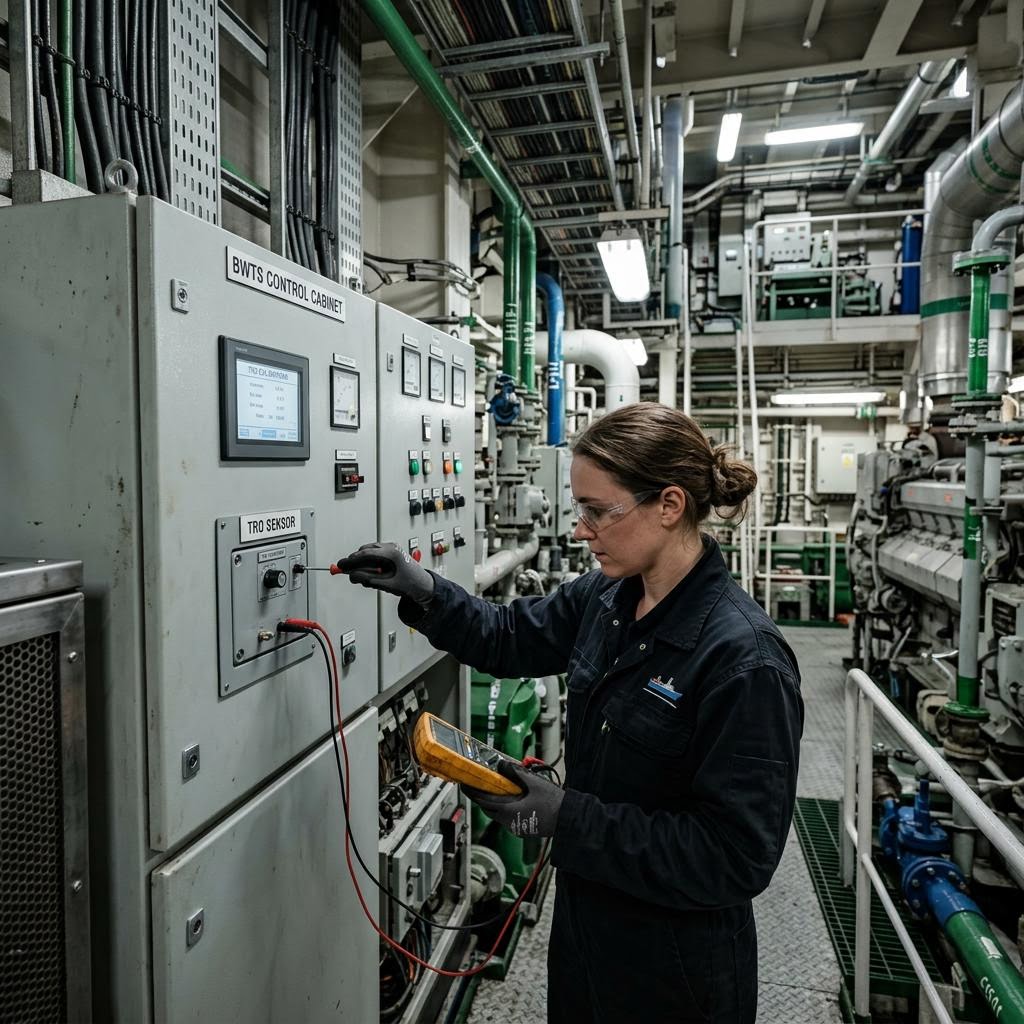
On the electrochlorination variant, treatment relies on generating hypochlorite in an electrolyser and dosing it to reach the TRO setpoint, with neutralisation on discharge. The electrolyser electrodes are coated-titanium wear items, and scaling is the most common reversible cause of falling output, addressed by acid cleaning before replacement.
TRO analysers, dosing pumps, neutraliser supply and actuated valves are the other duty items, similar to other electrochlorination BWMS. Many apparent dosing faults trace to analyser consumables, sample lines or pump cartridges rather than the electrolyser itself, so methodical checking saves unnecessary part changes.
Sea Clean supplies electrolyser components, TRO analyser consumables, dosing-pump spares and filter parts for the Aquarius EC variant, and supplies sodium thiosulphate neutraliser and reagents where the system uses them. Parts are matched to the model from the system data.
Common Faults and Diagnosis
Across both variants, the filter is a common point of interruption, with high differential pressure or trips in turbid water resolved by backflush checks, element replacement or a slower ballasting rate. Control, communication and power-supply faults appear on both and are worked through against the alarm history.
On the UV variant, low-UV alarms point to lamps, sleeves or sensors; on the EC variant, TRO alarms point to either measurement issues or genuine dosing problems in the electrolyser or neutralisation circuit. Identifying the variant and reading the alarm log together gives the fastest route to the cause.
Many faults are within crew capability with spares aboard. Engineer attendance is warranted for recurring faults, unclear diagnosis, repairs beyond the crew's tools, or an imminent commissioning test or PSC inspection.
Independent Parts Sourcing
Sea Clean provides independent service and parts support for Wärtsilä Aquarius systems. We are not an authorised Wärtsilä agent and claim no OEM approval; we source genuine and compatible Aquarius parts through our supplier network and supply them with the documentation a vessel and class need.
For owners, independent sourcing offers a single contact for both Aquarius variants who can combine BWTS parts with reagents and general ship spares in one delivery. Where a genuine OEM component is the right choice, such as an electrolyser cell or a specific UV lamp, we say so and source accordingly.
Because Aquarius exists in multiple variants and generations, accurate identification is critical. Sending the variant, model, serial numbers and nameplate photographs lets us confirm the correct part before dispatch.
Engineer Attendance and Planning
Aquarius service attendance covers UV or EC maintenance as applicable, filter service, sensor and TRO checks, and fault diagnosis. Combining service with a parts delivery in one visit reduces port calls and downtime.
For Norwegian and North Sea port calls an engineer typically reaches the vessel within 0-24 hours; for worldwide calls mobilisation is as fast as flights, visas and port access allow, with parts routed by courier or air freight to the agent. We confirm a realistic ETA rather than promising instant global arrival.
Send the vessel name, IMO number, Aquarius variant and model, and the requirement to post@seaclean.no to plan attendance and parts together. Early notice is the main factor in meeting a port window.
Frequently asked questions
Which Aquarius variant is on my vessel?
Aquarius was supplied as Aquarius UV (filtration plus ultraviolet) and Aquarius EC (filtration plus electrochlorination). Check the system documentation and nameplate to confirm which is fitted, since the two have entirely different treatment stages and consumables. Identifying the variant is the first step before sourcing any part.
Is Sea Clean authorised by Wärtsilä for Aquarius?
No. Sea Clean provides independent service and parts support for Wärtsilä Aquarius systems and claims no OEM approval. We are an authorized agent only for Headway. For Aquarius we source genuine and compatible parts and supply them with the documentation a vessel and class require.
What are the main wear items on the Aquarius EC variant?
The electrolyser electrodes are coated-titanium wear items, with scaling the most common reversible cause of low output, addressed by acid cleaning before replacement. TRO analysers, dosing pumps, neutraliser supply and actuated valves are the other duty items, similar to other electrochlorination systems.
Can Sea Clean attend both Aquarius variants?
Yes. Attendance covers UV or EC maintenance as applicable, filter service, sensor and TRO checks and fault diagnosis. Combining service with a parts delivery in one visit reduces port calls. ETA is typically 0-24h for Norway and North Sea calls and as fast as logistics allow worldwide.