BWTS Service Programs: A Practical Overview for Fleets
Updated
Keeping a ballast water treatment system compliant is not one task but a program: scheduled calibration and function checks, commissioning and VGP sampling coordination, responsive troubleshooting, spares and reagent supply, and clear documentation. This overview maps the service elements a fleet needs, how they fit the regulatory calendar, and how Sea Clean delivers them on a multi-brand basis across the North Sea and, by arrangement, worldwide.
Key takeaways
- BWTS compliance is a recurring program — calibration, function tests, sampling, troubleshooting and spares — not one-off repairs.
- Annual attendance combines function tests, component checks and sensor calibration per VGP and IMO (MEPC.279(70)) intervals.
- Commissioning (MEPC.325(75)) and VGP sampling are coordinated with accredited ISO 17025 labs; Sea Clean is not itself a test lab.
- Engineers attend the North Sea within 0–24 hours and worldwide by arrangement as flights, visas and port access allow.
- Genuine and multi-brand spares plus dated TRO reagents and neutraliser are delivered with the visit or as timed consignments.
- Every attendance leaves a class-ready service report; fleet programs align calibration, sampling and spares across all vessels.
Why a Program, Not Just Repairs
A BWTS is regulated equipment whose compliance depends on ongoing verification, not one-off fixes. The EPA VGP and IMO guidance both build in recurring obligations — annual function tests, sensor calibration, sampling — so a reactive, break-fix approach leaves gaps that surface as port state control deficiencies. Treating service as a program aligns the work with the rules and the vessel's trading pattern.
A program also lowers cost and downtime. Planned attendance lets spares and reagents be pre-staged, sampling windows booked with accredited laboratories in advance, and multiple tasks combined into a single port call. Reactive attendance, by contrast, pays a premium for urgency and risks the vessel discharging non-compliantly or being detained while parts are sourced.
For a fleet, a program brings consistency: the same calibration intervals, the same documentation standard and the same spares policy across ships, so a superintendent can see at a glance which vessel is due for what. That visibility is what turns compliance from a series of surprises into a managed schedule.
Scheduled Calibration and Function Checks
The backbone of any program is the annual attendance that satisfies the recurring regulatory checks: a system function test of all functions, an annual system check of components with alarm-log review and software update, and calibration of sensors. Under IMO guidance (MEPC.279(70)) that means annual calibration of pressure and temperature devices and bi-annual calibration of flow meters and UV sensors; the VGP adds annual calibration of UV, flow, temperature and pressure sensors with TRO and pH probes more often.
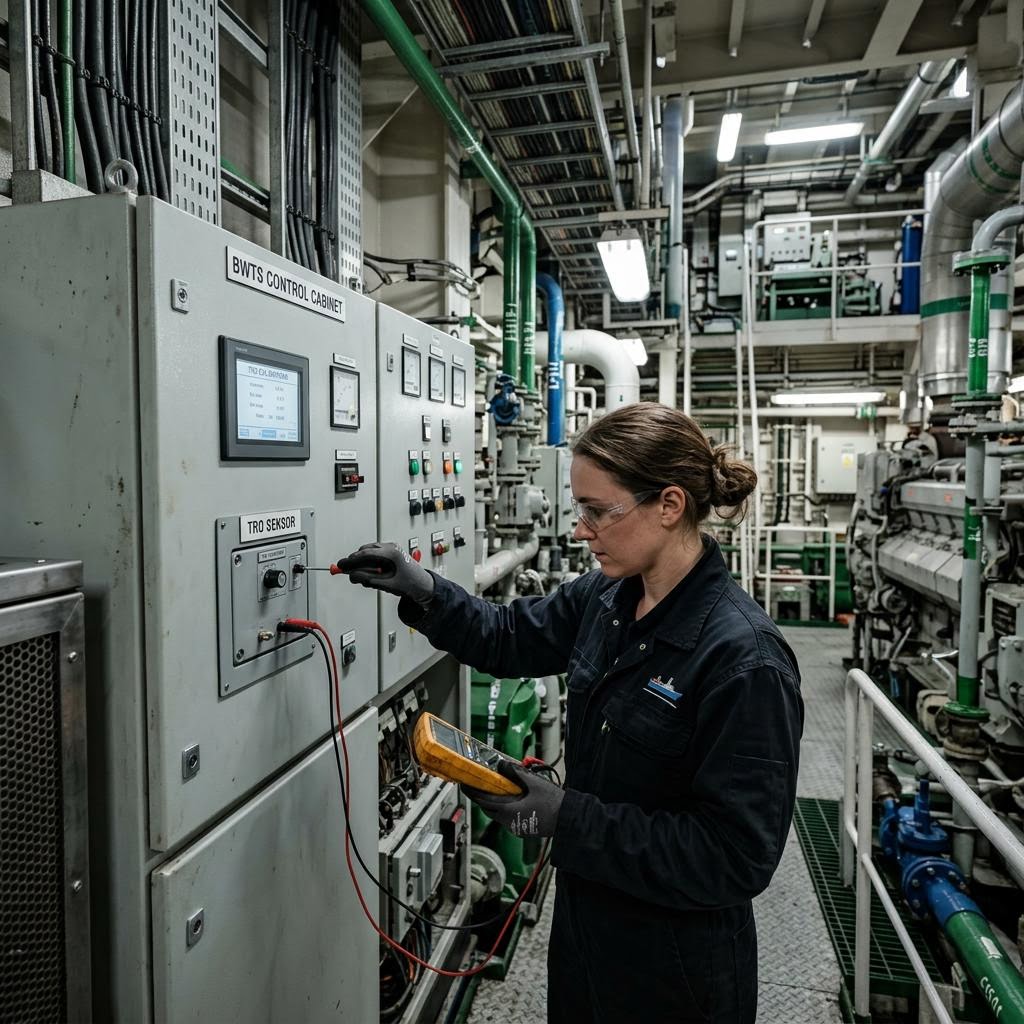
For oxidant systems, TRO sensor calibration and verification are central — calibration adjusts the sensor to a known standard, verification confirms it still reads correctly — and both belong in the maintenance record. For UV systems, the annual visit checks delivered dose, UV transmittance response, lamp hours and quartz-sleeve condition. A function check also exercises the automatic discharge-stop logic that the VGP requires to be tested annually.
Scheduling these together in one attendance keeps the paperwork coherent and the system inside its type-approved envelope. Sea Clean provides annual calibration and function-check attendance sized to the system fitted, leaving a service report suitable for the planned maintenance system and class records.
Commissioning and VGP Sampling Coordination
New or retrofitted systems need commissioning testing under the IMO BWMS Code (MEPC.325(75)) to validate that the installed system's processes function correctly through indicative analysis; it is compulsory, may not be arranged by the maker as the testing party, and is a start-up process check rather than a definitive D-2 biological pass or fail. Vessels trading to US waters then follow VGP compliance sampling — typically two to four times in the first year, reducing to annually after two consecutive passes, with bi-annual residual biocide sampling for oxidant systems.
Sampling is where the honesty line matters. Sea Clean is not an accredited test laboratory; it coordinates commissioning and VGP sampling with accredited ISO 17025 laboratories and flag- or class-authorised parties. The program element Sea Clean provides is the engineer attendance, correct sampling-point access, sample collection, chain-of-custody handling and documentation that let the accredited lab's result stand up to scrutiny.
Building sampling into the program means the analytical window is booked before the vessel arrives and combined with the engineer visit, so a single call can deliver a function check, calibration and a compliance sample. This is far more efficient than treating sampling as a separate, last-minute event at a busy port.
Troubleshooting and Breakdown Response
Even a well-maintained system develops faults — a failed UV lamp array, an electrolytic cell that will not reach target TRO, a control or power fault, a software alarm that stops discharge. A service program includes responsive attendance for these, because an unresolved fault can prevent the vessel ballasting or de-ballasting compliantly and expose it to detention.
Sea Clean's engineers attend across the North Sea within 0–24 hours for urgent breakdowns and, worldwide, by arrangement as flights, visas and port access allow, with non-European ports attended by arrangement rather than from a local office. The engineer boards with the tools, likely spares and reagents for the reported fault, so the aim is to restore compliant operation within the port stay rather than defer it.
Because troubleshooting draws on knowing each design's failure modes, multi-brand experience matters. Sea Clean is an authorized Headway agent for OceanGuard and provides independent, non-manufacturer-authorized service for Techcross, Erma First, Sunrui, Alfa Laval, Optimarin, Wärtsilä, JFE, Panasia, De Nora and others across UV and oxidant systems.
Spares, Reagents and Logistics
A program is only as reliable as its supply chain. Sea Clean supplies genuine Headway OceanGuard parts and multi-brand components — filter elements and seals, UV lamps and quartz sleeves, electrolyser and electrode spares, sample-line fittings — plus ballast water reagents, TRO kits and sodium thiosulfate neutraliser, delivered with the engineer or as a timed consignment. Reagents are supplied in date and labelled for the vessel.
Critical-spares planning is part of the program: identifying, from nameplates and the bill of materials, which parts should be held aboard to avoid a discharge-stopping fault becoming a detention. Where a part is not in regional stock it is sourced through Sea Clean's supplier network and routed by road, sea or air freight, including hand-courier for genuinely urgent items, against the vessel's ETA.
Consolidating spares, reagents and the service visit into one coordinated call reduces handling and the number of separate attendances a vessel needs. Accurate make, model and nameplate detail with each request ensures the correct parts reach the right berth first time.
Documentation and Building Your Program
Every attendance in the program closes with a service report describing the work done, parts fitted, readings taken and any open items, suitable for the planned maintenance system and class records, plus commissioning or VGP documentation where relevant. For TRO-based systems, post-service verification of uptake dosing and discharge neutralisation is recorded so the vessel can demonstrate compliance to a surveyor or port state control officer.
A fleet program is built around each vessel's trading area and system type: the calibration and sampling calendar, the critical-spares list, the reagent replacement cycle and the attendance ports. Aligning these across a fleet gives the superintendent a single view of upcoming obligations and removes the last-minute scramble that drives cost and risk.
To set up or extend a service program, send the vessel names and IMO numbers, the BWTS makes and models, the trading pattern and the ports of call to post@seaclean.no. Sea Clean will propose a calibration, sampling and spares schedule matched to each vessel and coordinate attendance and accredited-lab sampling around your port calls.
Frequently asked questions
What does a BWTS service program include?
Scheduled annual calibration and function checks, commissioning and VGP sampling coordination with accredited laboratories, responsive troubleshooting, spare-parts and reagent supply, critical-spares planning, and class-ready documentation. The elements are aligned to each vessel's trading area, system type and regulatory calendar.
How is a program better than calling for service when something breaks?
A program lets spares and reagents be pre-staged, sampling windows booked in advance, and tasks combined into single port calls, lowering cost and downtime. Break-fix attendance pays a premium for urgency and risks non-compliant discharge or detention while parts are sourced. It also keeps recurring VGP and IMO checks from lapsing.
Can Sea Clean service mixed fleets with different BWTS brands?
Yes. Sea Clean is an authorized Headway Technology agent for OceanGuard and provides independent, non-manufacturer-authorized service for Techcross, Erma First, Sunrui, Alfa Laval, Optimarin, Wärtsilä, JFE, Panasia, De Nora and others across UV and oxidant designs, so a mixed fleet can be supported under one program.
How do I set up a service program with Sea Clean?
Send the vessel names and IMO numbers, the BWTS makes and models, the trading pattern and the ports of call to post@seaclean.no. Sea Clean will propose a calibration, sampling and spares schedule matched to each vessel and coordinate engineer attendance and accredited-lab sampling around your port calls.
Sources
- IMO Guidelines MEPC.279(70) — Maintenance, calibration and function-check intervals
- EPA Vessel General Permit (VGP 2013) — Annual checks, sampling schedule and calibration expectations
Related articles
- BWTS Service FAQ: Answers for Ship Owners and Operators
- BWTS Annual Service and Planned Maintenance
- BWTS Annual Calibration Service for Sensors and Analysers
- BWTS Spare Parts Supply Service: Genuine and Multi-Brand
- BWTS Service and Engineer Attendance at the Port of Aberdeen
- Headway OceanGuard BWTS Service and Support