BWTS Service FAQ: Answers for Ship Owners and Operators
Updated
Ship operators ask the same practical questions about ballast water treatment service: what the system does, who is allowed to work on it, how often calibration and sampling are required, and what D-2, TRO and VGP actually demand. This FAQ answers them with the specifics superintendents need — regulation references, calibration intervals and the difference between what a service provider and an accredited laboratory can do.
Key takeaways
- A BWTS treats ballast to remove or inactivate organisms; mechanical, physical and chemical approaches all pair a filter with a disinfection step.
- Manufacturers, authorized agents or experienced independents may service a BWTS; since 1 June 2022 the maker may not arrange the commissioning sample as the testing party.
- Sea Clean is an authorized Headway agent and an independent (not manufacturer-authorized) service provider for all other brands.
- D-2 sets viable-organism limits by size class; TRO discharge is capped at 0.1 mg/L and ships must not discharge with sensors inoperable.
- VGP expects annual sensor calibration and function tests, with TRO and pH probes calibrated more often; IMO calibrates flow and UV sensors bi-annually.
- Sea Clean is not an accredited lab; it coordinates commissioning and VGP sampling with accredited ISO 17025 laboratories via post@seaclean.no.
What a BWTS Is and the Treatment Approaches
A ballast water treatment system treats the water a ship takes on for stability and trim, removing, inactivating or rendering harmless the aquatic organisms and pathogens in it before discharge, to prevent the spread of invasive species. It is the equipment that lets a vessel meet the IMO D-2 discharge standard rather than relying on open-ocean exchange.
There are three broad treatment approaches. Mechanical methods use separation and filtration to remove larger organisms and particles. Physical methods inactivate organisms with UV radiation, ozone or electrical processes. Chemical methods dose oxidising or non-oxidising biocides — most commonly chlorine-based chemistry generated by electrochlorination or injected directly. Almost every installed system pairs a filter with one of these disinfection principles.
The practical consequence for service is that different systems fail and are maintained in different ways. A UV system's recurring work is lamps and quartz sleeves; an oxidant system's is the electrolytic cell, TRO sensors and neutralisation. Matching the service scope and spares to the specific make and model is the foundation of keeping any BWTS compliant.
Who Is Allowed to Service a BWTS
A BWTS can be serviced by the manufacturer, an authorized agent of that manufacturer, or an experienced independent service provider — but the distinction matters for warranty and for how work is documented. For some tasks, notably commissioning testing, regulation restricts who may perform them: since 1 June 2022 the manufacturer is barred from arranging the commissioning sample as the testing party, which is why an independent sampling arrangement is used.
Sea Clean is an authorized Headway Technology agent, providing manufacturer-backed service, genuine spares and commissioning-test support for Headway OceanGuard systems. For all other brands — Techcross, Erma First, Sunrui, Alfa Laval, Optimarin, Wärtsilä, JFE, Panasia, De Nora and similar — Sea Clean provides independent service that is explicitly not manufacturer-authorized, based on hands-on experience across UV, electrochlorination and filtration designs.
For anything involving biological sampling, the testing itself must be handled correctly: Sea Clean is not an accredited test laboratory and coordinates sampling and commissioning testing with accredited ISO 17025 laboratories and flag- or class-authorised parties. The service provider attends, collects and handles samples under chain of custody; the accredited lab produces the certified result.
D-2, TRO and the Key Numbers
The IMO D-2 standard defines the maximum viable organisms in discharged ballast: fewer than 10 organisms greater than or equal to 50 micrometres per cubic metre, fewer than 10 organisms from 10 to 50 micrometres per millilitre, plus limits on indicator microbes including toxicogenic Vibrio cholerae, E. coli and intestinal enterococci. The D-2 compliance date for the fleet was 8 September 2024.
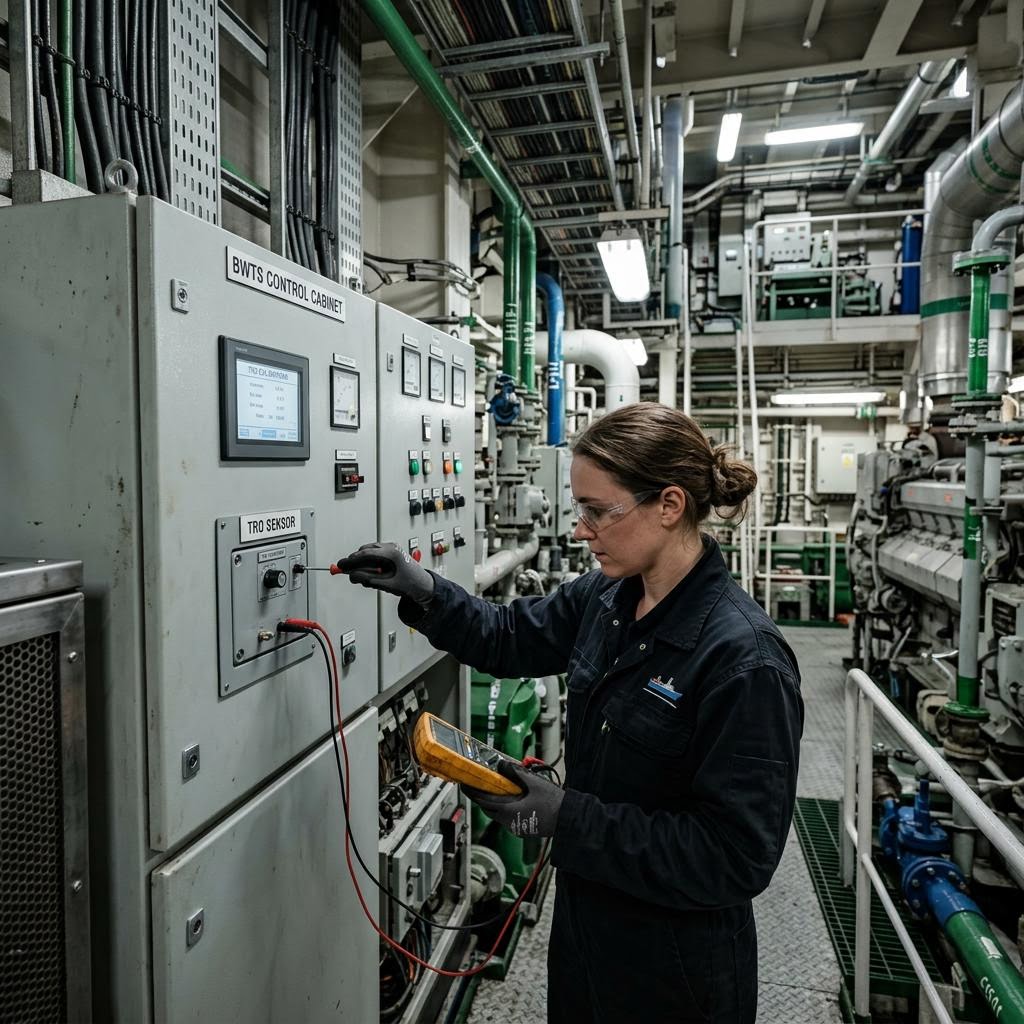
TRO — Total Residual Oxidant — is the measure of oxidising agents such as chlorine present in ballast water treated by an oxidant system. It indicates whether treatment is dosing correctly at uptake and, at discharge, whether residual has been neutralised. IMO sets a discharge limit of less than 0.1 mg/L as Cl2, mirrored by the EPA VGP's 24-hour ceiling, and the vessel must not discharge with TRO sensors inoperable.
These numbers are the yardstick for both operation and inspection. A system that cannot reach target TRO at uptake will not achieve D-2; one that discharges above 0.1 mg/L is non-compliant even if disinfection worked. Knowing the figures lets a crew judge in real time whether a tank is safe to discharge and gives the superintendent defensible record-book entries.
Calibration and Function Checks: How Often
For vessels trading to US waters, the EPA VGP expects annual system checks of all components with alarm-log review and software update, annual function tests of all functions, and annual calibration of sensors for UV, flow, temperature and pressure. The EPA further expects several instrument types — turbidity sensors, TRO sensors and pH probes among them — to require calibration on a shorter cycle than yearly, and the ship must not discharge while those sensors are inoperable.
Under IMO guidance (MEPC.279(70)) the pattern is annual system checks, annual function tests, annual calibration of pressure sensors and temperature switches/transmitters, and bi-annual calibration of flow meters and UV sensors. There is currently no requirement for annual D-2 biological testing after commissioning, though that could change; commissioning sampling remains mandatory at installation.
In practice, aligning an annual BWTS service with these calibration intervals — sensor calibration, function test, alarm review and software check in one attendance — keeps the paperwork coherent and the system inside its envelope. TRO reagent replacement (roughly every 90 days once opened) sits on a shorter cycle managed by the crew between visits.
Commissioning and VGP Sampling Explained
Commissioning testing under the IMO BWMS Code (MEPC.325(75)) confirms at installation that the BWTS works to its design specification across its mechanical, physical, chemical and biological functions. It is compulsory, and the maker may not act as the testing party. The check relies on indicative analysis to validate that the system is functioning — it is process validation at start-up, not a definitive biological compliance test against the D-2 numeric limits.
VGP compliance sampling is the ongoing check for vessels trading to US waters. Sampling is generally required two to four times during the first year after installation; if results stay below permit limits for two consecutive events, monitoring may reduce to once a year, and if the vessel exceeds limits it returns to twice-yearly. Residual biocide sampling is required bi-annually for oxidant systems, and annual crew training is expected.
VGP analytical monitoring does not have to use an EPA-approved laboratory, but it must use an EPA-approved method with correct chain-of-custody records, holding times and conditions, or the result is not defensible. Sea Clean follows these practices and coordinates the analysis with accredited laboratories so a sample survives scrutiny.
Arranging Service, Parts and Sampling
Sea Clean attends vessels for BWTS service, TRO and system calibration, troubleshooting, commissioning support and sampling coordination across the North Sea within 0–24 hours, and worldwide by arrangement as flights, visas and port access allow. Non-European ports are attended by arrangement rather than from a local office. The contact point for all requests is post@seaclean.no.
The company also supplies genuine Headway and multi-brand spare parts and ballast water reagents — TRO reagent kits and sodium thiosulfate neutraliser — delivered to the vessel with the engineer or as a separate consignment. Accurate make, model and nameplate detail with the request ensures the correct parts arrive at the right berth.
The most efficient calls combine service, calibration, parts delivery and any required sampling into one attendance. Provide the vessel name and IMO number, BWTS make and model, the fault or planned scope, the port and ETA, and the agent's details, and Sea Clean will pre-stage everything and brief the engineer before boarding.
Frequently asked questions
Who is allowed to service my ballast water treatment system?
The manufacturer, an authorized agent, or an experienced independent service provider. Sea Clean is an authorized Headway Technology agent for OceanGuard and an independent, non-manufacturer-authorized service provider for other brands. Note that since 1 June 2022 the maker is not permitted to arrange the commissioning sample as the testing party.
How often must a BWTS be calibrated?
The EPA VGP expects annual calibration of UV, flow, temperature and pressure sensors, with TRO and pH probes often needing more frequent attention. IMO guidance (MEPC.279(70)) calls for annual calibration of pressure sensors and temperature devices and bi-annual calibration of flow meters and UV sensors. Ships must not discharge while sensors are inoperable.
Is annual biological D-2 testing required after commissioning?
Under current IMO rules there is no requirement for annual D-2 biological testing after commissioning, though it could be introduced in future. Commissioning sampling at installation is compulsory. Vessels trading to US waters follow the separate VGP sampling schedule, typically two to four times in the first year, then annually if results stay within limits.
Does VGP sampling have to be done by an accredited laboratory?
The VGP does not require an EPA-approved laboratory, but analysis must use an EPA-approved method with correct chain-of-custody records and holding times. Sea Clean is not an accredited lab; it coordinates sampling with accredited ISO 17025 laboratories and follows EPA best practice so results are defensible.
Sources
- EPA Vessel General Permit (VGP 2013) — Calibration, sampling and monitoring requirements for US waters
- IMO BWMS Code (MEPC.325(75)) — Commissioning testing requirement for installed systems
Related articles
- BWTS Service Programs: A Practical Overview for Fleets
- BWTS Annual Calibration Service for Sensors and Analysers
- BWMS Commissioning Testing and Sampling Coordination
- TRO in Ballast Water Treatment: Common Questions Answered
- BWTS Service and Engineer Attendance at Istanbul and Tuzla
- Headway OceanGuard BWTS Service and Support