BWTS Power Requirements and Electrical Integration
Updated
A BWTS adds significant electrical load during ballasting — electrochlorination draws a large DC load through its rectifier, and UV load scales with lamp count and flow. Electrical integration must confirm the switchboard and generators can carry the peak load with the ballast pumps running, size cabling and protection correctly, and tie the system into the ballast control for coordinated operation. Undersized generation is a common reason a technically suitable system underperforms.
Request BWTS spare parts, annual calibration or ballast-water testing
Key takeaways
- BWTS load adds on top of ballast-pump and existing loads; the critical check is the combined peak during ballasting.
- UV load scales with lamp count and flow; electrochlorination draws a large DC load through its rectifier that varies with conductivity.
- A load study for the ballasting condition is part of the class-approved electrical documentation and prevents generator overload at commissioning.
- Control integration reads the ballast flowmeter to modulate dose and enforces interlocks that inhibit non-compliant ballasting or discharge.
- Electrochlorination generates hydrogen that must be vented and diluted with interlocked degassing; a degassing alarm must never be bypassed.
- Undersized generation, undersized DC cabling, and poor earthing are common electrical pitfalls traced back to engineering shortcuts.
How Much Power Does a BWTS Draw?
Power demand depends on technology and flow. UV systems draw load in proportion to lamp count, and lamp count scales with the treatment-rated flow, so a large-flow UV system can present a substantial continuous load throughout ballasting. Medium-pressure lamps draw more per lamp than low-pressure amalgam lamps.
Electrochlorination systems draw a large DC load through a rectifier to drive the electrolysis, and that current scales with rated capacity and with water conductivity. At very large flows EC is often more power-efficient per cubic metre than UV, but its instantaneous draw during ballasting is still significant.
The exact figures come from the type approval certificate and the manufacturer's electrical data sheet for the specific model and flow rate. Sizing must use those numbers, not rules of thumb.
Can the Ship's Generators Carry the Load?
The critical check is the peak load during ballasting with the ballast pumps already running. The BWTS load adds on top of the pump load and the existing engine-room and hotel loads, and it is this combined peak that the generators must carry with margin.
On smaller ships with limited generator capacity, the added BWTS load can exceed available headroom, requiring an additional generator to run during ballasting or, in some cases, generator upgrades. This is a design decision made during engineering, not discovered at commissioning.
A load study for the ballasting condition is part of the class-approved electrical documentation. It confirms the generators, and the emergency source where relevant, can supply the system without overload or unacceptable voltage dip.
How Is the System Wired In?
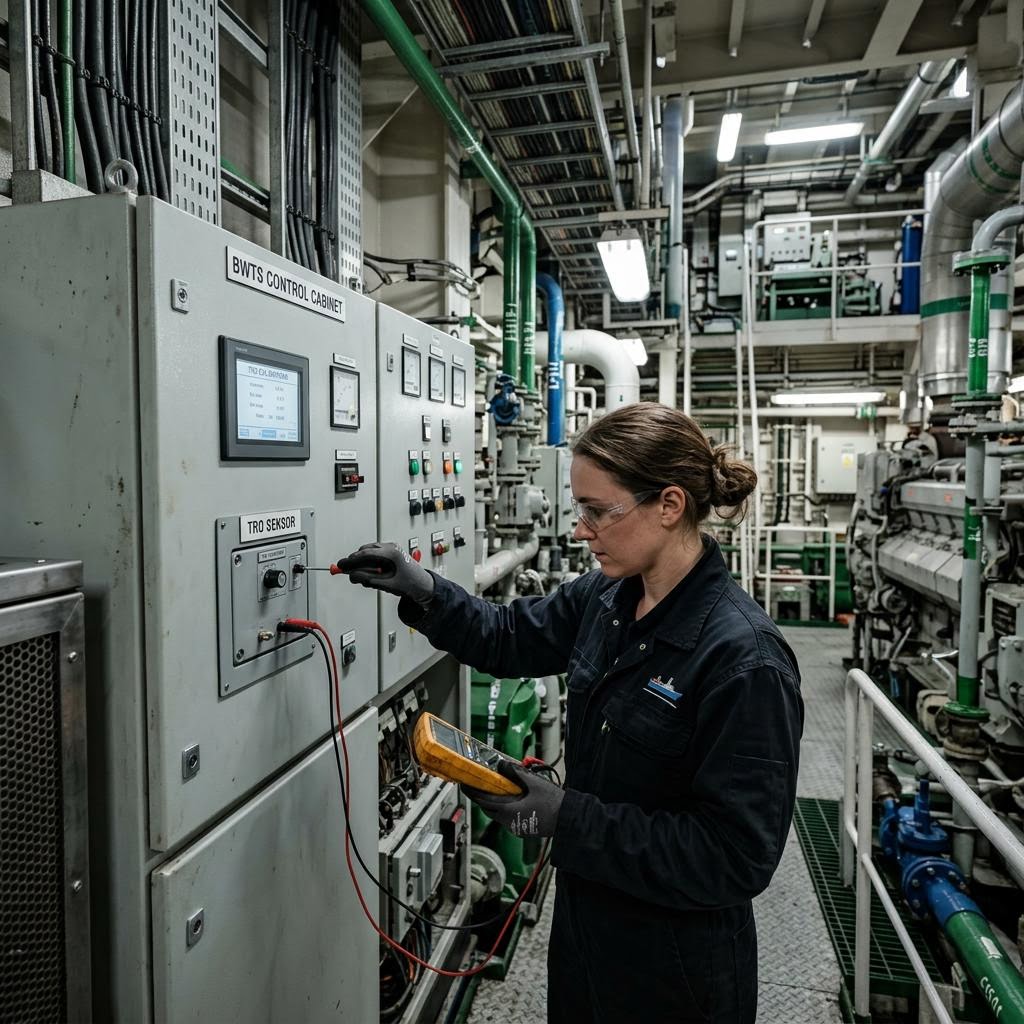
The BWTS is supplied from the main switchboard through a dedicated feeder sized for the peak load, with protection coordinated to the switchboard. Electrochlorination rectifiers and large UV power supplies present specific harmonic and inrush characteristics that the electrical design must account for.
Cabling is sized for the current and the run length, and routed clear of hazardous areas or through certified equipment where the route crosses them. On tankers, all equipment in hazardous zones must carry the correct explosion-protection certification.
Earthing, bonding, and — for EC systems — the DC feed to the electrolyser cell are detailed in the approved drawings. Poor earthing or undersized DC cabling shows up as nuisance trips and voltage problems in service.
How Does Control Integration Work?
The BWTS control system ties into the ballast control so that pumps, valves, and treatment start, run, and stop as one coordinated sequence. The system must know flow rate to control dose or UV intensity, so it reads the ballast flowmeter and modulates accordingly.
Interlocks prevent unsafe or non-compliant operation: the system should inhibit ballasting if it cannot reach dose or TRO target, and prevent discharge if residual oxidant is above the limit. These interlocks are verified during commissioning and are central to compliant operation.
The control panel logs each operation with time, volume, flow, and treatment parameters, feeding the ballast water record book and self-monitoring records used for port state control.
What About Hydrogen and Safety on EC Systems?
Electrolysis generates hydrogen as a by-product. The system design must safely vent and dilute this gas below its flammable limit, with degassing arrangements and ventilation that are interlocked so the system will not run if degassing fails.
A degassing or ventilation alarm on an EC system is a safety item that must be resolved, never bypassed. This is a frequent point of scrutiny at survey and in the safety management review.
UV systems avoid hydrogen but present their own safety points: lamp handling, UV exposure protection during maintenance, and quartz-sleeve integrity. Both technologies require the crew to be trained on their specific hazards.
What Are the Common Electrical Pitfalls?
The most common pitfall is undersized generation discovered too late — a system that overloads the generators during ballasting is effectively unusable at full flow. A proper load study in engineering prevents this.
Other recurring problems are undersized DC cabling to EC electrolysers causing voltage drop, poor earthing causing nuisance trips, and control integration that does not correctly read flow, so dose control drifts. Each traces back to engineering shortcuts.
Sea Clean AS supports installation and commissioning including verification of electrical integration and control interlocks, attending 0–24h in Norway and the North Sea region and by arrangement elsewhere. Contact post@seaclean.no with the installed model and electrical particulars.
Frequently asked questions
Will a BWTS overload my ship's generators?
It can, if generation is not sized for the peak load during ballasting with the pumps running. A load study during engineering confirms whether the existing generators have headroom or whether an extra generator must run during ballasting.
Which uses more power, UV or electrochlorination?
UV load scales with lamp count and flow and can be heavy on small ships; electrochlorination is often more power-efficient per cubic metre at very large flows but still draws a large DC load. Use the model's electrical data sheet, not rules of thumb.
Does the BWTS need to know the ballast flow rate?
Yes. The control system reads the ballast flowmeter to modulate UV intensity or oxidant dose so treatment matches the actual flow. Incorrect flow signals cause dose control to drift and can lead to under- or over-treatment.
How is hydrogen from electrochlorination handled?
The design safely vents and dilutes hydrogen below its flammable limit using degassing arrangements interlocked with the system, so it will not run if degassing fails. A degassing or ventilation alarm is a safety item that must be resolved, never bypassed.
Sources
Related articles
Request spares, calibration or ballast-water testing
Include BWMS brand/model, vessel/IMO number, port/terminal, date/ETA and scope or part numbers. These links prepare an email draft; you must send it yourself.
- Request a parts quote — Sensors, TRO reagents, calibration kits and replacement parts. Confirm compatibility, availability and delivery for your installed system.
- Request a calibration booking — Annual instrument calibration with a calibration certificate for the work completed. OEM instructions, drift or applicable rules may require earlier work.
- Request testing coordination — Arrange sampling and testing with an appropriately qualified party for your IMO D-2, commissioning or other stated purpose.
Authorised Headway agent. Other-brand enquiries are independently reviewed; no OEM authorisation is claimed. Sea Clean is not an accredited laboratory or approving authority. Calibration does not demonstrate biological D-2 compliance. Attendance, testing scope and parts delivery are confirmed per enquiry.