BWTS Commissioning Checklist for Crews
Updated
A BWTS commissioning checklist runs from mechanical verification (filter backflush, valve line-up, pressure test) through functional checks (dose or TRO target at rated flow, neutralisation, alarms, and interlocks) to documentation (type approval certificate, ballast water management plan, calibration records, and the MEPC.325(75) commissioning test report). Working the dry checks before biological sampling is how crews avoid a commissioning test failing on something mechanical.
Request BWTS spare parts, annual calibration or ballast-water testing
Key takeaways
- Complete and prove the mechanical and electrical installation before commissioning; the dry checks come before biological sampling.
- Verify the filter backflushes cleanly, the valve line-up matches the drawings, and the bypass cannot be operated by accident.
- Run at rated flow on real ballast water and confirm UV intensity or TRO target, and that EC neutralisation drops discharge TRO below about 0.1 mg/L.
- Test every alarm and interlock deliberately; non-functional interlocks give false confidence and are worse than none.
- Calibrate the TRO and UV-intensity sensors against a standard, log reagent lot and expiry, and set the calibration schedule.
- The MEPC.325(75) commissioning test is one-time indicative testing, not a full D-2 validation, and the crew should understand the difference.
What Comes Before Commissioning?
Before any commissioning test, the mechanical and electrical installation must be complete and proven: new piping hydrostatically tested, cabling meggered and terminated, and the system energised. Commissioning verifies function, so it assumes a sound installation.
The crew and attending engineer confirm the valve line-up matches the drawings, that the ballast pumps and BWTS are correctly interlocked, and that the correct consumables — TRO reagents, calibration standards, neutralising chemical — are on board and in date.
Skipping these checks and going straight to biological sampling is the most common way a commissioning test fails on something mechanical. The dry checks come first.
Mechanical Checklist
Confirm the filter backflushes cleanly: trigger a backflush and verify the valve operates, the differential-pressure transmitter reads sensibly, and the backflush discharge line is clear. A silted dP sensing line or a backflush valve that has lost its seat shows up here.
Check the valve line-up for both ballasting and deballasting paths, and confirm the bypass valves are shut and cannot be operated by accident. Verify pipe supports, penetrations, and that there are no leaks under pressure.
For UV systems, confirm quartz sleeves are clean and lamps strike; for EC systems, confirm the electrolyser and degassing arrangements are correct and the neutralisation dosing skid is primed.
Functional and Dose Checklist
Run the system at rated flow on real ballast water and confirm it reaches its target: UV intensity above the minimum required for dose, or TRO within the target band for EC. Confirm the control system reads flow correctly and modulates treatment accordingly.
On EC systems, verify the neutralisation loop drops discharge TRO below the discharge limit of around 0.1 mg/L. Confirm the thiosulfate dosing pump strokes and the stock is adequate for the ship's discharge pattern.
Trend the key readings during the run rather than taking single snapshots: cell voltage and rectifier current on EC, lamp intensity on UV, and TRO on both. A single good reading does not prove stable operation.
Alarms and Interlocks Checklist
Every alarm and interlock must do what the drawing says. Verify the low-dose or low-TRO alarm inhibits ballasting, that a high discharge-TRO condition inhibits or neutralises discharge, and that a filter high-dP alarm and degassing alarm (EC) function.
Test the interlocks deliberately, simulating each fault condition where safe to do so, and confirm the system responds as designed. Interlocks that are present but non-functional are worse than none because they give false confidence.
Record which alarms were tested and the response, so the commissioning report shows the safety and compliance functions were proven, not assumed.
Calibration and Sensor Checklist
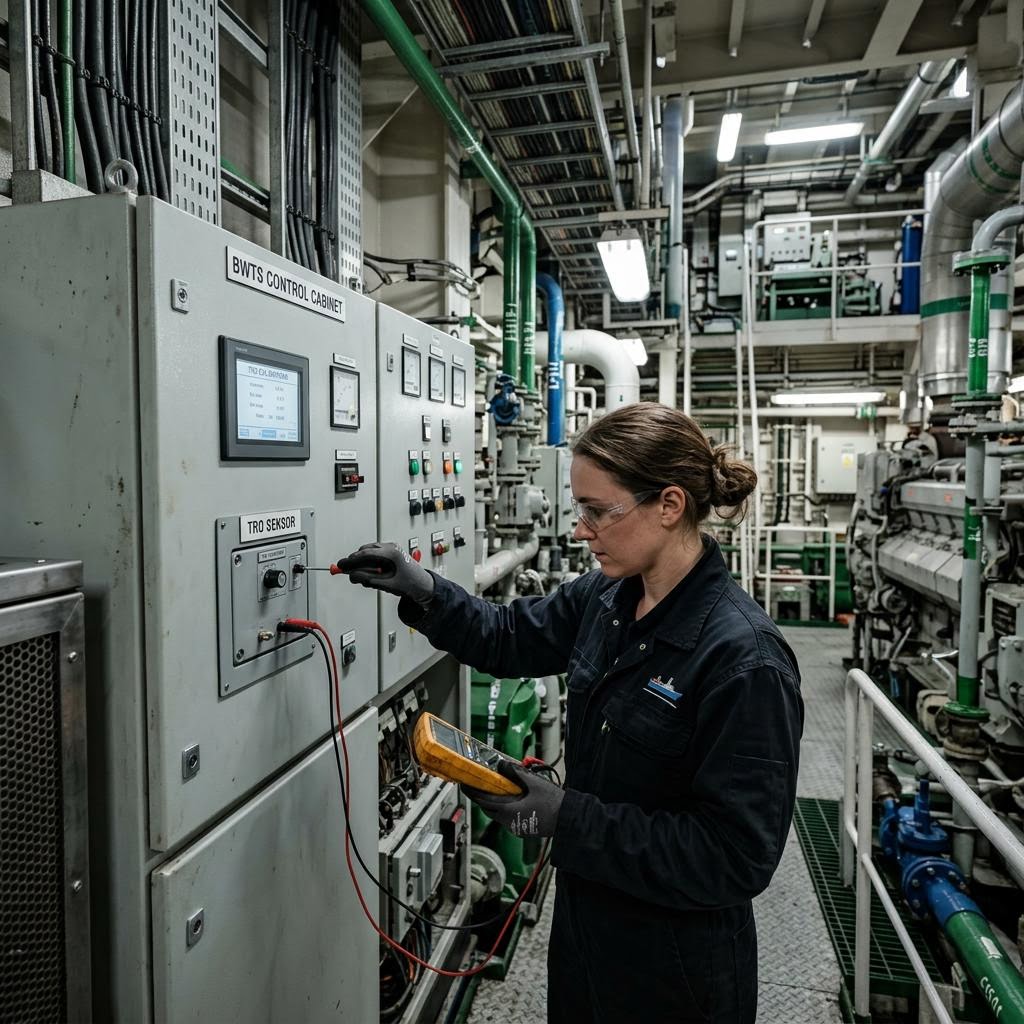
Confirm the TRO analyser is calibrated against a known standard, not merely verified, and that the calibration certificate is on board. Check the reagent lot and expiry are logged, because expired reagent is the most common cause of a self-monitoring record that later disagrees with a port state control sample.
For UV systems, confirm the UV-intensity sensor is calibrated and the reference is recorded. Check the flowmeter reads correctly against a known reference, since flow feeds dose control.
Establish the calibration schedule at commissioning so the crew knows when each sensor is next due. Calibration against a standard is distinct from routine verification, and both belong in the maintenance routine.
Documentation and Handover Checklist
Confirm the ship holds the type approval certificate matching the installed model and rated capacity, the ballast water management plan, and the commissioning test report for class and port state control. The record book should be started and the first entries made.
The MEPC.325(75) commissioning test — a one-time verification including indicative biological sampling — confirms the installed system operates according to specification. It is indicative testing, not a full validation that the ship meets D-2 in all conditions, and the crew should understand that distinction.
Crew training on operation, alarms, and the ballast water management plan completes handover. Sea Clean AS provides commissioning support, sampling coordination with independent ISO 17025 laboratories (Sea Clean is not itself an accredited lab), and crew training, attending 0–24h in Norway and the North Sea region and by arrangement elsewhere. Contact post@seaclean.no.
Frequently asked questions
What is checked during BWTS commissioning?
Mechanical function (filter backflush, valve line-up, pressure test), dose or TRO target at rated flow, neutralisation on EC systems, every alarm and interlock, sensor calibration, and documentation including the type approval certificate and management plan. The MEPC.325(75) test adds indicative biological sampling.
Why do commissioning tests fail?
Most often on something mechanical — a backflush valve, a silted dP sensor, an unprimed dosing pump — because crews jumped to biological sampling before completing the dry checks. Working the mechanical and functional checklist first prevents this.
Is commissioning testing the same as D-2 compliance?
No. The MEPC.325(75) commissioning test is a one-time verification with indicative biological sampling that confirms the installed system operates according to specification. It is indicative testing, not a full validation that the ship meets the D-2 numeric limits in all conditions.
What documentation must be on board after commissioning?
The type approval certificate matching the installed model, the ballast water management plan, the commissioning test report, sensor calibration records, and a started ballast water record book. These support class and port state control inspections.
Sources
Related articles
Request spares, calibration or ballast-water testing
Include BWMS brand/model, vessel/IMO number, port/terminal, date/ETA and scope or part numbers. These links prepare an email draft; you must send it yourself.
- Request a parts quote — Sensors, TRO reagents, calibration kits and replacement parts. Confirm compatibility, availability and delivery for your installed system.
- Request a calibration booking — Annual instrument calibration with a calibration certificate for the work completed. OEM instructions, drift or applicable rules may require earlier work.
- Request testing coordination — Arrange sampling and testing with an appropriately qualified party for your IMO D-2, commissioning or other stated purpose.
Authorised Headway agent. Other-brand enquiries are independently reviewed; no OEM authorisation is claimed. Sea Clean is not an accredited laboratory or approving authority. Calibration does not demonstrate biological D-2 compliance. Attendance, testing scope and parts delivery are confirmed per enquiry.