How Long Does BWTS Installation Take?
Updated
A BWTS installation typically needs 3–6 months of lead time — survey, engineering, class approval, and procurement — followed by 1–3 weeks of physical installation and commissioning. The physical downtime can be as little as a few days when work is prefabricated ashore and done by a riding crew, or longer when combined with a drydock. Long-lead equipment procurement is usually the critical path, not the fitting itself.
Request BWTS spare parts, annual calibration or ballast-water testing
Key takeaways
- A typical BWTS retrofit needs 3–6 months of planning and procurement, then 1–3 weeks of physical installation and commissioning.
- Long-lead equipment procurement is usually the critical path, not the physical fitting.
- Prefabricating pipe spools and foundations ashore from the 3D model can cut on-board downtime to a few days.
- New builds have no separate downtime because the system is designed in and installed during construction.
- Riding-crew installation lets the ship stay in service but only suits scopes where the piping, structure, and power allow work at sea.
- A thorough 3D scan and complete engineering package before the yard period is the best defence against costly on-site rework.
What Is the Total Project Timeline?
From decision to a fully commissioned system, a typical retrofit runs 4–8 months. The bulk of that is planning and procurement rather than physical work. The physical installation and commissioning is usually 1–3 weeks, and the actual out-of-service downtime can be compressed to days when the work is prefabricated ashore.
New builds are different: the BWTS is designed into the ship from the outset and installed during construction, so there is no separate downtime — the system is part of the delivery schedule.
The honest answer is that timelines vary widely by system type, yard availability, and how congested the engine room is. Any single figure is indicative; a firm schedule comes only after the survey and system selection.
Why Does Planning Take Months?
The planning phase includes the on-board survey and 3D scan, system selection and sizing, detailed engineering, and class approval of drawings. Class review of piping, electrical, structural, and hazardous-area documentation can itself take several weeks and cannot be rushed.
Procurement of the main equipment — reactor or electrolyser, filter, power supply, and control cabinet — carries lead times from a few weeks to a few months depending on the manufacturer's order book. This is frequently the single longest item and defines the earliest possible installation date.
Because these activities overlap, experienced project managers run engineering, class approval, and procurement in parallel rather than in sequence. Sequencing them one after another can double the planning time.
How Long Is the Physical Installation?
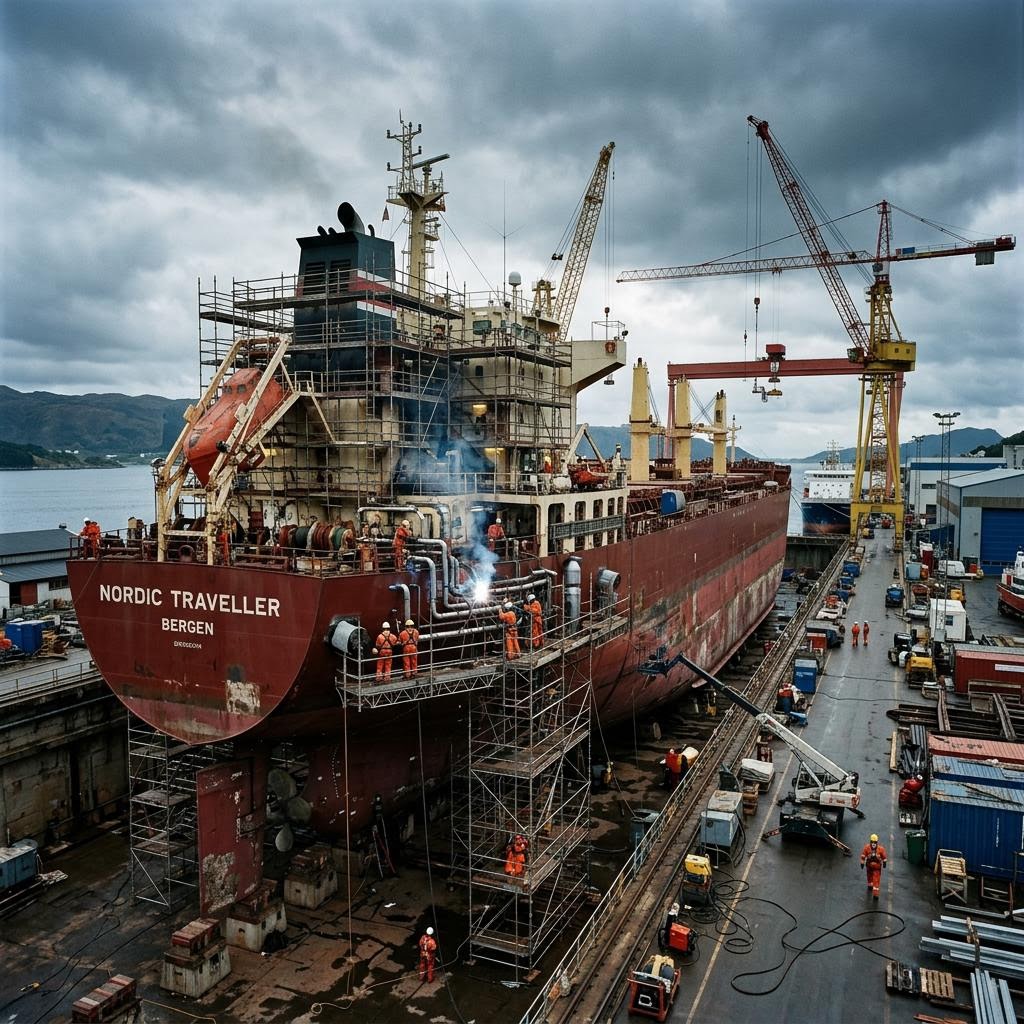
The physical work — foundations, pipe spool welding, cabling, equipment mounting, and integration — typically takes 1–3 weeks. The range depends on system size, how much can be prefabricated ashore, and how congested the space is.
Prefabrication is the biggest lever on downtime. When pipe spools and foundations are built ashore from the 3D model and approved drawings while the ship trades, on-board time drops sharply because the yard is only cutting in and connecting pre-made assemblies.
Hydrostatic testing of new piping and functional testing of valves and interlocks add a day or two before commissioning can start.
Drydock vs Riding Crew vs Repair Berth
A drydock installation suits ships that need the BWTS work done alongside hull, propeller, or tank work. It concentrates all steel and underwater work into one docking, but drydock slots are expensive and must be booked well ahead.
A repair berth or afloat installation is common when no underwater work is needed; the ship lies alongside for the fitting period. A riding-crew installation goes further, with the installation team sailing with the ship and completing the work between and during voyages so the ship never leaves service.
Riding-crew installation minimises commercial downtime but requires that the ballast piping, structure, and power allow work while trading, and that the crew and installers can work safely at sea. Not every scope suits it.
What Extends the Timeline?
Long equipment lead times are the most common delay. Ordering the main system late, after class approval rather than in parallel, pushes the whole schedule back by the procurement period.
Discovering unmodelled clashes during fitting causes on-site redesign and rework, which is why a thorough 3D scan pays for itself. Congested engine rooms, asbestos or coatings requiring special handling, and incomplete as-built drawings all add time.
Class comments requiring drawing revisions, and any hazardous-area certification issues on tankers, can also extend the schedule. Building float into the plan for these is prudent.
How Do You Shorten the Timeline?
Start early and run activities in parallel. Order long-lead equipment as soon as the system is selected, run class approval alongside procurement, and prefabricate ashore from the 3D model.
A high-quality 3D scan and complete engineering package before the yard period is the single most effective way to avoid on-site surprises and rework. It converts unpredictable field work into predictable assembly.
Sea Clean AS supports installation and commissioning and can attend on short notice in Norway and the North Sea region on a 0–24h basis, and by arrangement elsewhere. Contact post@seaclean.no with the vessel particulars, installed or intended model, and schedule to scope the work.
Frequently asked questions
Can a BWTS be installed in a week?
The physical fitting can sometimes be done in under a week when spools and foundations are prefabricated ashore and the engine room is not too congested. However, the whole project still needs several months of prior planning and procurement.
What takes the longest in a BWTS project?
Procurement of the main equipment is usually the longest single item, with lead times from a few weeks to a few months. Class approval of drawings also takes several weeks and should run in parallel with procurement.
Does installation require the ship to stop trading?
Not necessarily. Riding-crew and afloat installations let the ship keep trading, and prefabrication ashore keeps out-of-service time short. Drydock is chosen when the work coincides with hull or tank work.
How far ahead should I start planning?
Begin the survey and system selection at least 4–8 months before the intended installation window so engineering, class approval, and equipment procurement can all be completed in time.
Sources
Related articles
Request spares, calibration or ballast-water testing
Include BWMS brand/model, vessel/IMO number, port/terminal, date/ETA and scope or part numbers. These links prepare an email draft; you must send it yourself.
- Request a parts quote — Sensors, TRO reagents, calibration kits and replacement parts. Confirm compatibility, availability and delivery for your installed system.
- Request a calibration booking — Annual instrument calibration with a calibration certificate for the work completed. OEM instructions, drift or applicable rules may require earlier work.
- Request testing coordination — Arrange sampling and testing with an appropriately qualified party for your IMO D-2, commissioning or other stated purpose.
Authorised Headway agent. Other-brand enquiries are independently reviewed; no OEM authorisation is claimed. Sea Clean is not an accredited laboratory or approving authority. Calibration does not demonstrate biological D-2 compliance. Attendance, testing scope and parts delivery are confirmed per enquiry.