BWTS Piping Design and Pressure Drop Considerations
Updated
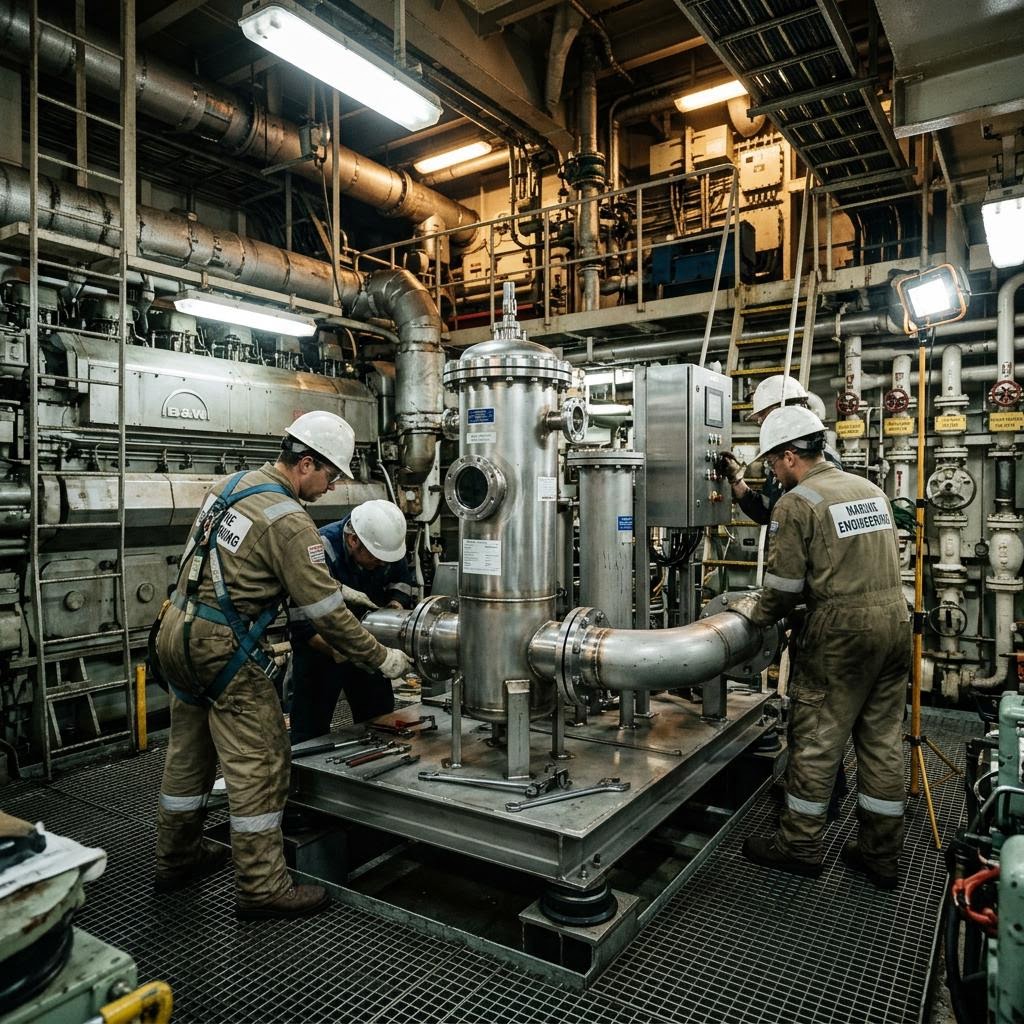
BWTS piping must pass the full rated ballast flow without dropping pressure so far that ballasting times lengthen or the pumps cavitate. The filter and reactor add pressure loss that must be within the ballast pumps' available head, so piping is sized to keep velocity reasonable, penetrations and bends minimised, and a compliant bypass provided for emergencies. Undersizing the system or its piping to save space is a common and costly mistake.
Request BWTS spare parts, annual calibration or ballast-water testing
Key takeaways
- BWTS piping must pass the full rated ballast flow within the pumps' available head; excess pressure drop lengthens ballasting or causes cavitation.
- The filter is the largest source of pressure drop, and its drop rises as it loads, so the design must cover the loaded-filter condition.
- Pipe diameter is sized to keep velocity to a few metres per second because pressure drop rises with the square of velocity.
- The BWTS sits on the main line close to the pumps, filter first then disinfection, treating all ballast on uptake.
- A bypass is provided for emergency ballasting only, recorded as a non-compliant event under the ballast water management plan.
- Undersizing the system or piping to save space permanently derates ballasting flow and is a common, costly mistake.
Why Does Pressure Drop Matter?
Ballast pumps have a finite head. The BWTS filter, reactor or electrolyser, valves, and added pipe length all consume some of that head as pressure drop. If the total drop is too high, the achievable flow falls, ballasting and deballasting take longer, and in the worst case the pumps cavitate or fail to prime.
Longer ballasting times have real commercial cost in port, and a system that cannot pass the ship's rated flow effectively derates the ballast operation. The piping design exists to keep the pressure drop within the pumps' available margin at the rated flow.
The filter is the largest single source of pressure drop, and its drop rises as it loads with sediment before backflush. The design must accommodate the loaded-filter condition, not just a clean filter.
How Is the Piping Sized?
Pipe diameter is chosen to keep flow velocity in a sensible range — typically a few metres per second — because pressure drop rises with the square of velocity. Oversized pipe wastes space and cost; undersized pipe throttles the flow and can erode at high velocity.
The route is kept as short and straight as the engine room allows, because every bend, tee, and valve adds loss. On a congested retrofit the 3D model is used to plan the shortest compliant route and to size the spools before fabrication.
The BWTS is normally placed close to the ballast pumps on the main line so the whole flow is treated on uptake with minimal added length. Placement is a compromise between hydraulic efficiency and available space.
Where Does the BWTS Sit in the Line?
The system is plumbed into the main ballast line, generally between the pumps and the tank distribution, so all ballast passes through treatment on the way in. The filter comes first, then the disinfection stage, so the reactor or electrolyser sees filtered water.
On UV systems the reactor is commonly arranged so water can be treated on both ballasting and deballasting; on EC systems the neutralisation injection point is on the discharge side. The valve arrangement must support these flow paths without operator error.
Integration with existing ballast valves and the stripping/eductor system must be worked out so that all normal and emergency ballast operations remain possible after the retrofit.
What About Bypass and Emergency Ballasting?
A bypass around the BWTS is normally provided so the ship can still ballast in an emergency if the system fails. Using the bypass is a contingency measure under the ballast water management plan, not a routine operation, and it must be recorded and reported to authorities as a non-compliant ballasting event.
The bypass and its valves must be designed so that treated and untreated paths cannot be confused, and so that bypassing is a deliberate, logged action. Class reviews the arrangement to ensure it does not become a routine compliance workaround.
Contingency ballasting through the bypass triggers specific record-keeping and, on the next opportunity, treatment or exchange to restore compliance. The piping design must make the compliant path the default and the bypass the exception.
What Materials and Fittings Are Used?
Ballast piping is typically steel, often with internal coating or of higher-grade material where corrosion is a concern, especially on lines carrying oxidant on EC systems. The wetted materials of the BWTS, seals, and gaskets must be compatible with seawater and, on EC systems, with the oxidant.
Seals, O-rings, and gaskets must be the correct material grade for the service; a leaking joint on a chlorinated line is both a compliance and a corrosion problem. These are carried as spares in the correct grade.
Penetrations through decks and bulkheads must be class-approved and, where they cross fire or watertight boundaries, must maintain the boundary's integrity. This is part of the structural review of the installation.
What Are the Common Piping Pitfalls?
Undersizing the system or its piping to fit a tight space is the classic mistake: it saves space at commissioning but permanently derates ballasting flow and lengthens every port call. Sizing to the ship's real rated flow is non-negotiable.
Failing to account for the loaded-filter pressure drop, ignoring the added loss of a long congested route, and neglecting the bypass arrangement are other recurring errors. Each is avoidable with a proper hydraulic calculation and 3D-model routing.
Sea Clean AS supports retrofit engineering, including 3D scanning and piping integration, and installation and commissioning, attending 0–24h in Norway and the North Sea region and by arrangement elsewhere. Contact post@seaclean.no with the ballast system particulars and intended model.
Frequently asked questions
How much pressure drop does a BWTS add?
It varies with system type, flow, and filter loading, but the design target is to keep total added drop within the ballast pumps' available head at rated flow. The filter is the largest single contributor and its drop rises as it loads before backflush.
Can I use a smaller BWTS than my ballast pump flow?
Not without consequences. Undersizing the system to save space throttles the ballasting flow, lengthens every port call, and can strain the pumps. The system should be sized to the ship's real rated ballast flow.
Is a bypass around the BWTS allowed?
Yes, as an emergency contingency. Ballasting through the bypass is a non-compliant event that must be recorded under the ballast water management plan and reported, with treatment or exchange to restore compliance at the next opportunity. It is not a routine path.
Where should the BWTS be installed in the ballast line?
On the main ballast line close to the pumps, with the filter first and the disinfection stage after it, so all ballast is treated on uptake with minimal added pipe length and pressure drop.
Sources
Related articles
Request spares, calibration or ballast-water testing
Include BWMS brand/model, vessel/IMO number, port/terminal, date/ETA and scope or part numbers. These links prepare an email draft; you must send it yourself.
- Request a parts quote — Sensors, TRO reagents, calibration kits and replacement parts. Confirm compatibility, availability and delivery for your installed system.
- Request a calibration booking — Annual instrument calibration with a calibration certificate for the work completed. OEM instructions, drift or applicable rules may require earlier work.
- Request testing coordination — Arrange sampling and testing with an appropriately qualified party for your IMO D-2, commissioning or other stated purpose.
Authorised Headway agent. Other-brand enquiries are independently reviewed; no OEM authorisation is claimed. Sea Clean is not an accredited laboratory or approving authority. Calibration does not demonstrate biological D-2 compliance. Attendance, testing scope and parts delivery are confirmed per enquiry.