Does 'Not Detected' Mean a Ballast Sample Contains Zero Organisms?
Updated
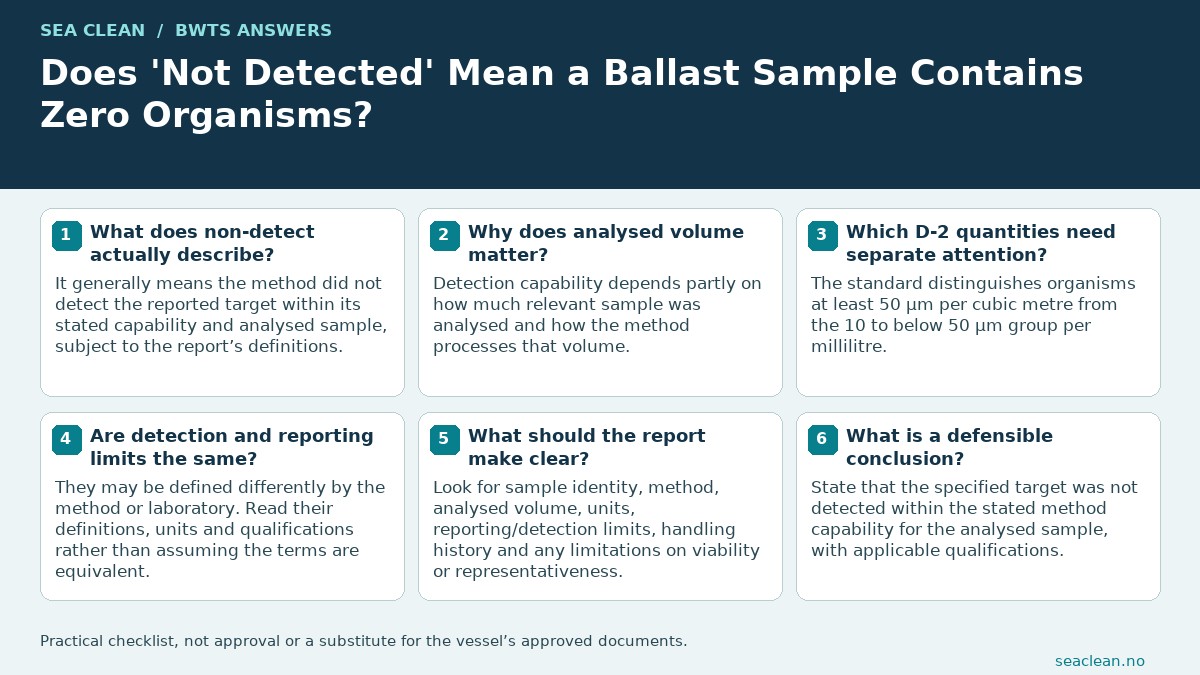
Not detected is a statement about a method and the portion analysed, not proof that an entire tank or discharge contains no organisms. Read the reporting limit and scope before drawing a compliance conclusion.
Request BWTS spare parts, annual calibration or ballast-water testing
Key takeaways
- Non-detect is not absolute zero.
- Identify the target and method.
- Check analysed volume and units.
- Separate D-2 organism groups.
- Read detection and reporting limits.
- Keep conclusions within the tested scope.
What does non-detect actually describe?
It generally means the method did not detect the reported target within its stated capability and analysed sample, subject to the report’s definitions.
Check whether the target is an organism size class, viable organisms, indicator microbes or a chemical constituent. These are not interchangeable results.
Why does analysed volume matter?
Detection capability depends partly on how much relevant sample was analysed and how the method processes that volume.
A concentration inferred from a small analysed portion has different limitations from a suitable larger-volume method. Ask the testing party to explain its reporting basis.
Related guidance: BWTS Sampling Plan for Troubleshooting a Disputed Result
Which D-2 quantities need separate attention?
The standard distinguishes organisms at least 50 µm per cubic metre from the 10 to below 50 µm group per millilitre.
Specified indicator microbes have separate limits and units. A non-detect result for one group cannot stand in for all required groups.
Are detection and reporting limits the same?
They may be defined differently by the method or laboratory. Read their definitions, units and qualifications rather than assuming the terms are equivalent.
Do not invent a universal rule for converting a less-than result into a pass. Apply the relevant method and authority’s interpretation.
What should the report make clear?
Look for sample identity, method, analysed volume, units, reporting/detection limits, handling history and any limitations on viability or representativeness.
If a required detail is absent, request clarification before presenting the result as complete discharge evidence.
Related guidance: Why Can Two Ballast-Water Test Results Disagree?
What is a defensible conclusion?
State that the specified target was not detected within the stated method capability for the analysed sample, with applicable qualifications.
Do not rephrase that as 'zero organisms in the vessel' or universal D-2 certification. Compliance interpretation remains tied to the required scope.
Frequently asked questions
Can non-detect be written as zero?
Not without the method’s justified reporting convention; preserve the actual reported result and limitations.
Does one organism group cover all D-2 criteria?
No. Size groups and indicator microbes have separate requirements.
Does a larger sample automatically guarantee validity?
No. Representativeness, handling and the analytical method also matter.
Who should explain an unclear reporting limit?
The responsible laboratory/testing party, with authority interpretation where needed.
Sources
- IMO — BWMS Code, MEPC.300(72) — Approval framework, monitoring, system design limitations and biological performance; not a universal maker procedure.
- IMO — BWM Convention and implementation guidelines
- IMO — G2 sampling guidelines, MEPC.173(58)
Related articles
- Does Passing BWMS Commissioning Prove Every Future Discharge?
- Why Can Two Ballast-Water Test Results Disagree?
- BWTS Sampling Plan for Troubleshooting a Disputed Result
- Biological Ballast-Water Compliance Testing
- How Do You Verify a Ballast Laboratory’s Actual Testing Scope?
- What Is a Ballast Water Treatment System? Explained
Request spares, calibration or ballast-water testing
Include BWMS brand/model, vessel/IMO number, port/terminal, date/ETA and scope or part numbers. These links prepare an email draft; you must send it yourself.
- Request a parts quote — Sensors, TRO reagents, calibration kits and replacement parts. Confirm compatibility, availability and delivery for your installed system.
- Request a calibration booking — Annual instrument calibration with a calibration certificate for the work completed. OEM instructions, drift or applicable rules may require earlier work.
- Request testing coordination — Arrange sampling and testing with an appropriately qualified party for your IMO D-2, commissioning or other stated purpose.
Authorised Headway agent. Other-brand enquiries are independently reviewed; no OEM authorisation is claimed. Sea Clean is not an accredited laboratory or approving authority. Calibration does not demonstrate biological D-2 compliance. Attendance, testing scope and parts delivery are confirmed per enquiry.