Why Do BWMS Alarm Times Differ from the Ballast Record Book?
Updated
A timestamp difference can arise from timezone configuration, clock drift or different event definitions. Establish the physical chronology without rewriting the source data or confusing acknowledgment with occurrence.
Request BWTS spare parts, annual calibration or ballast-water testing
Key takeaways
- Verify UTC and ship-time settings.
- Separate occurrence from acknowledgment.
- Check drift and reboot history.
- Use independent chronology evidence.
- Preserve original exports.
- Document every clock correction.
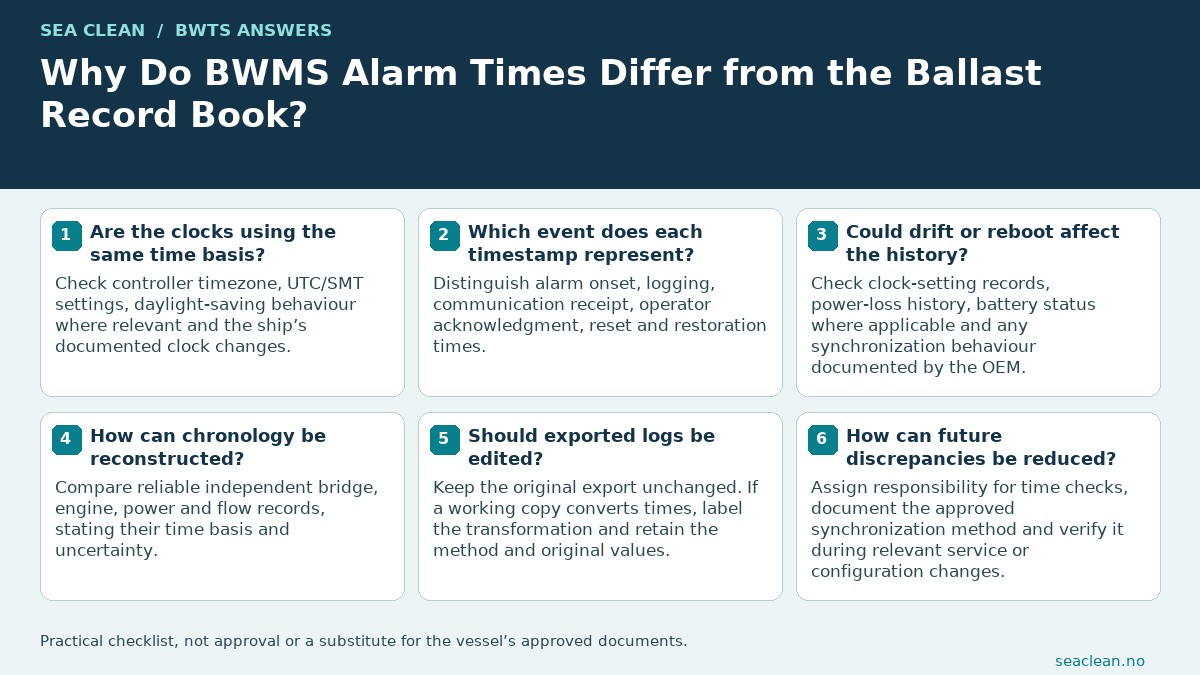
Are the clocks using the same time basis?
Check controller timezone, UTC/SMT settings, daylight-saving behaviour where relevant and the ship’s documented clock changes.
A fixed offset may be explainable, but it must be verified. Do not infer timezone solely from the difference that makes one event align.
Which event does each timestamp represent?
Distinguish alarm onset, logging, communication receipt, operator acknowledgment, reset and restoration times.
A report’s acknowledgment time cannot automatically replace the actual failure time. Read the maker’s event definitions and retain their meaning.
Related guidance: BWM Compliance Responsibility Matrix for Shipowners, Managers, Masters and Chief Engineers
Could drift or reboot affect the history?
Check clock-setting records, power-loss history, battery status where applicable and any synchronization behaviour documented by the OEM.
A clock corrected midway through an operation can change apparent sequence. Preserve the original data and record the correction event.
How can chronology be reconstructed?
Compare reliable independent bridge, engine, power and flow records, stating their time basis and uncertainty.
Use a comparison note to map timestamps onto the physical event sequence. Do not manufacture second-level precision where the evidence supports only a range.
Should exported logs be edited?
Keep the original export unchanged. If a working copy converts times, label the transformation and retain the method and original values.
Corrections to record-book entries should follow the transparent signed/dated procedure; hiding the mismatch removes useful evidence.
Related guidance: How Do You Verify a Ballast Laboratory’s Actual Testing Scope?
How can future discrepancies be reduced?
Assign responsibility for time checks, document the approved synchronization method and verify it during relevant service or configuration changes.
Changing clock settings must not alter approved controls or erase events. Keep a traceable history of interventions and any residual discrepancy.
Frequently asked questions
Is every timestamp mismatch suspicious?
No. Timezone, clock drift or event definitions can explain it, but the explanation needs evidence.
Can acknowledgment be used as failure time?
Only if it genuinely identifies the event; usually these are different timestamps.
Can I normalize times in a working spreadsheet?
Yes, transparently, while preserving originals and documenting the transformation.
Does synchronization erase earlier discrepancy?
No. Keep the prior history and correction event traceable.
Sources
- IMO — BWMS Code, MEPC.300(72) — Approval framework, monitoring, system design limitations and biological performance; not a universal maker procedure.
- IMO — BWM.2/Circ.80/Rev.1: record-keeping and reporting — The linked PDF is the revised circular dated 24 October 2024, despite its shorter filename.
- IMO — BWM Convention and implementation guidelines
Related articles
- How Should a BWMS Return to Service After Lay-Up?
- How Do You Verify a Ballast Laboratory’s Actual Testing Scope?
- BWM Compliance Responsibility Matrix for Shipowners, Managers, Masters and Chief Engineers
- BWMS Logs and Record Books: Building a PSC Evidence Pack
- Does Passing BWMS Commissioning Prove Every Future Discharge?
- How Does a Tank Refill Affect BWMS Holding-Time Requirements?
Request spares, calibration or ballast-water testing
Include BWMS brand/model, vessel/IMO number, port/terminal, date/ETA and scope or part numbers. These links prepare an email draft; you must send it yourself.
- Request a parts quote — Sensors, TRO reagents, calibration kits and replacement parts. Confirm compatibility, availability and delivery for your installed system.
- Request a calibration booking — Annual instrument calibration with a calibration certificate for the work completed. OEM instructions, drift or applicable rules may require earlier work.
- Request testing coordination — Arrange sampling and testing with an appropriately qualified party for your IMO D-2, commissioning or other stated purpose.
Authorised Headway agent. Other-brand enquiries are independently reviewed; no OEM authorisation is claimed. Sea Clean is not an accredited laboratory or approving authority. Calibration does not demonstrate biological D-2 compliance. Attendance, testing scope and parts delivery are confirmed per enquiry.