How Should a BWMS Return to Service After Lay-Up?
Updated
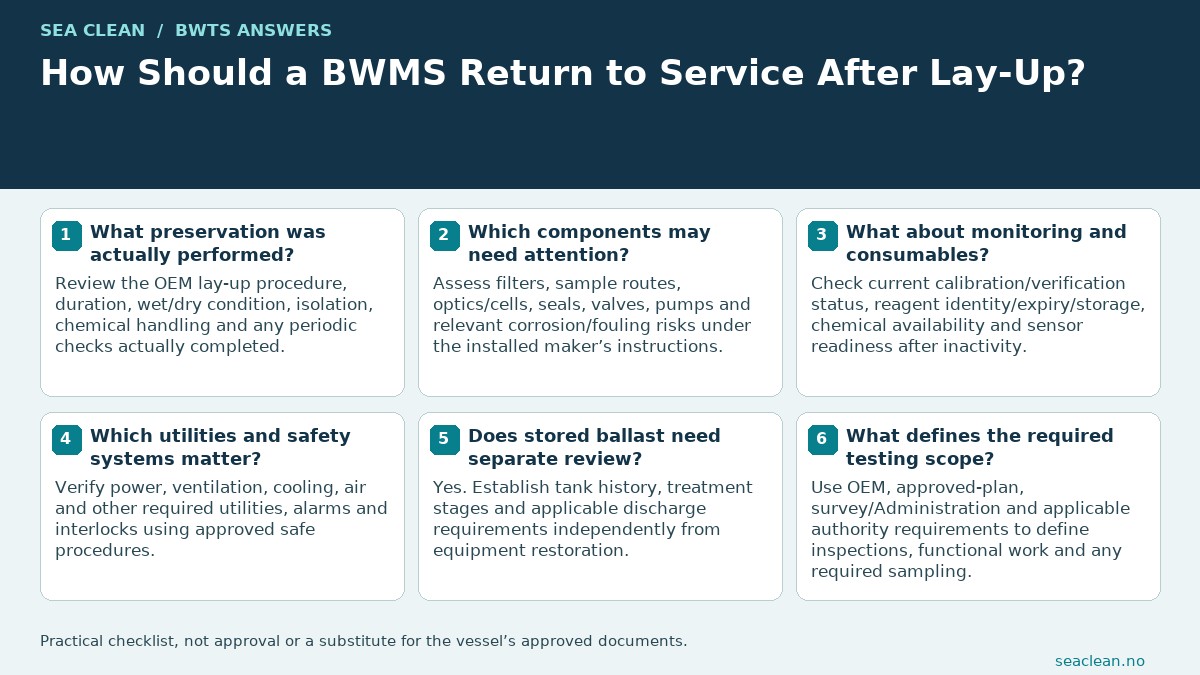
Lay-up can affect more than the machinery’s ability to start. Review preservation, wet systems, consumables, monitoring and stored ballast history before deciding which inspections and tests are needed for the next operation.
Request BWTS spare parts, annual calibration or ballast-water testing
Key takeaways
- Verify actual preservation history.
- Inspect maker-specific vulnerable components.
- Review sensors and stored consumables.
- Test required utilities and interlocks.
- Assess stored ballast separately.
- Define testing from applicable requirements.
What preservation was actually performed?
Review the OEM lay-up procedure, duration, wet/dry condition, isolation, chemical handling and any periodic checks actually completed.
Do not assume the checklist was followed merely because it was issued. Missing preservation evidence should shape the inspection scope.
Which components may need attention?
Assess filters, sample routes, optics/cells, seals, valves, pumps and relevant corrosion/fouling risks under the installed maker’s instructions.
Avoid a universal cleaning recipe. Aggressive chemicals or unsuitable methods may damage approved components or create safety and configuration problems.
Related guidance: BWM Compliance Responsibility Matrix for Shipowners, Managers, Masters and Chief Engineers
What about monitoring and consumables?
Check current calibration/verification status, reagent identity/expiry/storage, chemical availability and sensor readiness after inactivity.
A new container does not establish sample-line cleanliness or calibration. Preserve any out-of-tolerance as-found condition before adjustment.
Which utilities and safety systems matter?
Verify power, ventilation, cooling, air and other required utilities, alarms and interlocks using approved safe procedures.
A controller power-on test alone does not exercise treatment flow, hazardous-gas controls where relevant or the actual ballast routing.
Does stored ballast need separate review?
Yes. Establish tank history, treatment stages and applicable discharge requirements independently from equipment restoration.
Returning the BWMS to service does not retrospectively treat water accumulated, transferred or left uncertain during the lay-up period.
Related guidance: Why Do BWMS Alarm Times Differ from the Ballast Record Book?
What defines the required testing scope?
Use OEM, approved-plan, survey/Administration and applicable authority requirements to define inspections, functional work and any required sampling.
Do not assert that every lay-up mandates a new commissioning test—or that none does. Record the actual basis, results and release restrictions.
Frequently asked questions
Is powering on enough after lay-up?
No. It does not establish hydraulic, treatment, monitoring and safety readiness.
Must every lay-up repeat commissioning?
Determine the required scope from the applicable OEM, survey and authority requirements; do not assume a universal rule.
Does equipment restoration clear old ballast?
No. Its treatment history and discharge route need separate assessment.
Can a fleet-wide cleaning method be used?
Only where compatible with the installed approved equipment and maker instructions.
Sources
- IMO — BWMS Code, MEPC.300(72) — Approval framework, monitoring, system design limitations and biological performance; not a universal maker procedure.
- IMO — BWM.2/Circ.80/Rev.1: record-keeping and reporting — The linked PDF is the revised circular dated 24 October 2024, despite its shorter filename.
- IMO — BWM Convention and implementation guidelines
Related articles
- Must an Installed BWMS Be Replaced When Its Type-Approval Certificate Expires?
- Why Do BWMS Alarm Times Differ from the Ballast Record Book?
- BWM Compliance Responsibility Matrix for Shipowners, Managers, Masters and Chief Engineers
- BWMS Logs and Record Books: Building a PSC Evidence Pack
- What Is a Ballast Water Treatment System? Explained
- How Does BWTS Installation Work? Step by Step
Request spares, calibration or ballast-water testing
Include BWMS brand/model, vessel/IMO number, port/terminal, date/ETA and scope or part numbers. These links prepare an email draft; you must send it yourself.
- Request a parts quote — Sensors, TRO reagents, calibration kits and replacement parts. Confirm compatibility, availability and delivery for your installed system.
- Request a calibration booking — Annual instrument calibration with a calibration certificate for the work completed. OEM instructions, drift or applicable rules may require earlier work.
- Request testing coordination — Arrange sampling and testing with an appropriately qualified party for your IMO D-2, commissioning or other stated purpose.
Authorised Headway agent. Other-brand enquiries are independently reviewed; no OEM authorisation is claimed. Sea Clean is not an accredited laboratory or approving authority. Calibration does not demonstrate biological D-2 compliance. Attendance, testing scope and parts delivery are confirmed per enquiry.