How Does a Tank Refill Affect BWMS Holding-Time Requirements?
Updated
Where an approved BWMS requires a holding period, a later refill can introduce water with a different treatment timeline. Check the system-specific requirement before using the first uptake time for the whole tank.
Request BWTS spare parts, annual calibration or ballast-water testing
Key takeaways
- Use the installed system’s hold condition.
- Identify the correct starting event.
- Track later additions separately.
- Check short voyages before uptake.
- Do not substitute improvised treatment.
- Keep unmet conditions visible.
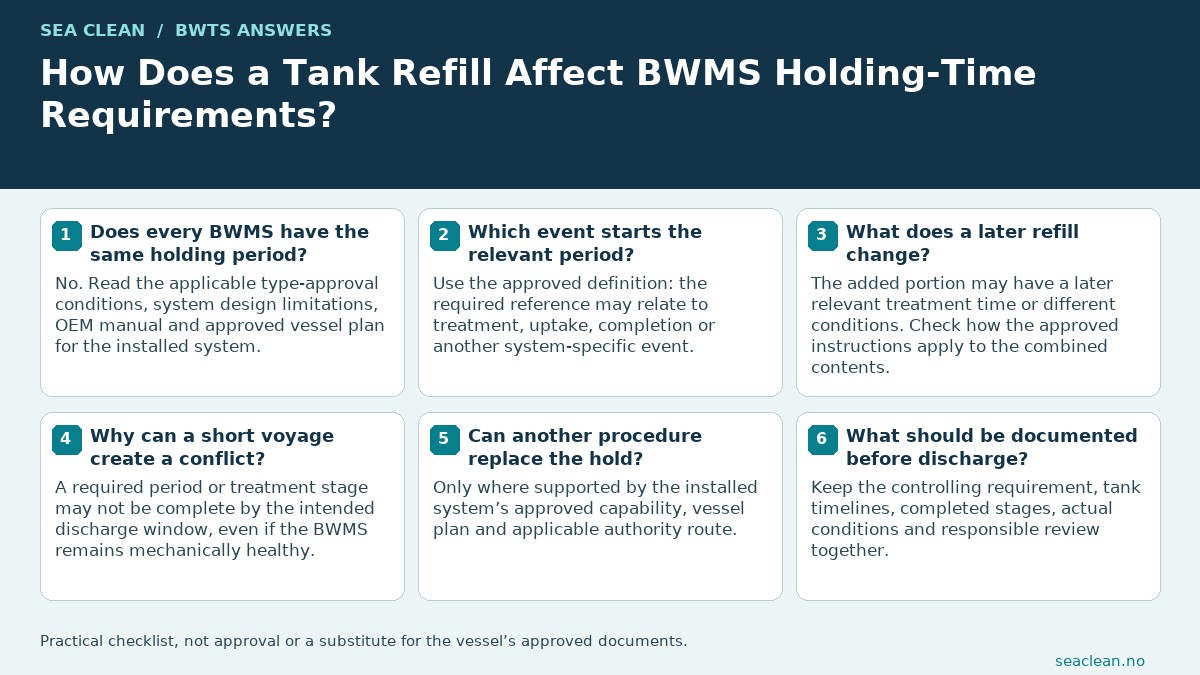
Does every BWMS have the same holding period?
No. Read the applicable type-approval conditions, system design limitations, OEM manual and approved vessel plan for the installed system.
Do not prescribe a generic number of hours for UV, electrochlorination and in-tank technologies; their treatment sequences and conditions differ.
Which event starts the relevant period?
Use the approved definition: the required reference may relate to treatment, uptake, completion or another system-specific event.
Record evidence of that event and its timezone. The crew should not choose whichever timestamp makes the planned discharge appear permissible.
Related guidance: BWMS Management Plan Change Control: When Does a Revision Need Approval?
What does a later refill change?
The added portion may have a later relevant treatment time or different conditions. Check how the approved instructions apply to the combined contents.
Do not automatically carry the first fill’s elapsed time onto newly admitted water. Preserve each addition’s quantity and timeline.
Why can a short voyage create a conflict?
A required period or treatment stage may not be complete by the intended discharge window, even if the BWMS remains mechanically healthy.
Assess this during voyage/cargo planning, allowing for actual uptake completion and delays. Commercial scheduling does not redefine the requirement.
Can another procedure replace the hold?
Only where supported by the installed system’s approved capability, vessel plan and applicable authority route.
Do not improvise repeated dosing, circulation or exchange as equivalent. Those actions can create separate treatment, safety and approval questions.
Related guidance: What Should Be Checked Before Discharging Long-Stored Ballast?
What should be documented before discharge?
Keep the controlling requirement, tank timelines, completed stages, actual conditions and responsible review together.
If a condition remains unmet or uncertain, identify the restriction and seek the appropriate direction instead of declaring readiness from elapsed voyage time alone.
Frequently asked questions
Is one holding time valid for all BWMS?
No. Requirements depend on the approved system and conditions.
Can the first fill time cover a later refill?
Not without support from the applicable approved instructions.
Does voyage length alone prove the hold is met?
No. The actual relevant treatment/uptake event and system conditions matter.
Can extra chemical dosing bypass the requirement?
Do not assume that; use only the approved method and authority route.
Sources
- IMO — BWMS Code, MEPC.300(72) — Approval framework, monitoring, system design limitations and biological performance; not a universal maker procedure.
- IMO — BWM.2/Circ.80/Rev.1: record-keeping and reporting — The linked PDF is the revised circular dated 24 October 2024, despite its shorter filename.
- IMO — BWM Convention and implementation guidelines
Related articles
- How Should You Track Ballast from Different Ports in One Tank?
- What Should Be Checked Before Discharging Long-Stored Ballast?
- BWMS Management Plan Change Control: When Does a Revision Need Approval?
- BWTS Contingency Notification Pack: What to Send Flag and Port
- Why Do BWMS Alarm Times Differ from the Ballast Record Book?
- What Is a Ballast Water Treatment System? Explained
Request spares, calibration or ballast-water testing
Include BWMS brand/model, vessel/IMO number, port/terminal, date/ETA and scope or part numbers. These links prepare an email draft; you must send it yourself.
- Request a parts quote — Sensors, TRO reagents, calibration kits and replacement parts. Confirm compatibility, availability and delivery for your installed system.
- Request a calibration booking — Annual instrument calibration with a calibration certificate for the work completed. OEM instructions, drift or applicable rules may require earlier work.
- Request testing coordination — Arrange sampling and testing with an appropriately qualified party for your IMO D-2, commissioning or other stated purpose.
Authorised Headway agent. Other-brand enquiries are independently reviewed; no OEM authorisation is claimed. Sea Clean is not an accredited laboratory or approving authority. Calibration does not demonstrate biological D-2 compliance. Attendance, testing scope and parts delivery are confirmed per enquiry.