How Do You Verify a Ballast Laboratory’s Actual Testing Scope?
Updated
A laboratory’s accreditation claim needs a scope check, not just a logo check. Confirm the actual methods, relevant site, sampling arrangements and any required authority acceptance before booking a ballast-water test.
Request BWTS spare parts, annual calibration or ballast-water testing
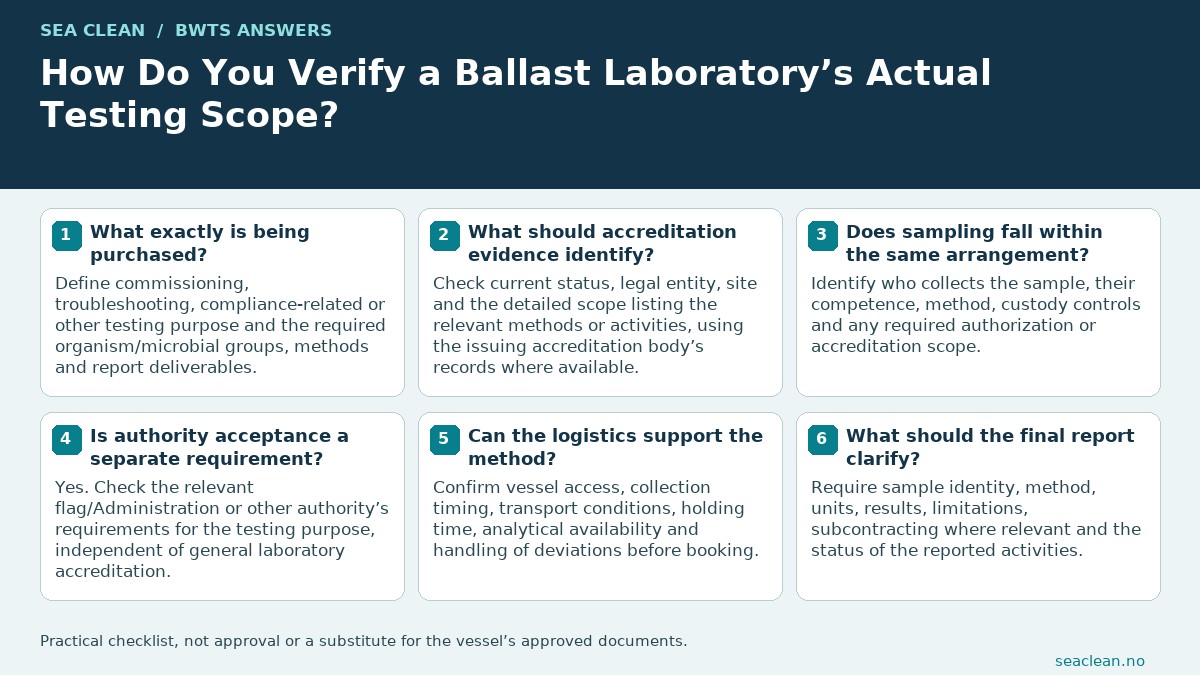
Key takeaways
- Define the testing purpose first.
- Check the detailed current scope.
- Verify sampling responsibility separately.
- Confirm required authority acceptance.
- Test logistics against method limits.
- Keep provider roles and report limits clear.
What exactly is being purchased?
Define commissioning, troubleshooting, compliance-related or other testing purpose and the required organism/microbial groups, methods and report deliverables.
Without a defined scope, a competent laboratory may provide a valid test that does not answer the vessel’s actual regulatory or technical question.
What should accreditation evidence identify?
Check current status, legal entity, site and the detailed scope listing the relevant methods or activities, using the issuing accreditation body’s records where available.
An ISO/IEC 17025 certificate alone does not imply that every method, sample type, site or onboard activity is within accredited scope.
Related guidance: BWM Compliance Responsibility Matrix for Shipowners, Managers, Masters and Chief Engineers
Does sampling fall within the same arrangement?
Identify who collects the sample, their competence, method, custody controls and any required authorization or accreditation scope.
Do not assume laboratory analysis accreditation automatically covers an independent sampler’s onboard collection activity. Confirm the division of responsibilities.
Is authority acceptance a separate requirement?
Yes. Check the relevant flag/Administration or other authority’s requirements for the testing purpose, independent of general laboratory accreditation.
A commercial provider cannot confer authority approval by describing a report as 'certified'. Verify the actual acceptance route.
Can the logistics support the method?
Confirm vessel access, collection timing, transport conditions, holding time, analytical availability and handling of deviations before booking.
A relevant method on a scope sheet is not enough if the actual ship-to-laboratory route cannot preserve a suitable sample.
Related guidance: What Ballast Issues Must a Relief Chief Engineer Receive?
What should the final report clarify?
Require sample identity, method, units, results, limitations, subcontracting where relevant and the status of the reported activities.
Sea Clean can support coordination but is not an accredited laboratory or approving authority. Keep the actual testing party’s role and report scope explicit.
Frequently asked questions
Does an accreditation logo cover every test?
No. Review the detailed scope, site, method and current status.
Does laboratory accreditation include every sampler?
Not automatically. Confirm sampling scope and responsibility separately.
Is accreditation the same as flag acceptance?
No. The relevant authority’s requirements must also be checked.
Does Sea Clean perform accredited laboratory analysis?
No. Sea Clean is not an accredited laboratory; any testing arrangement must identify the actual competent testing party.
Sources
- IMO — BWMS Code, MEPC.300(72) — Approval framework, monitoring, system design limitations and biological performance; not a universal maker procedure.
- IMO — BWM.2/Circ.80/Rev.1: record-keeping and reporting — The linked PDF is the revised circular dated 24 October 2024, despite its shorter filename.
- IMO — BWM Convention and implementation guidelines
Related articles
- Why Do BWMS Alarm Times Differ from the Ballast Record Book?
- What Ballast Issues Must a Relief Chief Engineer Receive?
- BWM Compliance Responsibility Matrix for Shipowners, Managers, Masters and Chief Engineers
- BWMS Logs and Record Books: Building a PSC Evidence Pack
- Does 'Not Detected' Mean a Ballast Sample Contains Zero Organisms?
- What Is a Ballast Water Treatment System? Explained
Request spares, calibration or ballast-water testing
Include BWMS brand/model, vessel/IMO number, port/terminal, date/ETA and scope or part numbers. These links prepare an email draft; you must send it yourself.
- Request a parts quote — Sensors, TRO reagents, calibration kits and replacement parts. Confirm compatibility, availability and delivery for your installed system.
- Request a calibration booking — Annual instrument calibration with a calibration certificate for the work completed. OEM instructions, drift or applicable rules may require earlier work.
- Request testing coordination — Arrange sampling and testing with an appropriately qualified party for your IMO D-2, commissioning or other stated purpose.
Authorised Headway agent. Other-brand enquiries are independently reviewed; no OEM authorisation is claimed. Sea Clean is not an accredited laboratory or approving authority. Calibration does not demonstrate biological D-2 compliance. Attendance, testing scope and parts delivery are confirmed per enquiry.