Ballast Water Testing and Sampling at the Port of Shanghai
Updated
Shanghai is the world's largest container port, spanning the Yangshan deep-water terminal and the Yangtze and Huangpu river facilities. This guide explains the China MSA and IMO framework, the influence of turbid, low-salinity river water on uptake, indicative versus detailed analysis, and how Sea Clean AS coordinates sampling support, reagents and engineer attendance by arrangement alongside accredited laboratories and authorised parties.
Key takeaways
- Shanghai is the world's largest container port, spanning Yangshan deep-water and Yangtze estuary river terminals.
- Turbid, low-salinity Yangtze water strains filtration and affects electrochlorination and UV during uptake.
- China applies the IMO Convention and D-2 standard; the China MSA enforces under the Tokyo MoU.
- Indicative analysis screens on board; detailed analysis by an ISO/IEC 17025 lab provides the certified result.
- Sea Clean attendance at Shanghai is by arrangement, mobilised as flights, visas and port access allow.
- Sea Clean supplies TRO kits and reagents via courier and coordinates testing with accredited labs and authorised parties.
Shanghai as a Testing Location
Shanghai is the world's largest container port by throughput, combining the Yangshan deep-water terminal on offshore islands with river terminals along the Yangtze estuary and the Huangpu. Many newbuildings and retrofits are completed at Chinese yards, so commissioning testing is frequently arranged in the Shanghai region as well as routine sampling for vessels in service.
The Yangtze estuary carries turbid, sediment-laden and seasonally low-salinity water, which strains filtration stages and can affect electrochlorination and UV transmittance during uptake. This is directly relevant to commissioning testing, where the system must demonstrate compliance under the demanding conditions it actually meets.
Sea Clean is not an accredited testing laboratory and does not certify results. At Shanghai, attendance is by arrangement and engineers are mobilised as flights, visas and port access allow; we coordinate sampling support, supply TRO test kits and reagents, and arrange for an accredited laboratory or authorised party to perform and certify detailed analysis where required.
The Regulatory Framework Applying at Shanghai
China is a party to the IMO Ballast Water Management Convention, so the D-2 discharge standard and the convention's survey and certification requirements apply to vessels calling Shanghai. Commissioning testing of new BWMS installations follows the BWMS Code under MEPC.325(75), with the International Ballast Water Management Certificate and record book the documents checked on board.
Enforcement is carried out by the China Maritime Safety Administration (China MSA) as the port state control authority within the Tokyo MoU. Inspectors verify documentation, may witness ballast operations and can call for sampling where compliance is doubtful, so records and self-monitoring data should be ready before arrival.
China has also developed national attention to ballast and biosecurity, and operators should confirm any local requirements with the agent. Where a fault prevents D-2 compliance, contingency measures and rectification should be documented clearly.
Indicative Versus Detailed Analysis
Indicative analysis is rapid on-board screening, typically fluorometry for the organism size classes plus chemical checks, giving a quick pass or fail indication against D-2 limits. It supports self-monitoring and a fast check during commissioning but is not on its own a certified result.
Detailed analysis is performed by an accredited laboratory to ISO/IEC 17025, quantifying viable organisms in the regulated size classes and verifying indicator microbes. For commissioning testing this is the element that satisfies the surveyor and flag administration, requiring an accredited lab or authorised party.
At Shanghai both can be combined: indicative screening runs on board, while detailed-analysis samples are taken under protocol and delivered to a laboratory within their holding times. The turbid estuary water makes a sound protocol and accurate uptake records especially important so the result reflects real performance.
Sampling Points and Collection on Board
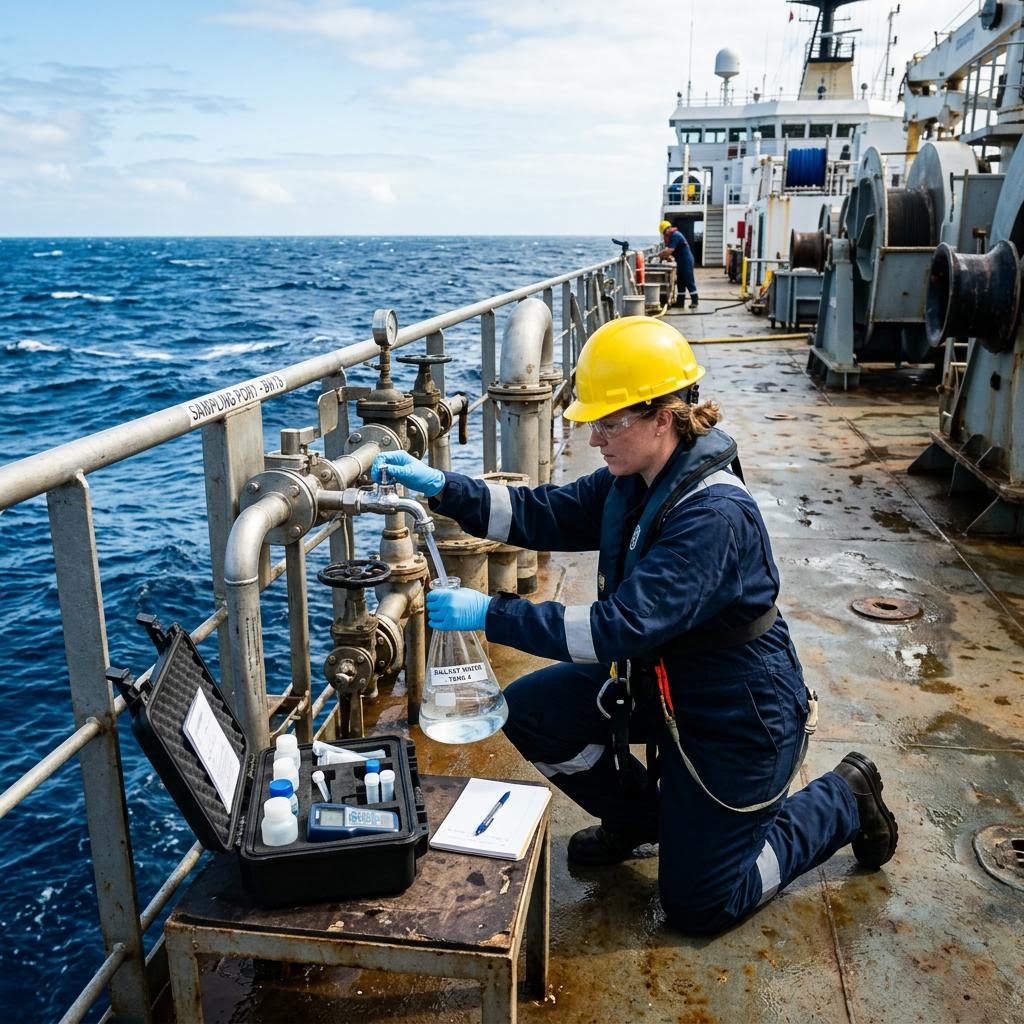
A representative sample must come from the designated sample port downstream of the treatment equipment, reflecting the water actually discharged overboard. With sediment-laden, low-salinity Yangtze water, recording turbidity and salinity at uptake helps interpret a borderline result and any filtration loading.
Isokinetic sampling and a steady discharge flow help capture organisms representatively, and the record should note the tank, processed volume, discharge rate and sample time. Linking the sample to a specific operation makes the result defensible to a surveyor.
Sea Clean coordinates attendance and consumables, helps the crew sample correctly, supports indicative checks and arranges for detailed-analysis samples to reach the laboratory. The accredited laboratory or authorised party then performs and certifies the analysis used in the commissioning record.
Coordinating a Test During a Shanghai Call
Shanghai calls are container-driven and tightly scheduled, and yard-based commissioning has its own programme, so testing must fit the available window. Early notice of the ETA or yard, the BWMS make and model, and whether commissioning testing or routine sampling is needed lets Sea Clean arrange attendance, consumables and any laboratory work in advance.
Because Shanghai is outside Sea Clean's home region, attendance is by arrangement: an engineer is mobilised as flights, visas and port access allow, and reagents and sampling equipment are supplied via courier or forwarding and local agent coordination. There is no fabricated standing office; logistics are arranged for each job.
Where detailed analysis is required, sample holding times drive the schedule, so the test is planned around a confirmed ballast operation. Sea Clean coordinates attendance, sampling and laboratory logistics with the vessel's agent or the yard into a single plan.
What Sea Clean Provides at Shanghai
Sea Clean supplies TRO test kits, sodium thiosulfate neutraliser and sampling consumables, routed to Shanghai via courier or forwarding, and arranges engineer attendance by arrangement to support self-monitoring and commissioning testing. As an authorized Headway agent and an independent service provider for other BWMS brands, attendance can combine a test with minor rectification.
For the certified element of any test we work with accredited laboratories and parties authorised by the flag administration or class, coordinating and facilitating rather than certifying results ourselves. This keeps the documentation institutionally correct while giving the vessel one point of contact.
Send the vessel name, IMO number, ETA or yard, BWMS details and test requirement to post@seaclean.no as early as possible. Early notice is the main factor in arranging attendance and reagents within Shanghai's schedule.
Frequently asked questions
How does Yangtze estuary water affect ballast water testing at Shanghai?
The water is turbid, sediment-laden and seasonally low in salinity, which strains filtration and can affect electrochlorination and UV transmittance during uptake. Commissioning testing must show compliance under those conditions, so turbidity and salinity are recorded with the sample.
Who enforces ballast water compliance at Shanghai?
The China Maritime Safety Administration (China MSA) acts as the port state control authority within the Tokyo MoU. Inspectors check the ballast water certificate and record book, may witness operations and can call for sampling where compliance is in doubt.
How does Sea Clean attend a vessel or yard at Shanghai?
Attendance at Shanghai is by arrangement. An engineer is mobilised as flights, visas and port access allow, and reagents and sampling equipment are supplied via courier or forwarding with local agent or yard coordination. Early notice is important given the schedule.
Does Sea Clean certify ballast water analysis at Shanghai?
No. Sea Clean is not an accredited testing laboratory. We coordinate sampling, supply TRO test kits and reagents and support indicative screening, while an accredited laboratory or an authorised party performs and certifies the detailed analysis.
Sources
Related articles
- Ballast Water Testing and Sampling at the Port of Busan
- Ballast Water Compliance in China
- Detailed Ballast Water Analysis in an Accredited Laboratory
- BWTS Service and Engineer Attendance at the Port of Shanghai
- USCG Ballast Water Compliance for Ships Calling the United States
- The US EPA VGP and VIDA Framework for Ballast Water