What Must Be Recorded When Ballast Sediment Is Removed?
Updated
Sediment handling has its own record-book category. A cleaning work order or waste receipt alone does not document every Code G item, and a tank-entry operation also needs separate safety controls.
Request BWTS spare parts, annual calibration or ballast-water testing
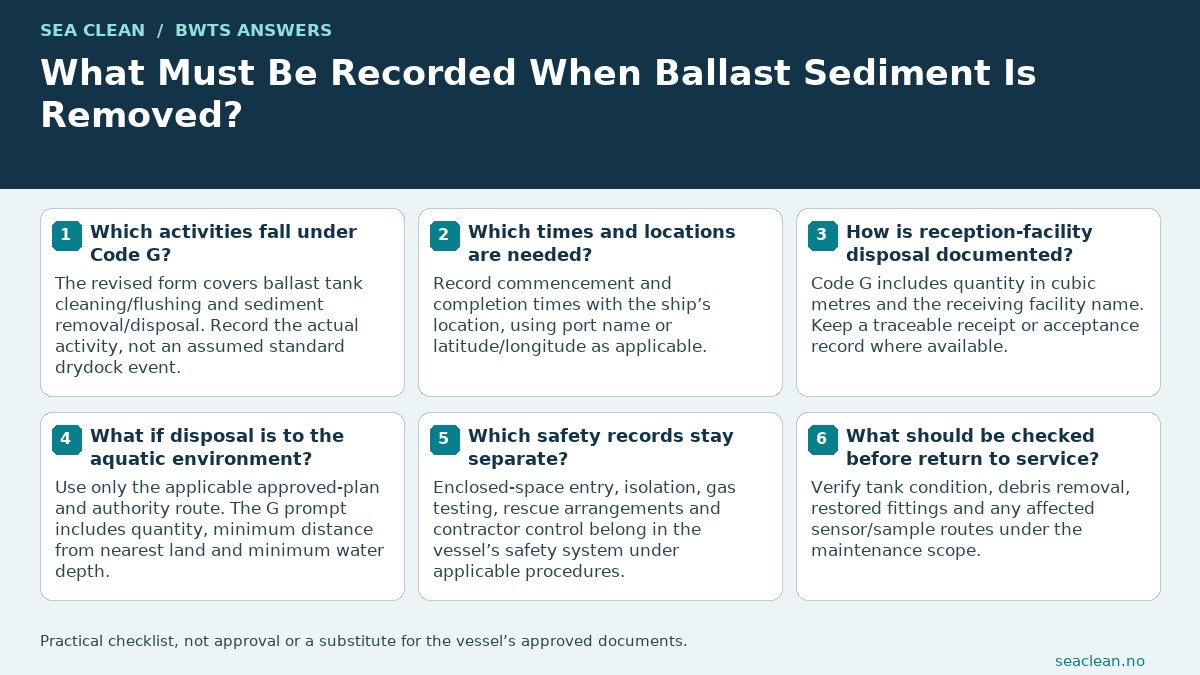
Key takeaways
- Use Code G for the actual activity.
- Name tanks exactly as in the BWMP.
- Record start and completion locations.
- Verify disposal quantity and units.
- Keep tank-entry safety controls separate.
- Retain facility acceptance evidence.
Which activities fall under Code G?
The revised form covers ballast tank cleaning/flushing and sediment removal/disposal. Record the actual activity, not an assumed standard drydock event.
Identify tanks using the approved BWMP nomenclature and distinguish the cleaning period from later collection, transport or disposal where necessary.
Which times and locations are needed?
Record commencement and completion times with the ship’s location, using port name or latitude/longitude as applicable.
Link any staged work so the sequence is clear. A contractor’s attendance date may not be the actual start or completion of the operation.
Related guidance: BWTS Record Book Entries After an Alarm, Repair or Failed Operation
How is reception-facility disposal documented?
Code G includes quantity in cubic metres and the receiving facility name. Keep a traceable receipt or acceptance record where available.
Check whether the receipt measures sediment, sediment/water mixture or another waste description. Do not silently convert a mass invoice into an unsupported volume.
What if disposal is to the aquatic environment?
Use only the applicable approved-plan and authority route. The G prompt includes quantity, minimum distance from nearest land and minimum water depth.
Recording these particulars is not permission to dump sediment. Local restrictions, safety and Convention obligations must be checked before the action.
Which safety records stay separate?
Enclosed-space entry, isolation, gas testing, rescue arrangements and contractor control belong in the vessel’s safety system under applicable procedures.
A correct Code G entry cannot substitute for a tank-entry permit or establish that the cleaning work was carried out safely.
Related guidance: What Records Are Needed When Water Quality Challenges the BWMS?
What should be checked before return to service?
Verify tank condition, debris removal, restored fittings and any affected sensor/sample routes under the maintenance scope.
Reconcile cleaning, disposal evidence and tank inventory. Preserve unresolved waste acceptance or quantity issues rather than closing the event on an unsigned receipt.
Frequently asked questions
Can a cleaning invoice replace the entry?
No. It does not necessarily contain all Code G times, locations, tank and disposal particulars.
Can tonnes be copied into a cubic-metre field?
No. Use a defensible documented basis for any conversion and identify limitations.
Does recording distance permit sediment discharge?
No. Discharge must independently comply with the approved plan and applicable requirements.
Is the record book a tank-entry permit?
No. Enclosed-space safety controls and permits are separate.
Sources
- IMO — BWM.2/Circ.80/Rev.1: record-keeping and reporting — The linked PDF is the revised circular dated 24 October 2024, despite its shorter filename.
- IMO — MEPC.369(80): revised record-book form
- IMO — BWMS Code, MEPC.300(72) — Approval framework, monitoring, system design limitations and biological performance; not a universal maker procedure.
Related articles
- How Should a BWMS Bypass Be Described in the Record Book?
- What Records Are Needed When Water Quality Challenges the BWMS?
- BWTS Record Book Entries After an Alarm, Repair or Failed Operation
- BWMS Logs and Record Books: Building a PSC Evidence Pack
- Is an Internal Ballast Transfer Code H or Code C2?
- What Should a Ballast Reception-Facility Receipt Confirm?
Request spares, calibration or ballast-water testing
Include BWMS brand/model, vessel/IMO number, port/terminal, date/ETA and scope or part numbers. These links prepare an email draft; you must send it yourself.
- Request a parts quote — Sensors, TRO reagents, calibration kits and replacement parts. Confirm compatibility, availability and delivery for your installed system.
- Request a calibration booking — Annual instrument calibration with a calibration certificate for the work completed. OEM instructions, drift or applicable rules may require earlier work.
- Request testing coordination — Arrange sampling and testing with an appropriately qualified party for your IMO D-2, commissioning or other stated purpose.
Authorised Headway agent. Other-brand enquiries are independently reviewed; no OEM authorisation is claimed. Sea Clean is not an accredited laboratory or approving authority. Calibration does not demonstrate biological D-2 compliance. Attendance, testing scope and parts delivery are confirmed per enquiry.