Is an Internal Ballast Transfer Code H or Code C2?
Updated
The purpose of the transfer matters. Revised IMO guidance distinguishes internal movement of similarly managed water for list, trim or stability from a separate treatment operation, even when both involve the same pumps and tanks.
Request BWTS spare parts, annual calibration or ballast-water testing
Key takeaways
- Code by the operation’s purpose.
- H covers qualifying trim/stability transfers.
- C2 covers independent treatment.
- A/B already cover ordinary inline treatment.
- Check each tank’s management history.
- Record current, not future, treatment.
When does Code H apply?
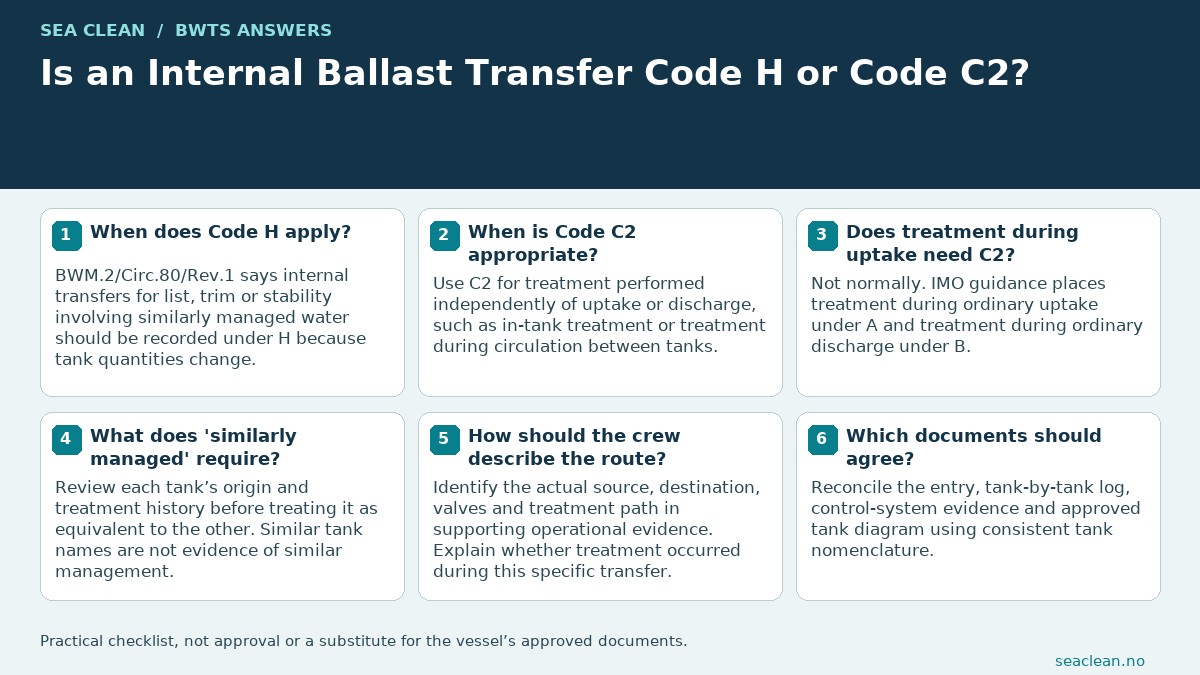
BWM.2/Circ.80/Rev.1 says internal transfers for list, trim or stability involving similarly managed water should be recorded under H because tank quantities change.
Identify source/destination tanks and the operational reason. Keep the changed inventory traceable in the supporting tank log.
When is Code C2 appropriate?
Use C2 for treatment performed independently of uptake or discharge, such as in-tank treatment or treatment during circulation between tanks.
Record start/completion times, affected tanks including source/destination where applicable, quantity treated and treatment method, using the revised form’s C section 2 prompts.
Related guidance: Ballast Water Record Book: Printable PDF, IMO Requirements and Calibration
Does treatment during uptake need C2?
Not normally. IMO guidance places treatment during ordinary uptake under A and treatment during ordinary discharge under B.
Adding C2 merely because the BWMS operated can duplicate the same event and confuse chronology. Code the actual operational scenario.
What does 'similarly managed' require?
Review each tank’s origin and treatment history before treating it as equivalent to the other. Similar tank names are not evidence of similar management.
If statuses differ, assess the transfer against the approved plan and preserve the distinct histories; avoid relabelling mixed contents as wholly treated.
How should the crew describe the route?
Identify the actual source, destination, valves and treatment path in supporting operational evidence. Explain whether treatment occurred during this specific transfer.
The guidance’s treatment field concerns the operation being recorded, not treatment intended at a later port or performed during an earlier event.
Related guidance: What Should a Ballast Reception-Facility Receipt Confirm?
Which documents should agree?
Reconcile the entry, tank-by-tank log, control-system evidence and approved tank diagram using consistent tank nomenclature.
When the route or purpose is unclear, consult the approved plan and responsible shore/flag guidance rather than choosing the code that looks most convenient.
Frequently asked questions
Is every transfer between tanks C2?
No. C2 identifies independent treatment, not simply an internal water movement.
Can H cover list correction?
Yes, revised guidance identifies qualifying transfers involving similarly managed water for list/trim/stability under H.
Must ordinary treated uptake use A and C2?
IMO guidance says treatment during ordinary uptake is recorded under A rather than duplicating C2.
What if the tanks have different treatment histories?
Assess the transfer under the approved plan and retain both histories; do not assume equivalent management.
Sources
- IMO — MEPC.369(80): revised record-book form
- IMO — BWM.2/Circ.80/Rev.1: record-keeping and reporting — The linked PDF is the revised circular dated 24 October 2024, despite its shorter filename.
- IMO — BWM Convention and implementation guidelines
Related articles
- How Do You Record a Partial Ballast Discharge from Several Tanks?
- What Should a Ballast Reception-Facility Receipt Confirm?
- Ballast Water Record Book: Printable PDF, IMO Requirements and Calibration
- BWMS Hard-Copy Records and Onboard Document Control
- What Must Be Recorded When Ballast Sediment Is Removed?
- What Is a Ballast Water Treatment System? Explained
Request spares, calibration or ballast-water testing
Include BWMS brand/model, vessel/IMO number, port/terminal, date/ETA and scope or part numbers. These links prepare an email draft; you must send it yourself.
- Request a parts quote — Sensors, TRO reagents, calibration kits and replacement parts. Confirm compatibility, availability and delivery for your installed system.
- Request a calibration booking — Annual instrument calibration with a calibration certificate for the work completed. OEM instructions, drift or applicable rules may require earlier work.
- Request testing coordination — Arrange sampling and testing with an appropriately qualified party for your IMO D-2, commissioning or other stated purpose.
Authorised Headway agent. Other-brand enquiries are independently reviewed; no OEM authorisation is claimed. Sea Clean is not an accredited laboratory or approving authority. Calibration does not demonstrate biological D-2 compliance. Attendance, testing scope and parts delivery are confirmed per enquiry.