How Should a BWMS Bypass Be Described in the Record Book?
Updated
A bypass is an operational fact, not a compliance category that grants permission. The record must distinguish the actual water route and treatment method from any repair, exceptional-event or authority decision associated with it.
Request BWTS spare parts, annual calibration or ballast-water testing
Key takeaways
- Describe actual treatment for that operation.
- Separate treated and bypassed volumes.
- Use additional codes where applicable.
- Preserve physical-route evidence.
- An entry does not grant permission.
- Keep affected-tank restrictions visible.
What does the treatment field mean?
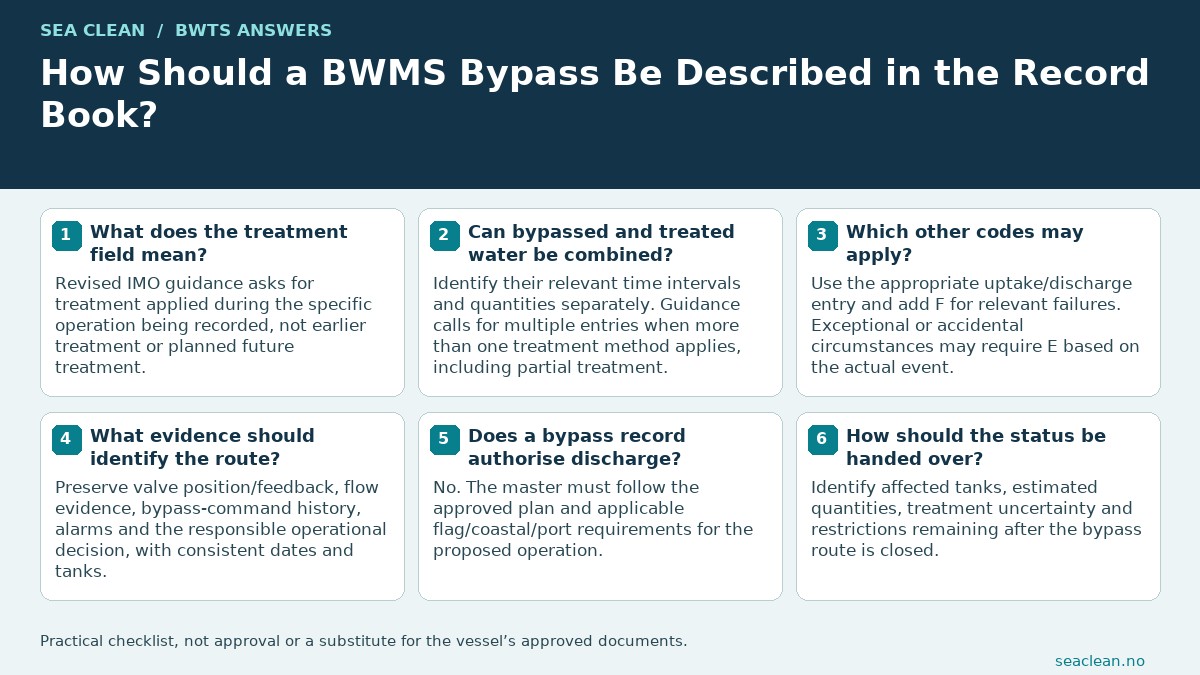
Revised IMO guidance asks for treatment applied during the specific operation being recorded, not earlier treatment or planned future treatment.
Where no treatment is performed, the guidance uses 'None' with the reason in relevant cases such as bypass; apply the appropriate actual scenario.
Can bypassed and treated water be combined?
Identify their relevant time intervals and quantities separately. Guidance calls for multiple entries when more than one treatment method applies, including partial treatment.
Do not write 'Approved BWMS' against the whole volume simply because the equipment ran during part of the operation.
Related guidance: BWTS Record Book Entries After an Alarm, Repair or Failed Operation
Which other codes may apply?
Use the appropriate uptake/discharge entry and add F for relevant failures. Exceptional or accidental circumstances may require E based on the actual event.
Avoid treating all bypasses as identical. The code documents what happened; it does not replace the approved contingency procedure or authority requirements.
What evidence should identify the route?
Preserve valve position/feedback, flow evidence, bypass-command history, alarms and the responsible operational decision, with consistent dates and tanks.
Keep authorised instructions and communications linked to the event. Do not rely only on an unlabelled photograph of a valve handle.
Does a bypass record authorise discharge?
No. The master must follow the approved plan and applicable flag/coastal/port requirements for the proposed operation.
If permission or restrictions apply, record their exact scope and conditions. An informal technical suggestion is not automatically a regulatory decision.
Related guidance: What Must Be Recorded When Ballast Sediment Is Removed?
How should the status be handed over?
Identify affected tanks, estimated quantities, treatment uncertainty and restrictions remaining after the bypass route is closed.
Repairing the equipment or closing the bypass does not retrospectively change the treatment history. Keep restoration and water-management closure distinct.
Frequently asked questions
Can a bypass be recorded as approved treatment?
No. Describe the actual treatment applied and explain any untreated portion truthfully.
Does Code E make bypass discharge legal?
No. An exceptional entry records circumstances; authority and approved-plan requirements remain separate.
Is closing the bypass enough to clear the tank?
No. It restores a route but does not treat water already transferred.
Should authority correspondence be retained?
Yes, where relevant, with its scope, conditions and connection to the actual operation.
Sources
- IMO — BWM.2/Circ.80/Rev.1: record-keeping and reporting — The linked PDF is the revised circular dated 24 October 2024, despite its shorter filename.
- IMO — MEPC.369(80): revised record-book form
- IMO — BWMS Code, MEPC.300(72) — Approval framework, monitoring, system design limitations and biological performance; not a universal maker procedure.
Related articles
- What Should You Preserve After a BWMS Power Loss?
- What Must Be Recorded When Ballast Sediment Is Removed?
- BWTS Record Book Entries After an Alarm, Repair or Failed Operation
- BWMS Logs and Record Books: Building a PSC Evidence Pack
- Can a Leaking Valve Undermine a Correct BWMS Reading?
- What Is a Ballast Water Treatment System? Explained
Request spares, calibration or ballast-water testing
Include BWMS brand/model, vessel/IMO number, port/terminal, date/ETA and scope or part numbers. These links prepare an email draft; you must send it yourself.
- Request a parts quote — Sensors, TRO reagents, calibration kits and replacement parts. Confirm compatibility, availability and delivery for your installed system.
- Request a calibration booking — Annual instrument calibration with a calibration certificate for the work completed. OEM instructions, drift or applicable rules may require earlier work.
- Request testing coordination — Arrange sampling and testing with an appropriately qualified party for your IMO D-2, commissioning or other stated purpose.
Authorised Headway agent. Other-brand enquiries are independently reviewed; no OEM authorisation is claimed. Sea Clean is not an accredited laboratory or approving authority. Calibration does not demonstrate biological D-2 compliance. Attendance, testing scope and parts delivery are confirmed per enquiry.