What Should a Ballast Reception-Facility Receipt Confirm?
Updated
A facility receipt supports a Code D entry but does not replace it. The receipt and ship’s record should describe the same transfer boundary, accepted quantity and facility, with any rejected remainder made explicit.
Request BWTS spare parts, annual calibration or ballast-water testing
Key takeaways
- Keep the Code D entry separate.
- Identify the actual receiving facility.
- Confirm accepted quantity and units.
- Reconcile measurement boundaries.
- Record any refused remainder.
- A receipt is not discharge approval.
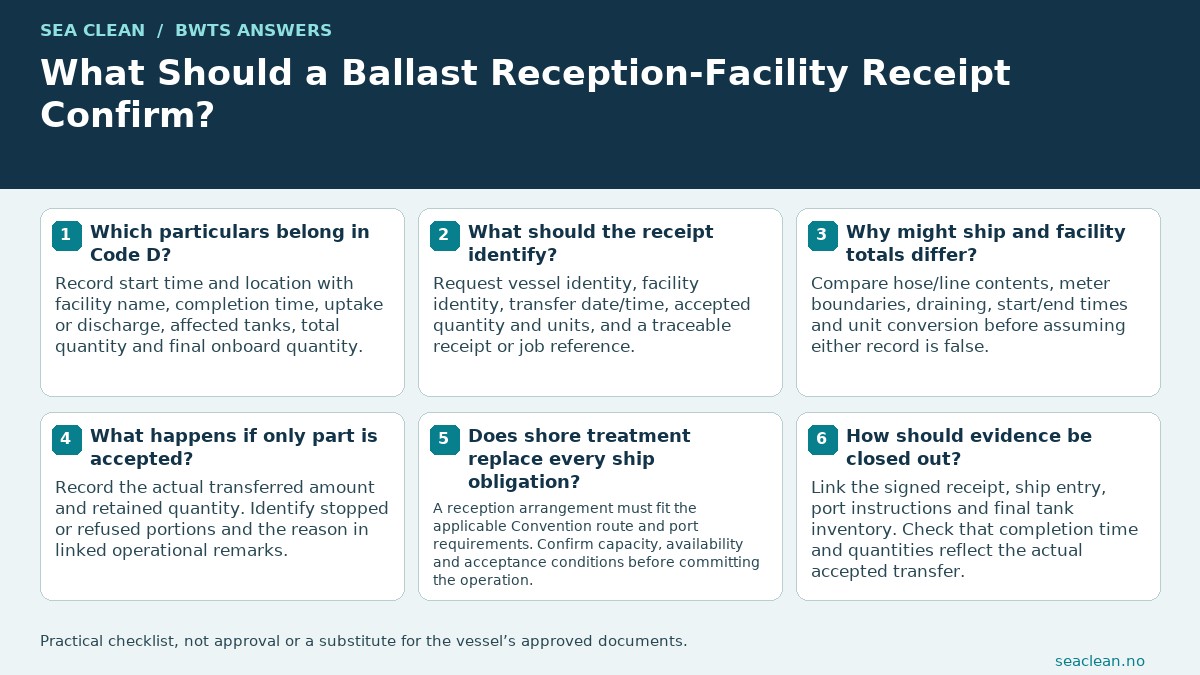
Which particulars belong in Code D?
Record start time and location with facility name, completion time, uptake or discharge, affected tanks, total quantity and final onboard quantity.
Also record approved-plan conformity and the onboard treatment method. A receipt stamped 'waste received' cannot supply all of these shipboard facts.
What should the receipt identify?
Request vessel identity, facility identity, transfer date/time, accepted quantity and units, and a traceable receipt or job reference.
Confirm whether the quantity is metered, estimated or otherwise determined. Keep responsible contact details and relevant acceptance conditions with the transfer file.
Related guidance: Ballast Water Record Book: Printable PDF, IMO Requirements and Calibration
Why might ship and facility totals differ?
Compare hose/line contents, meter boundaries, draining, start/end times and unit conversion before assuming either record is false.
Preserve both original figures and the reconciliation. Do not overwrite the ship’s estimate solely to reproduce an invoice total.
What happens if only part is accepted?
Record the actual transferred amount and retained quantity. Identify stopped or refused portions and the reason in linked operational remarks.
Reassess the remaining ballast route under the approved plan and authority instructions. A booking or partial receipt does not authorise alternative sea discharge.
Does shore treatment replace every ship obligation?
A reception arrangement must fit the applicable Convention route and port requirements. Confirm capacity, availability and acceptance conditions before committing the operation.
The vessel still needs its record-book entry and truthful treatment description; it should not label shore acceptance as proof of onboard BWMS performance.
Related guidance: How Do You Record Ballast Operations Across Midnight?
How should evidence be closed out?
Link the signed receipt, ship entry, port instructions and final tank inventory. Check that completion time and quantities reflect the actual accepted transfer.
Retain unresolved differences as an investigation item rather than hiding them. The master’s completed-page signature remains a separate record-book requirement.
Frequently asked questions
Is the receipt enough instead of Code D?
No. It is supporting evidence for the required shipboard entry.
Should booked volume be recorded as transferred?
No. Record the actual accepted transfer, not the planned or invoiced quantity alone.
What if the transfer is refused?
Preserve the refusal evidence, record what actually happened and seek an approved alternative route.
Can the remaining ballast be discharged at sea?
Only if the approved plan and applicable authority requirements permit the actual proposed operation.
Sources
- IMO — MEPC.369(80): revised record-book form
- IMO — BWM.2/Circ.80/Rev.1: record-keeping and reporting — The linked PDF is the revised circular dated 24 October 2024, despite its shorter filename.
- IMO — BWM Convention and implementation guidelines
Related articles
- Is an Internal Ballast Transfer Code H or Code C2?
- How Do You Record Ballast Operations Across Midnight?
- Ballast Water Record Book: Printable PDF, IMO Requirements and Calibration
- BWMS Hard-Copy Records and Onboard Document Control
- What Is a Ballast Water Treatment System? Explained
- How Does BWTS Installation Work? Step by Step
Request spares, calibration or ballast-water testing
Include BWMS brand/model, vessel/IMO number, port/terminal, date/ETA and scope or part numbers. These links prepare an email draft; you must send it yourself.
- Request a parts quote — Sensors, TRO reagents, calibration kits and replacement parts. Confirm compatibility, availability and delivery for your installed system.
- Request a calibration booking — Annual instrument calibration with a calibration certificate for the work completed. OEM instructions, drift or applicable rules may require earlier work.
- Request testing coordination — Arrange sampling and testing with an appropriately qualified party for your IMO D-2, commissioning or other stated purpose.
Authorised Headway agent. Other-brand enquiries are independently reviewed; no OEM authorisation is claimed. Sea Clean is not an accredited laboratory or approving authority. Calibration does not demonstrate biological D-2 compliance. Attendance, testing scope and parts delivery are confirmed per enquiry.