What Records Are Needed When Water Quality Challenges the BWMS?
Updated
Challenging water quality is a documented operational condition, not a universal excuse to bypass treatment. The revised IMO record-keeping guidance addresses these scenarios alongside the interim challenging-water-quality framework.
Request BWTS spare parts, annual calibration or ballast-water testing
Key takeaways
- Record measured conditions and limits.
- Use the installed system’s boundaries.
- Distinguish water quality from faults.
- Describe each volume’s actual treatment.
- Obtain the applicable contingency direction.
- Retain restrictions after leaving port.
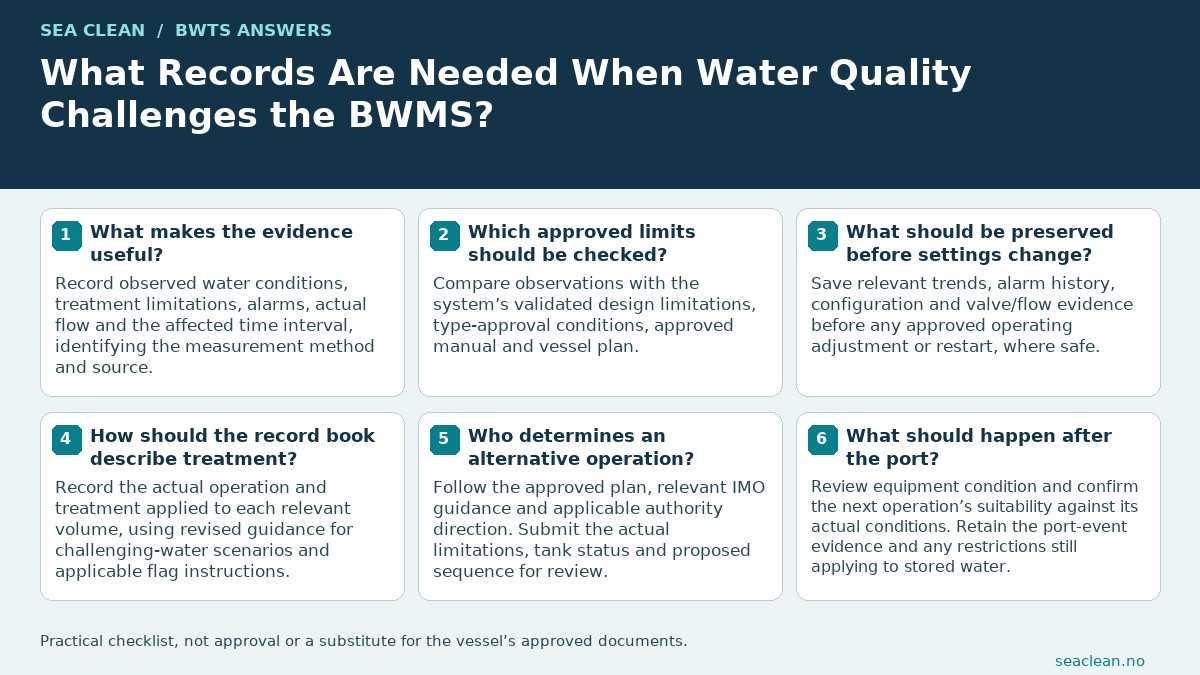
What makes the evidence useful?
Record observed water conditions, treatment limitations, alarms, actual flow and the affected time interval, identifying the measurement method and source.
Avoid unsupported statements such as 'port water impossible'. Show how the installed system encountered its documented limitation in the actual operation.
Which approved limits should be checked?
Compare observations with the system’s validated design limitations, type-approval conditions, approved manual and vessel plan.
There is no single universal turbidity, UV-transmittance or salinity threshold for every BWMS. Do not borrow another maker’s operating limit.
Related guidance: BWTS Record Book Entries After an Alarm, Repair or Failed Operation
What should be preserved before settings change?
Save relevant trends, alarm history, configuration and valve/flow evidence before any approved operating adjustment or restart, where safe.
Keep initial symptoms separate from confirmed causes. Fouling, sensor faults or inadequate utilities can resemble difficult water and require a different response.
How should the record book describe treatment?
Record the actual operation and treatment applied to each relevant volume, using revised guidance for challenging-water scenarios and applicable flag instructions.
Failures/inoperabilities and any exceptional operations still need their appropriate entries. A general remark must not conceal a missing failure or untreated portion.
Who determines an alternative operation?
Follow the approved plan, relevant IMO guidance and applicable authority direction. Submit the actual limitations, tank status and proposed sequence for review.
Do not imply that commercial delay, a nearby vessel’s practice or a vendor email automatically permits an alternative ballast operation.
Related guidance: What Should an Electronic Ballast Record Book Export Preserve?
What should happen after the port?
Review equipment condition and confirm the next operation’s suitability against its actual conditions. Retain the port-event evidence and any restrictions still applying to stored water.
Use repeated events to improve planning, spares, intake assessment and crew briefing, not to create an undocumented standing bypass rule.
Frequently asked questions
Does poor water quality automatically permit bypass?
No. Follow the approved plan, applicable guidance and relevant authority requirements.
Is turbidity the same as UV transmittance?
No. They are different properties and their operational relevance depends on the installed technology.
Can another vessel’s approval be reused?
No. Review the vessel, equipment, operation and applicable authority conditions independently.
Does leaving the port close the issue?
No. Affected stored water and outstanding equipment restrictions may remain.
Sources
- IMO — BWM.2/Circ.80/Rev.1: record-keeping and reporting — The linked PDF is the revised circular dated 24 October 2024, despite its shorter filename.
- IMO — MEPC.369(80): revised record-book form
- IMO — BWMS Code, MEPC.300(72) — Approval framework, monitoring, system design limitations and biological performance; not a universal maker procedure.
Related articles
- What Must Be Recorded When Ballast Sediment Is Removed?
- What Should an Electronic Ballast Record Book Export Preserve?
- BWTS Record Book Entries After an Alarm, Repair or Failed Operation
- BWMS Logs and Record Books: Building a PSC Evidence Pack
- Which Ballast Records Need Custody Control After Management Changes?
- What Is a Ballast Water Treatment System? Explained
Request spares, calibration or ballast-water testing
Include BWMS brand/model, vessel/IMO number, port/terminal, date/ETA and scope or part numbers. These links prepare an email draft; you must send it yourself.
- Request a parts quote — Sensors, TRO reagents, calibration kits and replacement parts. Confirm compatibility, availability and delivery for your installed system.
- Request a calibration booking — Annual instrument calibration with a calibration certificate for the work completed. OEM instructions, drift or applicable rules may require earlier work.
- Request testing coordination — Arrange sampling and testing with an appropriately qualified party for your IMO D-2, commissioning or other stated purpose.
Authorised Headway agent. Other-brand enquiries are independently reviewed; no OEM authorisation is claimed. Sea Clean is not an accredited laboratory or approving authority. Calibration does not demonstrate biological D-2 compliance. Attendance, testing scope and parts delivery are confirmed per enquiry.