Why Does a TRO Reading Lag Behind a Ballast Operation?
Updated
A TRO analyser reports the water reaching it, not necessarily the water passing the main line at that exact second. Sample transport, analyser cycling and software timestamps must be understood before a delayed reading is blamed on calibration.
Request BWTS spare parts, annual calibration or ballast-water testing
Key takeaways
- TRO describes water reaching the analyser.
- Check actual sample flow.
- Estimate volume divided by flow.
- Include analyser cycle delay.
- Compare aligned, stable conditions.
- Do not adjust away a sampling problem.
What causes the transport delay?
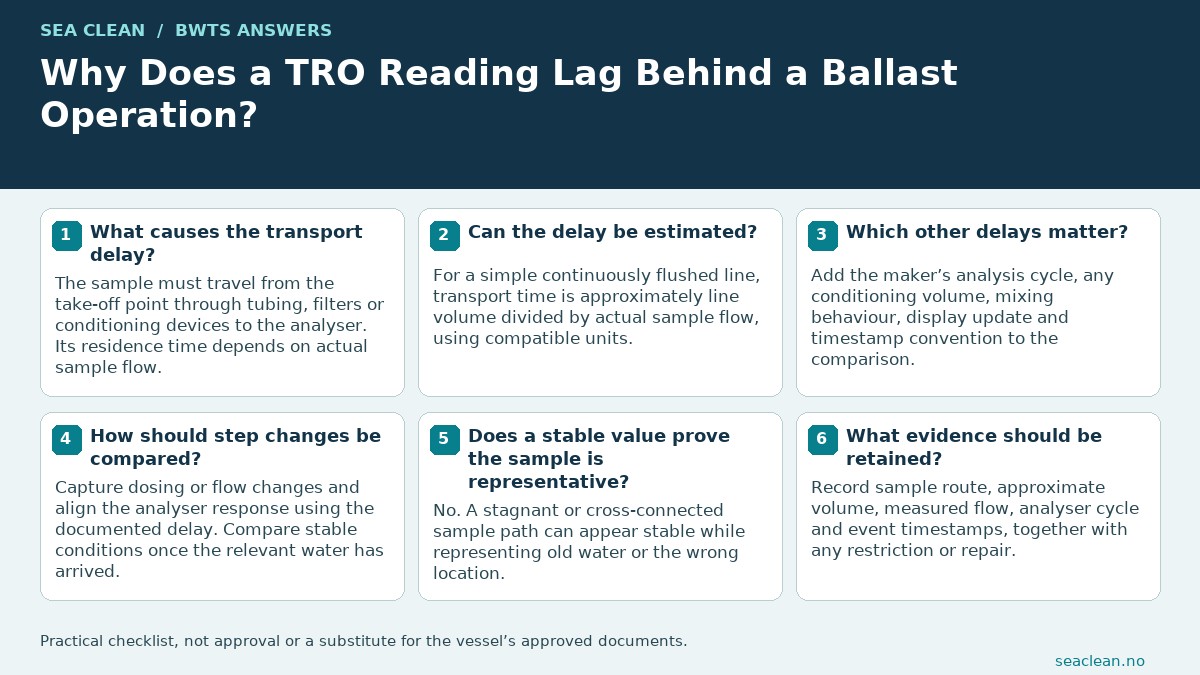
The sample must travel from the take-off point through tubing, filters or conditioning devices to the analyser. Its residence time depends on actual sample flow.
A long narrow line, restricted filter or reduced sample flow can delay the arrival of changed water even while the main ballast flow is high.
Can the delay be estimated?
For a simple continuously flushed line, transport time is approximately line volume divided by actual sample flow, using compatible units.
For example, 1.5 litres at 0.5 litres per minute implies roughly three minutes of transport, before analyser and other delays; this is illustrative, not an acceptance limit.
Related guidance: BWTS Sample-Line Design and Conditioning: Preventing Misleading Readings
Which other delays matter?
Add the maker’s analysis cycle, any conditioning volume, mixing behaviour, display update and timestamp convention to the comparison.
A sample result may be timestamped at cycle start, completion or transmission. Verify the convention instead of aligning every event to screen-refresh time.
How should step changes be compared?
Capture dosing or flow changes and align the analyser response using the documented delay. Compare stable conditions once the relevant water has arrived.
Do not repeatedly increase dosing because an expected response has not yet reached the analyser. Follow the approved control procedure and limits.
Does a stable value prove the sample is representative?
No. A stagnant or cross-connected sample path can appear stable while representing old water or the wrong location.
Verify route, actual flow, flushing and conditioning under the OEM instructions before adjusting the sensor or interpreting the value operationally.
Related guidance: Can Air Bubbles Cause Unstable TRO Analyser Readings?
What evidence should be retained?
Record sample route, approximate volume, measured flow, analyser cycle and event timestamps, together with any restriction or repair.
If transport behaviour changes, assess the cause and approved configuration implications. Do not alter tubing or controller delays without the necessary technical review.
Frequently asked questions
Does the main flow determine sample delay?
Not directly. The sample line’s own volume and actual flow determine transport delay.
Is three minutes always acceptable?
No. The example is arithmetic only; use the approved system’s requirements.
Can repeated dosing changes make interpretation harder?
Yes. Overlapping delayed responses can conceal which change caused a reading.
Should the analyser be recalibrated first?
Check representative sample delivery and timing before assuming calibration error.
Sources
- IMO — BWMS Code, MEPC.300(72) — Approval framework, monitoring, system design limitations and biological performance; not a universal maker procedure.
- IMO — BWM Convention and implementation guidelines
Related articles
- Why Can Two BWTS Salinity Readings Disagree?
- Can Air Bubbles Cause Unstable TRO Analyser Readings?
- BWTS Sample-Line Design and Conditioning: Preventing Misleading Readings
- BWTS Calibration Calendar and Instrument Register
- What Is a Ballast Water Treatment System? Explained
- How Does BWTS Installation Work? Step by Step
Request spares, calibration or ballast-water testing
Include BWMS brand/model, vessel/IMO number, port/terminal, date/ETA and scope or part numbers. These links prepare an email draft; you must send it yourself.
- Request a parts quote — Sensors, TRO reagents, calibration kits and replacement parts. Confirm compatibility, availability and delivery for your installed system.
- Request a calibration booking — Annual instrument calibration with a calibration certificate for the work completed. OEM instructions, drift or applicable rules may require earlier work.
- Request testing coordination — Arrange sampling and testing with an appropriately qualified party for your IMO D-2, commissioning or other stated purpose.
Authorised Headway agent. Other-brand enquiries are independently reviewed; no OEM authorisation is claimed. Sea Clean is not an accredited laboratory or approving authority. Calibration does not demonstrate biological D-2 compliance. Attendance, testing scope and parts delivery are confirmed per enquiry.