Can Air Bubbles Cause Unstable TRO Analyser Readings?
Updated
Air can disturb sample delivery or optical measurement in some analysers. The useful question is where it enters and how it affects the installed method—not whether a displayed fluctuation can be hidden with damping.
Request BWTS spare parts, annual calibration or ballast-water testing
Key takeaways
- Check method-specific bubble effects.
- Inspect suction-side air sources.
- Correlate values with sample flow.
- Repair delivery before recalibration.
- Review any hydraulic modification.
- Verify stability under real conditions.
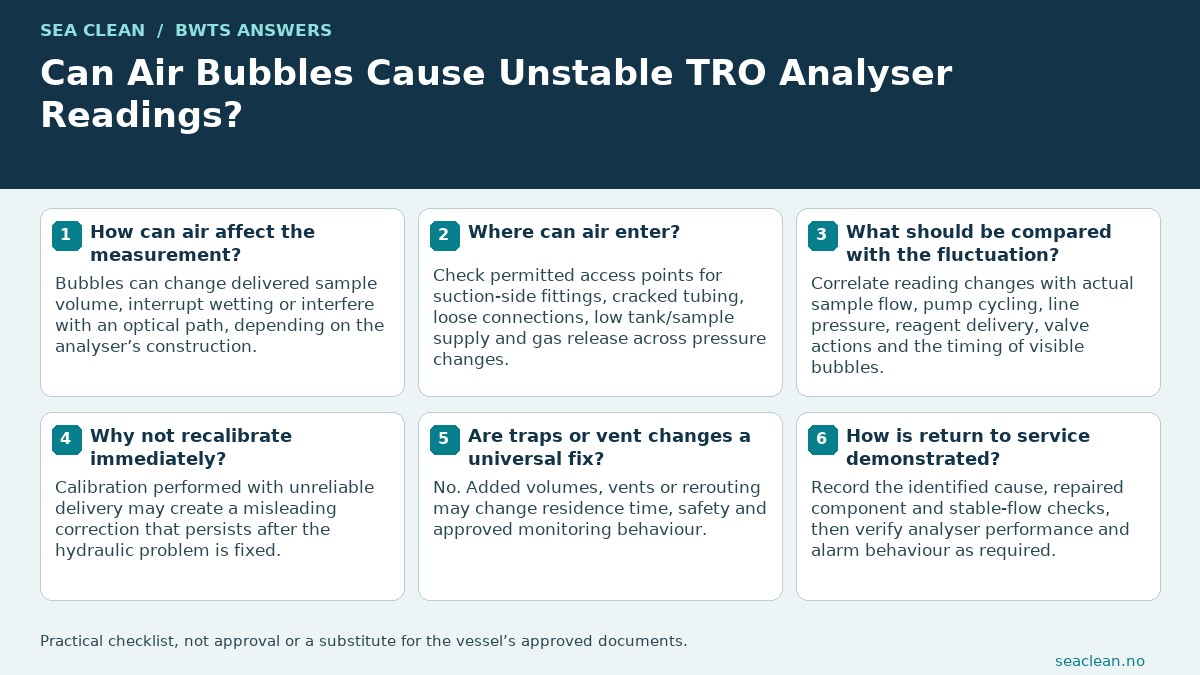
How can air affect the measurement?
Bubbles can change delivered sample volume, interrupt wetting or interfere with an optical path, depending on the analyser’s construction.
Use the maker’s troubleshooting guidance to identify relevant symptoms. Do not generalise every TRO technology as having the same bubble sensitivity.
Where can air enter?
Check permitted access points for suction-side fittings, cracked tubing, loose connections, low tank/sample supply and gas release across pressure changes.
A leak under suction may admit air without an obvious outward water leak. Inspect safely under the approved isolation procedure.
Related guidance: BWTS Sample-Line Design and Conditioning: Preventing Misleading Readings
What should be compared with the fluctuation?
Correlate reading changes with actual sample flow, pump cycling, line pressure, reagent delivery, valve actions and the timing of visible bubbles.
Photograph or trend relevant evidence where safe. One still image cannot establish whether the path remained continuously flushed during the operation.
Why not recalibrate immediately?
Calibration performed with unreliable delivery may create a misleading correction that persists after the hydraulic problem is fixed.
Stabilise representative sample delivery first, then perform the required verification or calibration under the OEM method and retain as-found evidence.
Are traps or vent changes a universal fix?
No. Added volumes, vents or rerouting may change residence time, safety and approved monitoring behaviour.
Obtain the necessary maker/configuration review before modification. Do not vent chemical or potentially hazardous sample paths casually into the machinery space.
Related guidance: How Can Reagent Lot, Expiry and Storage Affect TRO Results?
How is return to service demonstrated?
Record the identified cause, repaired component and stable-flow checks, then verify analyser performance and alarm behaviour as required.
Keep the operating conditions and any remaining limitation visible. A temporarily smooth display is not evidence that intermittent air entry has been removed.
Frequently asked questions
Must an air leak produce visible water leakage?
No. Suction-side leaks can draw air inward without obvious outward leakage.
Can display damping fix the cause?
No. It may hide fluctuations without correcting sample delivery.
Are added air traps always permitted?
No. Review their impact on the approved sample arrangement and safety.
Does one stable test close an intermittent fault?
Not necessarily. Verify relevant operating conditions and recurrence risk.
Sources
- IMO — BWMS Code, MEPC.300(72) — Approval framework, monitoring, system design limitations and biological performance; not a universal maker procedure.
- IMO — BWM Convention and implementation guidelines
Related articles
- Why Does a TRO Reading Lag Behind a Ballast Operation?
- How Can Reagent Lot, Expiry and Storage Affect TRO Results?
- BWTS Sample-Line Design and Conditioning: Preventing Misleading Readings
- BWTS Calibration Calendar and Instrument Register
- What Is a Ballast Water Treatment System? Explained
- How Does BWTS Installation Work? Step by Step
Request spares, calibration or ballast-water testing
Include BWMS brand/model, vessel/IMO number, port/terminal, date/ETA and scope or part numbers. These links prepare an email draft; you must send it yourself.
- Request a parts quote — Sensors, TRO reagents, calibration kits and replacement parts. Confirm compatibility, availability and delivery for your installed system.
- Request a calibration booking — Annual instrument calibration with a calibration certificate for the work completed. OEM instructions, drift or applicable rules may require earlier work.
- Request testing coordination — Arrange sampling and testing with an appropriately qualified party for your IMO D-2, commissioning or other stated purpose.
Authorised Headway agent. Other-brand enquiries are independently reviewed; no OEM authorisation is claimed. Sea Clean is not an accredited laboratory or approving authority. Calibration does not demonstrate biological D-2 compliance. Attendance, testing scope and parts delivery are confirmed per enquiry.