Why Can Two BWTS Salinity Readings Disagree?
Updated
A salinity comparison is meaningful only when the measurements use compatible methods and conditions. Temperature compensation, conversion scales and sample timing can explain disagreement without proving that either instrument needs adjustment.
Request BWTS spare parts, annual calibration or ballast-water testing
Key takeaways
- Confirm the actual measurand.
- Compare compatible units and scales.
- Check temperature compensation.
- Use representative, aligned samples.
- Verify against suitable references.
- Apply the installed system’s limits.
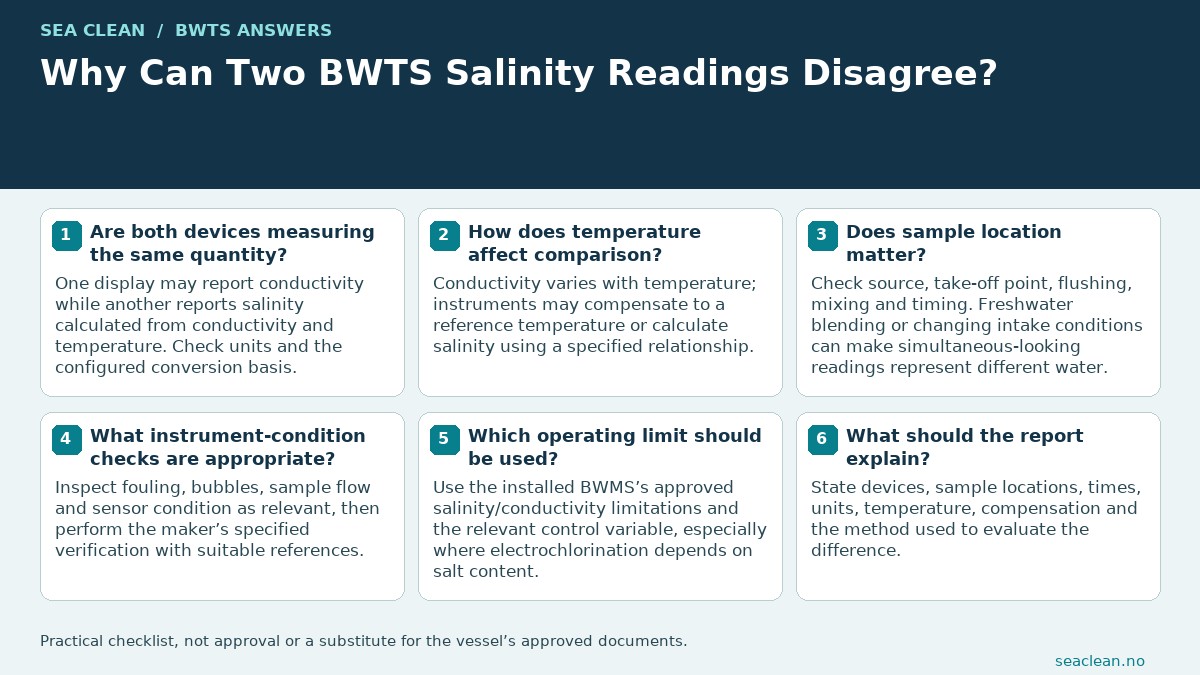
Are both devices measuring the same quantity?
One display may report conductivity while another reports salinity calculated from conductivity and temperature. Check units and the configured conversion basis.
Do not compare a conductivity number directly with a salinity number, even if both appear on the same BWMS screen.
How does temperature affect comparison?
Conductivity varies with temperature; instruments may compensate to a reference temperature or calculate salinity using a specified relationship.
Verify actual sample temperature and compensation settings. A handheld sample warming on deck may differ from an inline measurement taken earlier.
Related guidance: BWTS Sample-Line Design and Conditioning: Preventing Misleading Readings
Does sample location matter?
Check source, take-off point, flushing, mixing and timing. Freshwater blending or changing intake conditions can make simultaneous-looking readings represent different water.
Take representative comparison samples under the relevant procedure. Do not assume a bottle from a stagnant tap reflects the main treatment inlet.
What instrument-condition checks are appropriate?
Inspect fouling, bubbles, sample flow and sensor condition as relevant, then perform the maker’s specified verification with suitable references.
Keep reference identity, temperature and results. Do not adjust two devices toward each other without establishing which comparison is reliable.
Which operating limit should be used?
Use the installed BWMS’s approved salinity/conductivity limitations and the relevant control variable, especially where electrochlorination depends on salt content.
There is no universal low-salinity threshold or freshwater workaround for all systems. Follow the approved water/utility arrangement.
Related guidance: Why Does a TRO Reading Lag Behind a Ballast Operation?
What should the report explain?
State devices, sample locations, times, units, temperature, compensation and the method used to evaluate the difference.
Separate measurement discrepancy from system suitability. Two agreeing sensors do not establish that the water is within the BWMS’s approved operating boundary.
Frequently asked questions
Is conductivity identical to salinity?
No. Salinity may be calculated using conductivity, temperature and a defined relationship.
Can sample warming change the comparison?
Yes. Method and compensation settings determine how temperature influences reported values.
Should one device be adjusted to match the other?
Not without a reliable reference and documented method.
Does agreement prove the BWMS can treat the water?
No. Compare the actual conditions with its approved operating limitations separately.
Sources
- IMO — BWMS Code, MEPC.300(72) — Approval framework, monitoring, system design limitations and biological performance; not a universal maker procedure.
- IMO — BWM Convention and implementation guidelines
Related articles
- Why Is the BWTS Totaliser Different from the Ballast Pump Total?
- Why Does a TRO Reading Lag Behind a Ballast Operation?
- BWTS Sample-Line Design and Conditioning: Preventing Misleading Readings
- BWTS Calibration Calendar and Instrument Register
- Salinity and Temperature Limits of BWTS Systems
- What Is a Ballast Water Treatment System? Explained
Request spares, calibration or ballast-water testing
Include BWMS brand/model, vessel/IMO number, port/terminal, date/ETA and scope or part numbers. These links prepare an email draft; you must send it yourself.
- Request a parts quote — Sensors, TRO reagents, calibration kits and replacement parts. Confirm compatibility, availability and delivery for your installed system.
- Request a calibration booking — Annual instrument calibration with a calibration certificate for the work completed. OEM instructions, drift or applicable rules may require earlier work.
- Request testing coordination — Arrange sampling and testing with an appropriately qualified party for your IMO D-2, commissioning or other stated purpose.
Authorised Headway agent. Other-brand enquiries are independently reviewed; no OEM authorisation is claimed. Sea Clean is not an accredited laboratory or approving authority. Calibration does not demonstrate biological D-2 compliance. Attendance, testing scope and parts delivery are confirmed per enquiry.