How Can Reagent Lot, Expiry and Storage Affect TRO Results?
Updated
A reagent-driven analyser depends on more than the instrument’s certificate. Lot traceability, storage history, correct preparation and sample conditions help explain why results changed after a refill or shipment.
Request BWTS spare parts, annual calibration or ballast-water testing
Key takeaways
- Use the exact approved reagent.
- Record lot and relevant dates.
- Check storage and shipping conditions.
- Follow product-specific preparation.
- Separate refill from calibration.
- Investigate lot changes with controlled comparisons.
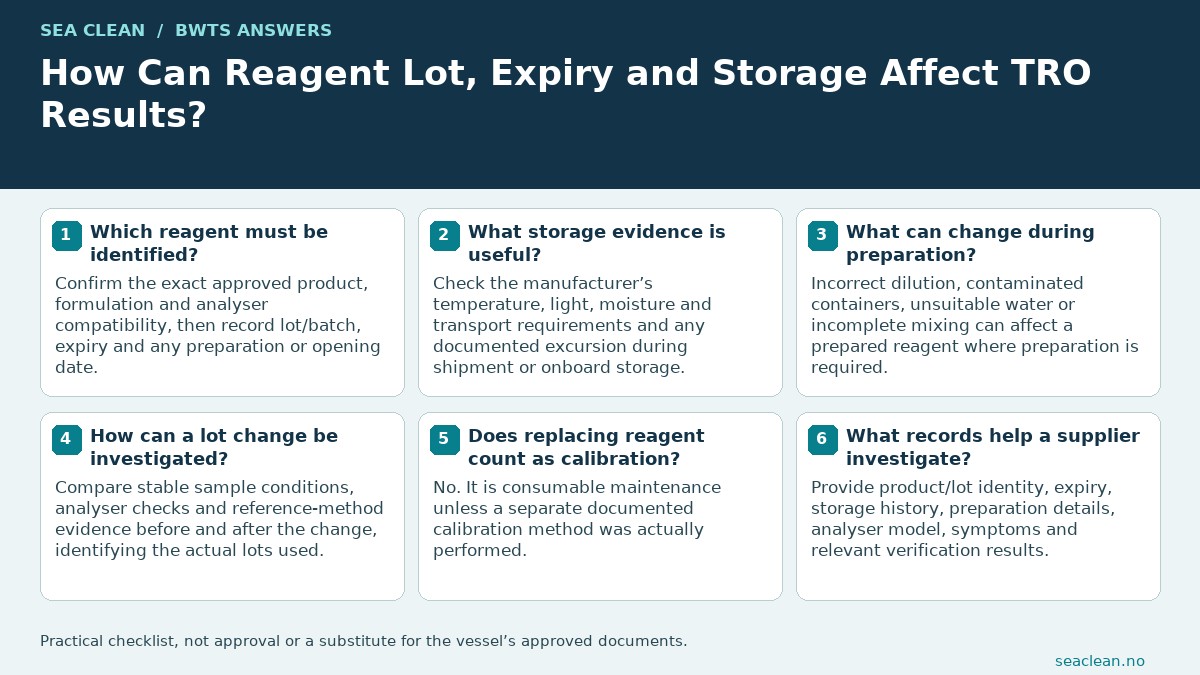
Which reagent must be identified?
Confirm the exact approved product, formulation and analyser compatibility, then record lot/batch, expiry and any preparation or opening date.
Do not substitute a visually similar reagent or change concentration based on another analyser’s instructions. Chemical identity and dosing method matter.
What storage evidence is useful?
Check the manufacturer’s temperature, light, moisture and transport requirements and any documented excursion during shipment or onboard storage.
An unexpired label does not establish correct storage. Avoid assuming a universal shelf life or permissible temperature for every formulation.
Related guidance: BWTS Sample-Line Design and Conditioning: Preventing Misleading Readings
What can change during preparation?
Incorrect dilution, contaminated containers, unsuitable water or incomplete mixing can affect a prepared reagent where preparation is required.
Follow the product’s actual method. Do not invent a fleet-wide dilution recipe for products supplied ready to use.
How can a lot change be investigated?
Compare stable sample conditions, analyser checks and reference-method evidence before and after the change, identifying the actual lots used.
A changed reading is a clue, not proof that the new lot is defective. Sample conditions, pump delivery and optics may have changed too.
Does replacing reagent count as calibration?
No. It is consumable maintenance unless a separate documented calibration method was actually performed.
Record replacement and any subsequent verification distinctly. Do not update the calibration date solely because the reagent container was changed.
Related guidance: Is Low UV Transmittance Caused by the Water or the Sensor?
What records help a supplier investigate?
Provide product/lot identity, expiry, storage history, preparation details, analyser model, symptoms and relevant verification results.
Preserve retained material only where safe and appropriate under the supplier’s instructions. Never describe an unexplained lot as proven defective without evidence.
Frequently asked questions
Does unexpired reagent guarantee correct results?
No. Storage, preparation, sample delivery and analyser condition also matter.
Can another brand’s dilution instructions be used?
Not without a documented compatibility basis and the applicable approved instructions.
Should reagent refill reset calibration due?
No, not unless the required separate calibration was performed and documented.
Does a changed result prove a bad lot?
No. Establish controlled comparison and exclude other changed conditions.
Sources
- IMO — BWMS Code, MEPC.300(72) — Approval framework, monitoring, system design limitations and biological performance; not a universal maker procedure.
- IMO — BWM Convention and implementation guidelines
Related articles
- Can Air Bubbles Cause Unstable TRO Analyser Readings?
- Is Low UV Transmittance Caused by the Water or the Sensor?
- BWTS Sample-Line Design and Conditioning: Preventing Misleading Readings
- BWTS Calibration Calendar and Instrument Register
- Can a TRO Reagent Shipment Be Used After an Uncertain Temperature Excursion?
- What Is a Ballast Water Treatment System? Explained
Request spares, calibration or ballast-water testing
Include BWMS brand/model, vessel/IMO number, port/terminal, date/ETA and scope or part numbers. These links prepare an email draft; you must send it yourself.
- Request a parts quote — Sensors, TRO reagents, calibration kits and replacement parts. Confirm compatibility, availability and delivery for your installed system.
- Request a calibration booking — Annual instrument calibration with a calibration certificate for the work completed. OEM instructions, drift or applicable rules may require earlier work.
- Request testing coordination — Arrange sampling and testing with an appropriately qualified party for your IMO D-2, commissioning or other stated purpose.
Authorised Headway agent. Other-brand enquiries are independently reviewed; no OEM authorisation is claimed. Sea Clean is not an accredited laboratory or approving authority. Calibration does not demonstrate biological D-2 compliance. Attendance, testing scope and parts delivery are confirmed per enquiry.