Is Low UV Transmittance Caused by the Water or the Sensor?
Updated
A low UVT indication can reflect actual water properties or a measurement problem. Distinguish UV transmittance from reactor intensity and investigate the approved measurement path before treating one low value as a complete diagnosis.
Request BWTS spare parts, annual calibration or ballast-water testing
Key takeaways
- UVT is not reactor intensity.
- Compare equivalent measurement methods.
- Check water and optical surfaces.
- Review sample flow and bubbles.
- Do not lower limits casually.
- Document mixed causes honestly.
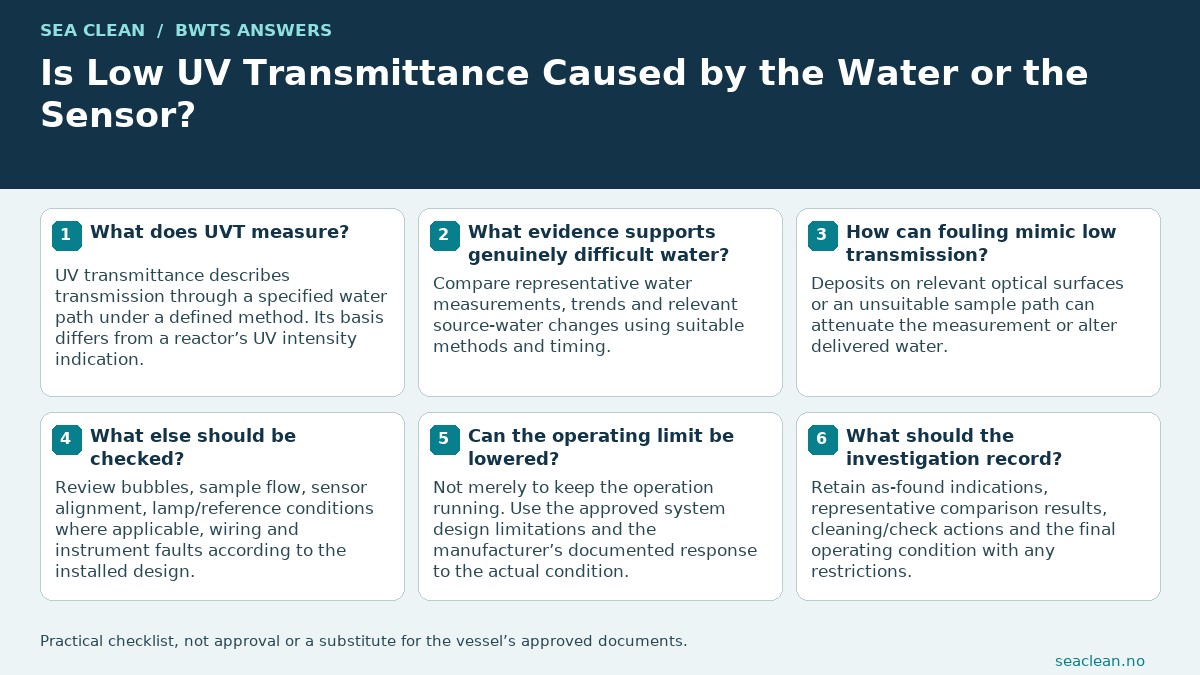
What does UVT measure?
UV transmittance describes transmission through a specified water path under a defined method. Its basis differs from a reactor’s UV intensity indication.
Use the instrument’s units, path length and wavelength conventions. A percentage from a different test configuration may not be directly comparable.
What evidence supports genuinely difficult water?
Compare representative water measurements, trends and relevant source-water changes using suitable methods and timing.
Avoid assuming turbidity alone explains UVT. Dissolved substances and other properties can affect transmission without the same turbidity response.
Related guidance: BWTS Sample-Line Design and Conditioning: Preventing Misleading Readings
How can fouling mimic low transmission?
Deposits on relevant optical surfaces or an unsuitable sample path can attenuate the measurement or alter delivered water.
Inspect and clean only under the OEM procedure and safe isolation. A cleaning improvement is evidence of fouling influence, not proof of all treatment performance.
What else should be checked?
Review bubbles, sample flow, sensor alignment, lamp/reference conditions where applicable, wiring and instrument faults according to the installed design.
Do not interchange UVT and intensity sensors or apply another maker’s compensation method. Their diagnostic checks and control roles can differ.
Can the operating limit be lowered?
Not merely to keep the operation running. Use the approved system design limitations and the manufacturer’s documented response to the actual condition.
Changing settings or alarm limits can affect the approval boundary. Reduced flow, alternative operation or stopping must follow the authorised procedure.
Related guidance: Why Is the BWTS Totaliser Different from the Ballast Pump Total?
What should the investigation record?
Retain as-found indications, representative comparison results, cleaning/check actions and the final operating condition with any restrictions.
Where poor water and measurement faults coexist, document both. Do not label the whole event as either 'sensor fault' or 'bad port water' without support.
Frequently asked questions
Does clear-looking water guarantee good UVT?
No. Dissolved properties can reduce transmission without obvious cloudiness.
Are UV intensity and UVT interchangeable?
No. They represent different measurements and may have different control roles.
Does cleaning prove D-2 compliance?
No. It can restore equipment condition but is not a biological discharge test.
Can another BWMS’s UVT limit be used?
No. Use the installed system’s approved boundaries and instructions.
Sources
- IMO — BWMS Code, MEPC.300(72) — Approval framework, monitoring, system design limitations and biological performance; not a universal maker procedure.
- IMO — BWM Convention and implementation guidelines
Related articles
- How Can Reagent Lot, Expiry and Storage Affect TRO Results?
- Why Is the BWTS Totaliser Different from the Ballast Pump Total?
- BWTS Sample-Line Design and Conditioning: Preventing Misleading Readings
- BWTS Calibration Calendar and Instrument Register
- Can a BWTS Operate in Low-Salinity Water?
- What Is a Ballast Water Treatment System? Explained
Request spares, calibration or ballast-water testing
Include BWMS brand/model, vessel/IMO number, port/terminal, date/ETA and scope or part numbers. These links prepare an email draft; you must send it yourself.
- Request a parts quote — Sensors, TRO reagents, calibration kits and replacement parts. Confirm compatibility, availability and delivery for your installed system.
- Request a calibration booking — Annual instrument calibration with a calibration certificate for the work completed. OEM instructions, drift or applicable rules may require earlier work.
- Request testing coordination — Arrange sampling and testing with an appropriately qualified party for your IMO D-2, commissioning or other stated purpose.
Authorised Headway agent. Other-brand enquiries are independently reviewed; no OEM authorisation is claimed. Sea Clean is not an accredited laboratory or approving authority. Calibration does not demonstrate biological D-2 compliance. Attendance, testing scope and parts delivery are confirmed per enquiry.