Onboard BWTS vs Shore-Side Treatment: Decision Guide
Updated
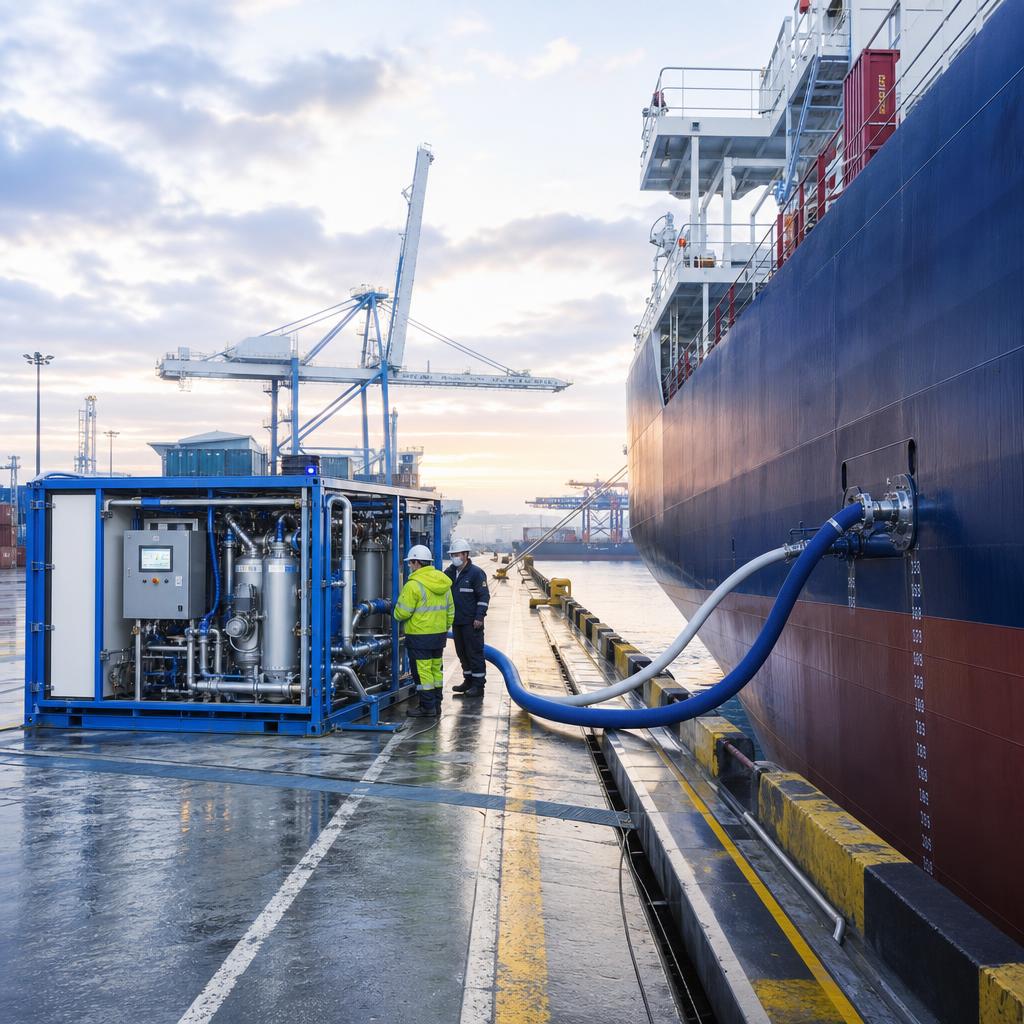
Onboard BWTS generally gives a vessel operational independence, while shore-side treatment can address defined port, project or contingency scenarios. The right route depends on trading pattern, hydraulic access, responsibility boundaries and local acceptance rather than a generic technology ranking.
Key takeaways
- Start with a documented vessel, berth and operating case for the treatment location.
- Confirm hose routing, access, isolation, power and control interfaces before mobilisation.
- Size transfer activity around verified flow, pressure, time window and drainage constraints.
- Assign responsibility for monitoring, solids, records and emergency response in writing.
- Check applicable flag, port, class, authority, permit and approval requirements project by project.
- Use the final operating plan and evidence pack to support a controlled handover.
Set the Operating and Trading Case
Onboard equipment travels with the vessel and suits variable trading, while a shore arrangement depends on a usable berth, local service availability and a defined connection. For the onboard versus shore-side treatment decision, that point belongs under “Set the Operating and Trading Case” rather than in a late site query. It directly shapes the treatment location.
Turn the requirement into a measurable check: identify the responsible party, the source document and the point at which it will be verified. Review it with ship and shore teams before the ballast sequence starts. Escalate a mismatch rather than relying on an operational workaround.
Keep the resulting evidence with the operating plan, including drawings, readings, photographs or signed interface checks as appropriate. The applicable flag, port, class, authority, permit and approval requirements still require project-specific confirmation. This record helps distinguish a controlled limitation from an undocumented assumption.
Compare Vessel and Shore Interfaces
Compare vessel manifold position and pump capability with shore hose routes, utility availability, traffic segregation and the terminal's ability to allocate working space. For the onboard versus shore-side treatment decision, that point belongs under “Compare Vessel and Shore Interfaces” rather than in a late site query. It directly shapes the treatment location.
Turn the requirement into a measurable check: identify the responsible party, the source document and the point at which it will be verified. Review it with ship and shore teams before the ballast sequence starts. Escalate a mismatch rather than relying on an operational workaround.
Keep the resulting evidence with the operating plan, including drawings, readings, photographs or signed interface checks as appropriate. The applicable flag, port, class, authority, permit and approval requirements still require project-specific confirmation. This record helps distinguish a controlled limitation from an undocumented assumption.
Assess Capacity and Scheduling
A shore option must fit the port-call window and may need buffer capacity or staged transfer when the berth schedule cannot tolerate a continuous operation. For the onboard versus shore-side treatment decision, that point belongs under “Assess Capacity and Scheduling” rather than in a late site query. It directly shapes the treatment location.
Turn the requirement into a measurable check: identify the responsible party, the source document and the point at which it will be verified. Review it with ship and shore teams before the ballast sequence starts. Escalate a mismatch rather than relying on an operational workaround.
Keep the resulting evidence with the operating plan, including drawings, readings, photographs or signed interface checks as appropriate. The applicable flag, port, class, authority, permit and approval requirements still require project-specific confirmation. This record helps distinguish a controlled limitation from an undocumented assumption.
Allocate Ownership and Operating Duties
Allocate responsibility for treatment operation, isolation, data capture, solids and emergency response before choosing a commercial model. For the onboard versus shore-side treatment decision, that point belongs under “Allocate Ownership and Operating Duties” rather than in a late site query. It directly shapes the treatment location.
Turn the requirement into a measurable check: identify the responsible party, the source document and the point at which it will be verified. Review it with ship and shore teams before the ballast sequence starts. Escalate a mismatch rather than relying on an operational workaround.
Keep the resulting evidence with the operating plan, including drawings, readings, photographs or signed interface checks as appropriate. The applicable flag, port, class, authority, permit and approval requirements still require project-specific confirmation. This record helps distinguish a controlled limitation from an undocumented assumption.
Review Contingency and Resilience
Shore-side capability can be valuable for a contingency or defined project, but it should not be described as an automatic replacement for onboard obligations. For the onboard versus shore-side treatment decision, that point belongs under “Review Contingency and Resilience” rather than in a late site query. It directly shapes the treatment location.
Turn the requirement into a measurable check: identify the responsible party, the source document and the point at which it will be verified. Review it with ship and shore teams before the ballast sequence starts. Escalate a mismatch rather than relying on an operational workaround.
Keep the resulting evidence with the operating plan, including drawings, readings, photographs or signed interface checks as appropriate. The applicable flag, port, class, authority, permit and approval requirements still require project-specific confirmation. This record helps distinguish a controlled limitation from an undocumented assumption.
Confirm the Acceptance Route
Acceptance turns on the applicable flag, port, authority, permit and project documentation; no generic comparison can determine that outcome. For the onboard versus shore-side treatment decision, that point belongs under “Confirm the Acceptance Route” rather than in a late site query. It directly shapes the treatment location.
Turn the requirement into a measurable check: identify the responsible party, the source document and the point at which it will be verified. Review it with ship and shore teams before the ballast sequence starts. Escalate a mismatch rather than relying on an operational workaround.
Keep the resulting evidence with the operating plan, including drawings, readings, photographs or signed interface checks as appropriate. The applicable flag, port, class, authority, permit and approval requirements still require project-specific confirmation. This record helps distinguish a controlled limitation from an undocumented assumption.
Frequently asked questions
When is shore-side treatment worth considering?
Onboard equipment travels with the vessel and suits variable trading, while a shore arrangement depends on a usable berth, local service availability and a defined connection. The answer must be confirmed against the actual vessel, berth and local acceptance route. Sea Clean can help coordinate the technical scope and appropriate project stakeholders, but it does not replace required authority, class or laboratory decisions.
Does shore treatment replace onboard BWTS?
Compare vessel manifold position and pump capability with shore hose routes, utility availability, traffic segregation and the terminal's ability to allocate working space. The answer must be confirmed against the actual vessel, berth and local acceptance route. Sea Clean can help coordinate the technical scope and appropriate project stakeholders, but it does not replace required authority, class or laboratory decisions.
Which interfaces drive the decision?
A shore option must fit the port-call window and may need buffer capacity or staged transfer when the berth schedule cannot tolerate a continuous operation. The answer must be confirmed against the actual vessel, berth and local acceptance route. Sea Clean can help coordinate the technical scope and appropriate project stakeholders, but it does not replace required authority, class or laboratory decisions.
Who accepts a shore-side arrangement?
Allocate responsibility for treatment operation, isolation, data capture, solids and emergency response before choosing a commercial model. The answer must be confirmed against the actual vessel, berth and local acceptance route. Sea Clean can help coordinate the technical scope and appropriate project stakeholders, but it does not replace required authority, class or laboratory decisions.