When Can a Vessel Use Port-Side Ballast Treatment?
Updated
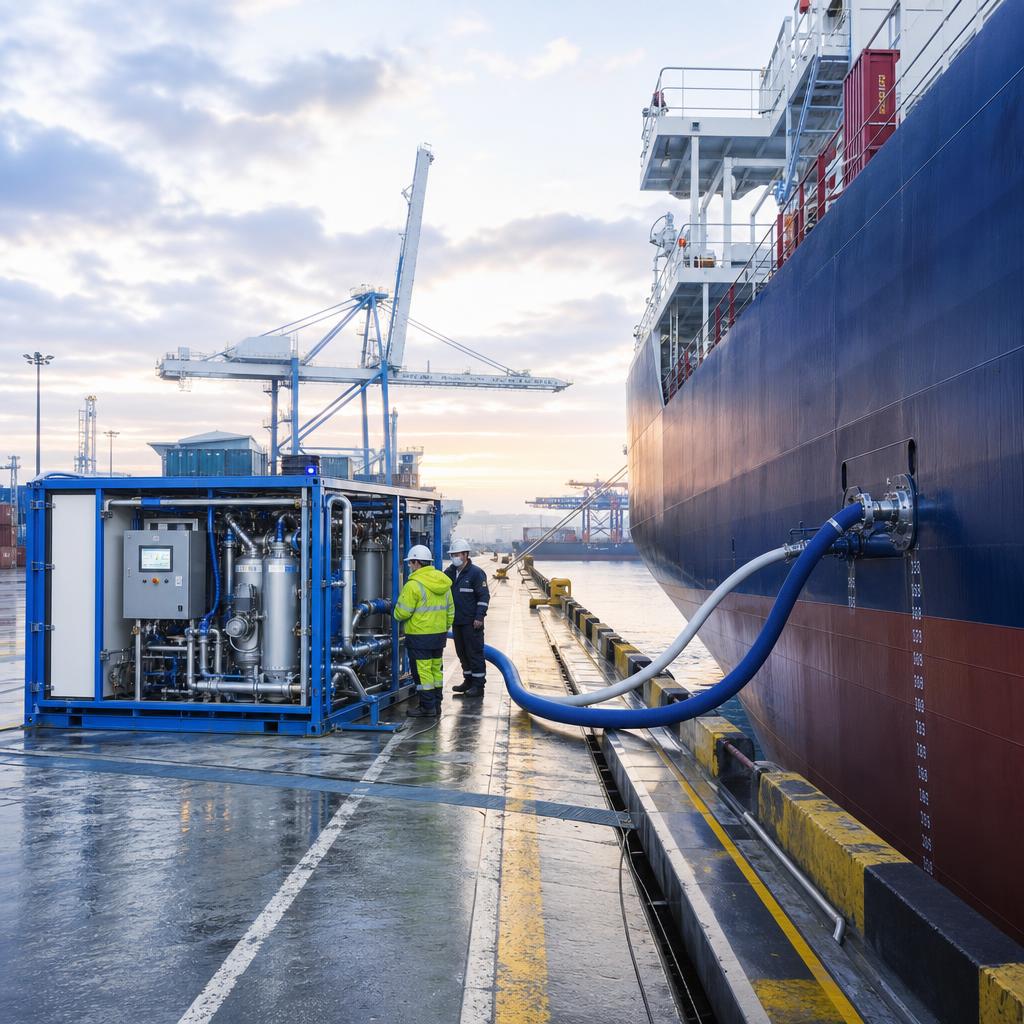
A vessel may use port-side treatment only when the proposed transfer is technically safe and accepted under the applicable vessel, port and authority framework. It should be evaluated as a documented operating case, not assumed as a universal alternative to the vessel's normal BWTS route.
Key takeaways
- The reason for using shore treatment determines the review path.
- Master and company procedures need to support the proposed transfer.
- Port and terminal acceptance should be obtained before mobilisation.
- A safe manifold and hose route remain essential.
- Notification and monitoring obligations should be agreed in advance.
- Complete records support later review by relevant parties.
Identify the trigger
Use-case identification is the starting point for the project brief. In this case, routine planning, equipment trouble and discharge restrictions require different decisions. Establish the vessel condition, voyage schedule and ballast management plan before comparing concepts, because these conditions determine whether shore-side work is practical.
The commercial case should be measured against the operating pattern rather than an equipment headline. Record the vessel condition, voyage schedule and ballast management plan alongside expected vessel demand, turnaround pressure and the consequence of an unavailable service. That creates a basis for deciding whether the option should be mobile, permanent or not pursued.
A feasibility note should state the assumptions that could change the conclusion. In particular, revisit the vessel condition, voyage schedule and ballast management plan when berth allocation, vessel mix or local rules change. This prevents a preliminary concept from being treated as an operational commitment.
Check vessel authority
Vessel-side authorization needs a physical walk-through, not just a drawing review. the master and company need a documented basis for the proposed transfer. Inspect flag instructions, class advice and management-plan procedures at the actual berth and include the people who will rig, monitor and disconnect the transfer.
Temporary interfaces should be designed for the full transfer sequence. Check flag instructions, class advice and management-plan procedures for safe access, containment, mechanical protection and an unambiguous isolation point. A route that works while idle may be unsuitable during cargo work or an emergency.
The operating procedure should identify who controls each boundary. It should cover flag instructions, class advice and management-plan procedures, communications between ship and shore, and the action to take after a leak, pressure alarm or loss of contact. Those details matter more than nominal connection compatibility.
Check port acceptance
Port-side acceptance must be calculated as a complete system rather than as a nameplate flow. the berth and receiving arrangement must be acceptable before hoses arrive. Use port authority requirements, terminal rules and local permits to establish the duty point over the expected range of vessel levels and transfer rates.
Pressure loss changes with hose length, fittings, filtration condition and elevation. Confirm port authority requirements, terminal rules and local permits using conservative fouling and operating assumptions, then agree the allowable setpoints with the vessel. This avoids forcing a shore service into a pump condition it cannot sustain.
Instrumentation should show whether the planned duty is actually being achieved. Trend port authority requirements, terminal rules and local permits with transfer volume, pressure and alarms, and preserve the data after the operation. It is the most useful evidence when a delay or abnormal stop needs explaining.
Confirm the physical transfer
Connection feasibility includes supporting systems that can be overlooked in an early layout. a suitable treatment service cannot overcome an unsafe manifold or hose route. Assess flange compatibility, pressure limit, access and emergency isolation as part of the treatment package, rather than leaving it for site mobilisation.
A workable installation provides safe access for inspection, cleaning and fault response. Verify flange compatibility, pressure limit, access and emergency isolation under normal work, night work and restricted terminal conditions. The layout should not depend on improvised cables, drains or access routes.
The design basis should also define what happens when a support service is lost. Test flange compatibility, pressure limit, access and emergency isolation against a power interruption, blocked drain, high solids load or control failure. A controlled stop is preferable to continuing a transfer without the required safeguards.
Agree monitoring and notification
Notification planning is governed by the local operating and acceptance framework. stakeholders may require notice before an unusual ballast operation starts. Confirm reporting contacts, sampling needs, monitoring points and stop criteria early with the parties whose approval, permit or instruction affects the work.
IMO G5 is guidance for reception facilities; it is not a licence or a universal technical design. Map reporting contacts, sampling needs, monitoring points and stop criteria against applicable flag, port, class, authority and discharge-permit requirements. The resulting gap list should be closed before a vessel is booked.
No port-side arrangement should be described as guaranteeing D-2 compliance or acceptance. Retain the decisions on reporting contacts, sampling needs, monitoring points and stop criteria, the agreed operating limits and the authority communications. That record makes the limits of the service clear to all parties.
Record the completed case
Post-operation documentation turns a completed transfer into an auditable operation. later review depends on a clear account of what was transferred and managed. Agree times, volumes, alarms, certificates and record-book entries before work starts so evidence is captured at the time it is created.
Useful records connect the vessel's ballast activity with shore actions and any separated-waste route. Reconcile times, volumes, alarms, certificates and record-book entries against timestamps, meter totals, alarms and the person responsible for each handover. Corrections made later are weaker than contemporaneous records.
Sampling or testing, where required, needs an agreed purpose and chain of responsibility. Sea Clean can coordinate with independent ISO 17025 laboratories and flag/class-authorised parties where required; it is not an accredited laboratory or independent certifier. Store times, volumes, alarms, certificates and record-book entries with the service report and relevant vessel documentation.
Frequently asked questions
Can a vessel decide at the berth to use shore treatment?
It should not rely on an informal last-minute decision. Transfer feasibility, service availability and required acceptance should be confirmed through the applicable process.
Does a BWMS failure automatically allow shore treatment?
No. A failure may trigger the vessel's contingency procedure, but use of a shore service remains subject to acceptance and technical feasibility.
What should be checked first?
Start with the reason for the operation and the vessel's approved documentation. Then confirm port acceptance and the physical connection.
What records are needed?
Requirements differ, but volumes, timing, monitoring, service activity and record-book entries are commonly relevant. Agree the evidence package before the job.