How Often Should BWTS Sensors Be Calibrated?
Updated
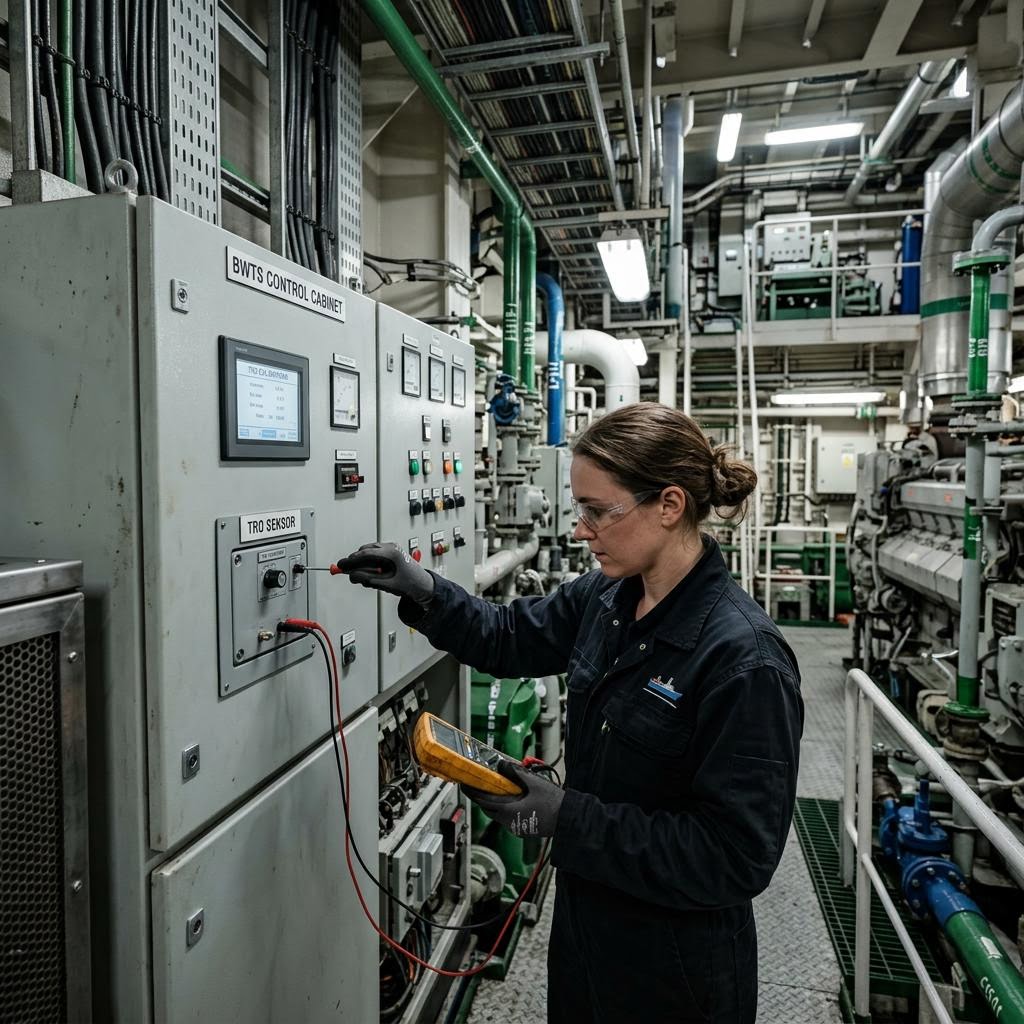
As a rule of thumb, colorimetric TRO analysers should be verified monthly and calibrated every 3-6 months or on every reagent change; UV intensity sensors are cleaned and checked at each lamp/quartz service and calibrated annually; flowmeters are verified against the OEM interval, often yearly. The controlling authority is always the manufacturer's manual and the BWMS Code (MEPC.300(72)) self-monitoring requirement, not a fixed universal number.
Request BWTS spare parts, annual calibration or ballast-water testing
Key takeaways
- Colorimetric TRO analysers should be verified about monthly, fully calibrated every 3-6 months, and always recalibrated on a reagent lot change.
- UV intensity sensors are cleaned and checked at every lamp/quartz service and calibrated or replaced against the OEM reference roughly annually.
- Flowmeters are a silent failure point: verify on the OEM interval (often annual) because drift corrupts dose per cubic metre with no alarm.
- The authoritative calibration interval is the system-specific manual behind the BWMS Code (MEPC.300(72)) type approval, not a universal number.
- Expired reagents plus a calibration never redone after a reagent change is the most common way a TRO log diverges from a PSC detailed sample.
- Keep calibration certificates and reagent lot/expiry logs with the ballast records - PSC failures are more often documentary than mechanical.
What Sensors Does a BWTS Actually Rely On?
Every type-approved ballast water treatment system carries a small set of instruments that the control logic and the discharge decision depend on. On electrochlorination and electrocatalysis systems the key one is the total residual oxidant (TRO) analyser, measuring oxidant in the low single-digit mg/L range on treatment and down to around 0.1 mg/L on discharge. UV systems instead rely on a UV intensity sensor and, usually, a UV transmittance (UVT) measurement of the incoming water.
Alongside these sit the flowmeter, which governs dose rate and rated-capacity compliance, and secondary instruments such as pressure, differential-pressure (filter dP), temperature and salinity or conductivity sensors. Each of these has its own drift behaviour and its own calibration need, and lumping them under a single interval is one of the most common maintenance mistakes crews make.
The reason calibration matters beyond good housekeeping is that under the BWMS Code the system's self-monitoring is what proves it operated within specification. If the TRO log is the vessel's evidence that discharge met the residual limit, an uncalibrated sensor makes that evidence worthless. Calibration is therefore both an operational and a compliance activity.
How Often Should the TRO Analyser Be Calibrated?
For colorimetric (DPD-based) TRO analysers the practical rhythm is: a functional verification against a known standard roughly monthly, a full calibration every three to six months, and a mandatory recalibration on every reagent lot change. Amperometric sensors need periodic electrolyte and membrane service and a calibration afterwards, typically on a similar three-to-six-month cadence depending on duty.
The single biggest driver of TRO error is reagent shelf life. Colorimetric reagents typically last only a few months once opened, and readings drift low or erratic as they age. Recalibrating on every reagent change and logging the reagent lot and expiry alongside the calibration record closes the gap where a system keeps running while its TRO log quietly diverges from reality.
Increase frequency if the vessel trades in variable salinity or turbidity, if alarms have been frequent, or if a previous calibration showed large offset. Never mask a persistent low-TRO alarm by widening the alarm band before confirming the sensor reads true against a fresh, in-date standard - that is how a vessel's own record ends up disagreeing with a port state control detailed sample.
What About UV Intensity and Flowmeter Calibration?
UV intensity sensors are checked and cleaned at every lamp and quartz-sleeve service - fouling on the sensor window reads as a false low intensity and triggers nuisance low-dose alarms. A formal calibration or sensor replacement against the OEM reference is typically annual, and a UV sensor that cannot be brought back to reference after cleaning is replaced rather than adjusted.
The flowmeter is often overlooked because it rarely alarms, yet it sets the dose per cubic metre and the rated-capacity limit. Most OEMs specify a verification or recalibration interval, frequently annual, and electromagnetic flowmeters can drift with electrode fouling or grounding faults. A flowmeter reading high makes the system believe it is dosing correctly when it is under-dosing, which is a silent compliance failure.
Salinity, conductivity, temperature, pressure and filter dP instruments should be verified at the annual service and whenever their readings look implausible. These are cheaper to replace than to chase, but a wrong salinity reading can push an electrochlorination system to under-dose in brackish water without any obvious alarm, so they are not optional extras.
Who Sets the Calibration Interval?
The authoritative source is always the system-specific operation and maintenance manual, which the type approval under the BWMS Code (MEPC.300(72)) is issued against. Manufacturers set intervals from the tested drift behaviour of their instruments, and deviating from them can be questioned at survey. Where the manual and a generic guide disagree, follow the manual.
Class and flag build on this through the survey regime: sensors are expected to be within calibration at annual and renewal surveys, and calibration certificates are part of the documentation an attending surveyor or PSC officer may ask for. There is no single regulation that states a universal calibration frequency - it is manufacturer-driven and evidenced through the vessel's records.
Sea Clean AS is an authorized Headway Technology agent for OceanGuard sensors and consumables, and provides independent, brand-agnostic calibration support, reagents and field attendance for other systems. Independent-support status is stated on every quote so there is no confusion over OEM or warranty position.
How Do You Prove Calibration to Port State Control?
The documentary chain is: a calibration certificate or record showing date, standard used and result; a reagent log showing lot and expiry; and a self-monitoring TRO or UV log that is internally consistent with the alarm history. A record book with impossibly flat readings, or reagents found expired in the locker, gives an inspector grounds to look harder and potentially to take a detailed sample.
Keep the last calibration certificate with the ballast water records rather than buried in a maintenance folder, and be able to reconcile the last few ballasting and discharge operations against the system log. This reconciliation is quick to do at sea and painful to reconstruct at the berth under inspection.
The practical discipline is small but must be built into the routine: track reagent lot and expiry, recalibrate on every reagent change, verify monthly, and print the certificate. Systems fail inspection on documentation far more often than on hardware, and calibration records are the most common weak point.
What Happens If You Skip Calibration?
A drifted TRO sensor produces one of two failures. If it reads high, the system believes it is dosing to target while under-dosing, and treated water may not actually meet the D-2 standard - an invisible failure until a compliance sample is taken. If it reads low, the system over-doses and raises nuisance alarms, wasting reagent and neutraliser and eroding crew confidence in the alarms.
A drifted UV sensor reads low from fouling and forces the lamps to full power or triggers a low-dose shutdown that stops ballasting mid-operation. On the flowmeter, drift corrupts the dose calculation across every operation without any alarm at all, making it the most dangerous instrument to leave unchecked.
The cumulative risk is a vessel whose own records look fine but whose discharge does not meet the numeric limit, discovered only at a PSC detailed sample. The cost of that - detention, delay, reputational damage - dwarfs the cost of reagents and a calibration standard, which is why calibration is a planned, logged, recurring task rather than a reactive one.
Frequently asked questions
How often should TRO sensors be calibrated?
Verify colorimetric TRO analysers against a known standard about monthly and perform a full calibration every three to six months. Always recalibrate whenever you change the reagent lot, because colorimetric reagents drift as they age and a fresh lot needs a fresh reference.
Do UV intensity sensors need calibration too?
Yes. Clean and check the UV intensity sensor at every lamp and quartz-sleeve service, since fouling reads as a false low intensity. A formal calibration or replacement against the OEM reference is typically annual, and a sensor that cannot return to reference after cleaning is replaced.
Is there a regulation that sets the calibration interval?
No single regulation states a universal frequency. Intervals come from the system-specific manual the type approval under the BWMS Code (MEPC.300(72)) is issued against, and are evidenced through the vessel's calibration records at class survey and PSC.
What does port state control want to see for calibration?
A calibration certificate showing date, standard and result; a reagent log with lot and expiry; and a self-monitoring log consistent with the alarm history. Keep these with the ballast water records so you can reconcile recent operations quickly if asked.
Sources
- IMO MEPC.300(72) BWMS Code — Type approval and self-monitoring framework
- IMO BWM Convention (D-2 standard) — Ballast Water Management Convention
Related articles
- TRO Sensor Calibration: A Step-by-Step Guide
- UV Intensity Sensor Maintenance and Calibration
- BWTS Annual Service and Calibration Schedule
- TRO Monitoring in Ballast Water Systems: Measuring Total Residual Oxidant
- What Is a Ballast Water Treatment System? Explained
- How Does BWTS Installation Work? Step by Step
Request spares, calibration or ballast-water testing
Include BWMS brand/model, vessel/IMO number, port/terminal, date/ETA and scope or part numbers. These links prepare an email draft; you must send it yourself.
- Request a parts quote — Sensors, TRO reagents, calibration kits and replacement parts. Confirm compatibility, availability and delivery for your installed system.
- Request a calibration booking — Annual instrument calibration with a calibration certificate for the work completed. OEM instructions, drift or applicable rules may require earlier work.
- Request testing coordination — Arrange sampling and testing with an appropriately qualified party for your IMO D-2, commissioning or other stated purpose.
Authorised Headway agent. Other-brand enquiries are independently reviewed; no OEM authorisation is claimed. Sea Clean is not an accredited laboratory or approving authority. Calibration does not demonstrate biological D-2 compliance. Attendance, testing scope and parts delivery are confirmed per enquiry.