BWTS Annual Service and Calibration Schedule
Updated
A workable BWTS maintenance plan layers tasks by interval: weekly checks and TRO verification; monthly sensor verification and reagent/thiosulfate stock review; quarterly TRO calibration (or on reagent change); and an annual service covering full sensor calibration, filter and UV overhaul, and record reconciliation aligned to the class annual survey. The exact intervals come from the system manual; the schedule below is a practical, defensible framework.
Request BWTS spare parts, annual calibration or ballast-water testing
Key takeaways
- Layer BWTS maintenance by interval: weekly/per-operation checks, monthly sensor verification and stock review, quarterly TRO calibration, and an annual full service.
- Verify TRO against expected values every operation and check thiosulfate level before each deballasting; catch depletion and drift before discharge.
- Full TRO calibration is every 3-6 months and on every reagent change; clean UV sensors and sleeves and track lamp run-hours on the same cadence.
- Align the annual service with the class annual survey so calibration certificates and overhaul records are current when the surveyor attends.
- Plan long-lead items - electrode replacement against amp-hours, lamp replacement against run-hours - into the docking/renewal cycle.
- The authoritative intervals are the system manual's; keep calibration certificates, lot/expiry logs and a reconciled record book to make the schedule defensible.
Why Structure Maintenance by Interval?
A BWTS has components that need attention on very different timescales - a reagent that lasts months, a lamp that lasts thousands of hours, a filter that responds to the water of the day. Lumping them into a single annual visit misses the frequent tasks that keep the system compliant between surveys, so an effective plan layers tasks by interval from weekly to annual.
The interval framework also matches how compliance is evidenced. Frequent verifications keep the self-monitoring log trustworthy day to day; the annual service produces the calibration certificates and overhaul records a surveyor expects. Both layers are needed - the annual visit alone cannot prove the system stayed in specification for the eleven months between visits.
The authoritative source for every interval is the system-specific operation and maintenance manual behind the type approval. The schedule that follows is a practical, defensible framework that suits common electrochlorination, electrocatalysis and UV systems, but where the manual specifies different intervals, the manual governs.
Weekly and Per-Operation Tasks
At the weekly and per-operation level the focus is confirmation that the system is behaving. Verify the TRO reading against expected values during ballast operations, watch that dose is reached on ballasting and residual is neutralised on discharge, and note any alarms with their resolution. On UV systems, confirm intensity and dose are being met and lamps are lit.
Check consumable levels that a single operation can deplete: thiosulfate tank level before a deballasting operation, reagent supply for the analyser, and the general condition of the plant. A quick per-operation check catches an empty neutraliser tank or a developing sensor drift before it becomes a compliance failure at discharge.
Record these checks in a way that reconciles with the ballast water record book. This running record is the raw material that makes the record book and self-monitoring log internally consistent, which is exactly what a PSC officer tests. Reconstructing it later is far harder than keeping it in real time.
Monthly and Quarterly Tasks
Monthly, verify the TRO sensor against a known standard, review reagent and neutraliser stock against expiry and trading needs, and inspect the filter dP behaviour and backflush frequency for signs of a developing screen or valve issue. Check UV sensor cleanliness and lamp run-hours against the replacement interval. These monthly touches catch drift early.
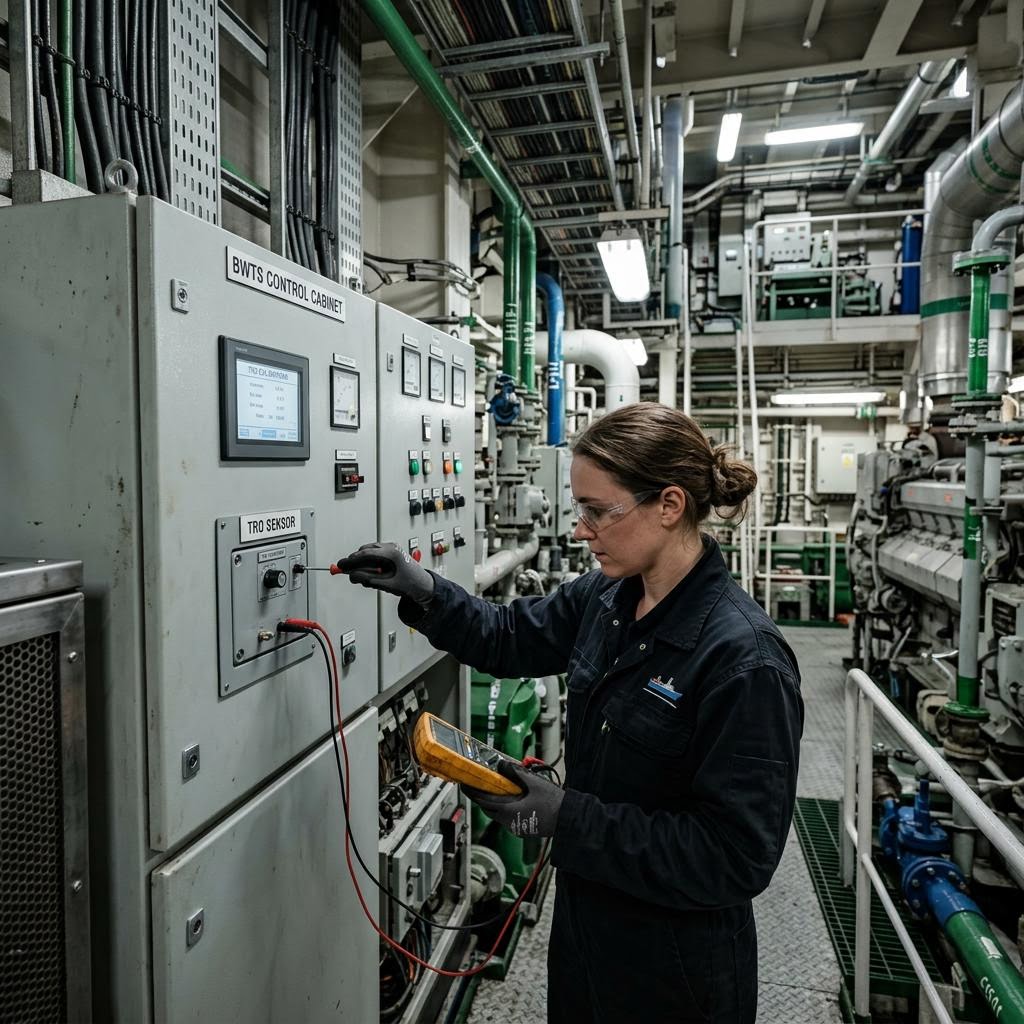
Quarterly - or more precisely every three to six months and on every reagent change - perform a full TRO analyser calibration against a standard, replacing DPD reagent or servicing amperometric membranes and electrolyte as required. Clean the UV intensity sensor and quartz sleeves, and inspect filter screens. Record each calibration with date, standard and result.
This is also the natural cadence to order shelf-life consumables timed to use, so reagents and neutraliser arrive fresh rather than being held long. Building reagent and thiosulfate reorder into the quarterly review, aligned with the passage plan, prevents the expired-stock deficiency that inspectors find so often.
The Annual Service
The annual service is the comprehensive intervention, ideally aligned with the class annual survey so calibration certificates and overhaul records are current when the surveyor attends. It covers a full calibration of all sensors - TRO, UV intensity, flowmeter verification, and the salinity, temperature and pressure instruments - against references, with certificates issued and filed.
Mechanically it covers filter inspection and screen and backflush-valve servicing; UV lamp and quartz-sleeve replacement or inspection against run-hours; electrode inspection and cleaning or planned replacement against amp-hours on electrolytic systems; and the neutralisation dosing pump and its seals. Seals and O-rings on oxidising service are renewed to correct material grade where due.
Finally the annual service reconciles the documentation: the type approval certificate against the installed configuration, the ballast water record book against the alarm and operation history, and the calibration certificates filed with the ballast records. Sea Clean AS performs annual service and calibration - authorized Headway support for OceanGuard and independent, brand-agnostic service for other systems; attendance is 0-24h in Norway and the North Sea and by arrangement elsewhere.
Aligning With Class Surveys and Deadlines
Ballast water equipment is covered by the vessel's survey regime, with sensors expected to be within calibration and records in order at annual and renewal surveys. Scheduling the annual service just ahead of the class annual survey means the surveyor sees fresh calibration certificates and a reconciled record book, which is the smoothest path through survey.
Longer-interval items align with the docking and renewal cycle: major overhaul scope, electrode replacement, and any modification are naturally planned into a drydock. Tracking electrode amp-hours and lamp run-hours against these longer cycles lets long-lead planned parts be ordered in time rather than as emergencies.
Keep the maintenance plan and its records in the planned maintenance system so intervals are not missed and evidence is retrievable. A documented, followed schedule is both the practical way to keep the system available and the evidence that satisfies class and PSC that the system is properly managed.
How Do You Keep the Schedule Defensible?
Defensibility rests on records: a calibration certificate for each sensor with date, standard and result; reagent and neutraliser lot and expiry logs; lamp and electrode run-hour tracking; and a ballast water record book that reconciles with the alarm history. These, filed with the ballast records and kept current, are what turn a maintenance routine into compliance evidence.
Trend the data across intervals - TRO offsets and spans, cell voltages, UV intensity, filter dP behaviour - so that a slow degradation is visible and a replacement can be planned before a failure. Trending turns the schedule from a checklist into a predictive tool that reduces both downtime and inspection risk.
Adjust intervals to the vessel's reality: more frequent checks for challenging trades, variable salinity, or a system with a history of alarms, always within or tighter than the manual's guidance. Sea Clean AS can build and support a service and calibration schedule matched to the installed system and trade, and supply the reagents, standards and spares it calls for. Contact post@seaclean.no with the system make, model and serial.
Frequently asked questions
How often should I service my BWTS?
Layer it: weekly/per-operation checks, monthly sensor verification and stock review, a full TRO calibration every three to six months (and on every reagent change), and a comprehensive annual service aligned to the class annual survey. The exact intervals come from your system's manual.
What does an annual BWTS service cover?
Full calibration of TRO, UV intensity and other sensors plus flowmeter verification; filter and backflush-valve servicing; UV lamp and quartz-sleeve replacement or inspection against run-hours; electrode inspection; neutralisation pump service; seal renewal; and reconciliation of the record book and certificates.
Should the annual service align with the class survey?
Yes. Scheduling the annual service just before the class annual survey means the surveyor sees fresh calibration certificates and a reconciled ballast water record book, which is the smoothest path through survey and keeps the compliance evidence current.
Who can carry out BWTS annual service and calibration?
Sea Clean AS performs BWTS annual service and calibration - authorized Headway support for OceanGuard and independent, brand-agnostic service for other systems, stated on every quote. Attendance is 0-24h in Norway and the North Sea and by arrangement elsewhere. Provide the system make, model and serial.
Sources
- IMO MEPC.300(72) BWMS Code — Type approval and maintenance framework
- DNV rules and ballast water services — Class survey and BWTS guidance
Related articles
Request spares, calibration or ballast-water testing
Include BWMS brand/model, vessel/IMO number, port/terminal, date/ETA and scope or part numbers. These links prepare an email draft; you must send it yourself.
- Request a parts quote — Sensors, TRO reagents, calibration kits and replacement parts. Confirm compatibility, availability and delivery for your installed system.
- Request a calibration booking — Annual instrument calibration with a calibration certificate for the work completed. OEM instructions, drift or applicable rules may require earlier work.
- Request testing coordination — Arrange sampling and testing with an appropriately qualified party for your IMO D-2, commissioning or other stated purpose.
Authorised Headway agent. Other-brand enquiries are independently reviewed; no OEM authorisation is claimed. Sea Clean is not an accredited laboratory or approving authority. Calibration does not demonstrate biological D-2 compliance. Attendance, testing scope and parts delivery are confirmed per enquiry.