Troubleshooting Erma First BWTS
Updated
Erma First FIT faults group into filter differential pressure and backflush problems, electrolysis cell faults, dosing-system problems, low or unstable TRO, and neutralisation issues on discharge. This article describes the common patterns, how to separate instrumentation faults from process faults, and the fixes, with independent diagnosis and parts support from Sea Clean AS, which is not an Erma First-authorized agent.
Key takeaways
- Read filter differential, electrolysis voltage/current, dosing status, TRO, flow and salinity together to find the cause.
- Separate measurement faults (analyser, sample line, valves) from process faults before replacing major components.
- High filter differential usually means loading, a fouled element or a backflush valve/actuator problem.
- Rising cell voltage signals electrode scaling or coating loss; a dosing fault under-treats even with a healthy cell.
- Clear the TRO analyser first, then separate electrolysis from dosing causes for genuine low TRO.
- Escalate D-2-affecting or PSC-risk faults early; urgent Norway/North Sea attendance is typically within 0-24h.
A Methodical Read of FIT Faults
Erma First alarms are read most reliably by viewing the live parameters together: filter differential pressure, electrolysis voltage and current, dosing-pump status, TRO reading, flow and salinity. The combination usually identifies the cause more reliably than the single headline alarm, because the FIT architecture has several stages that can each generate alarms.
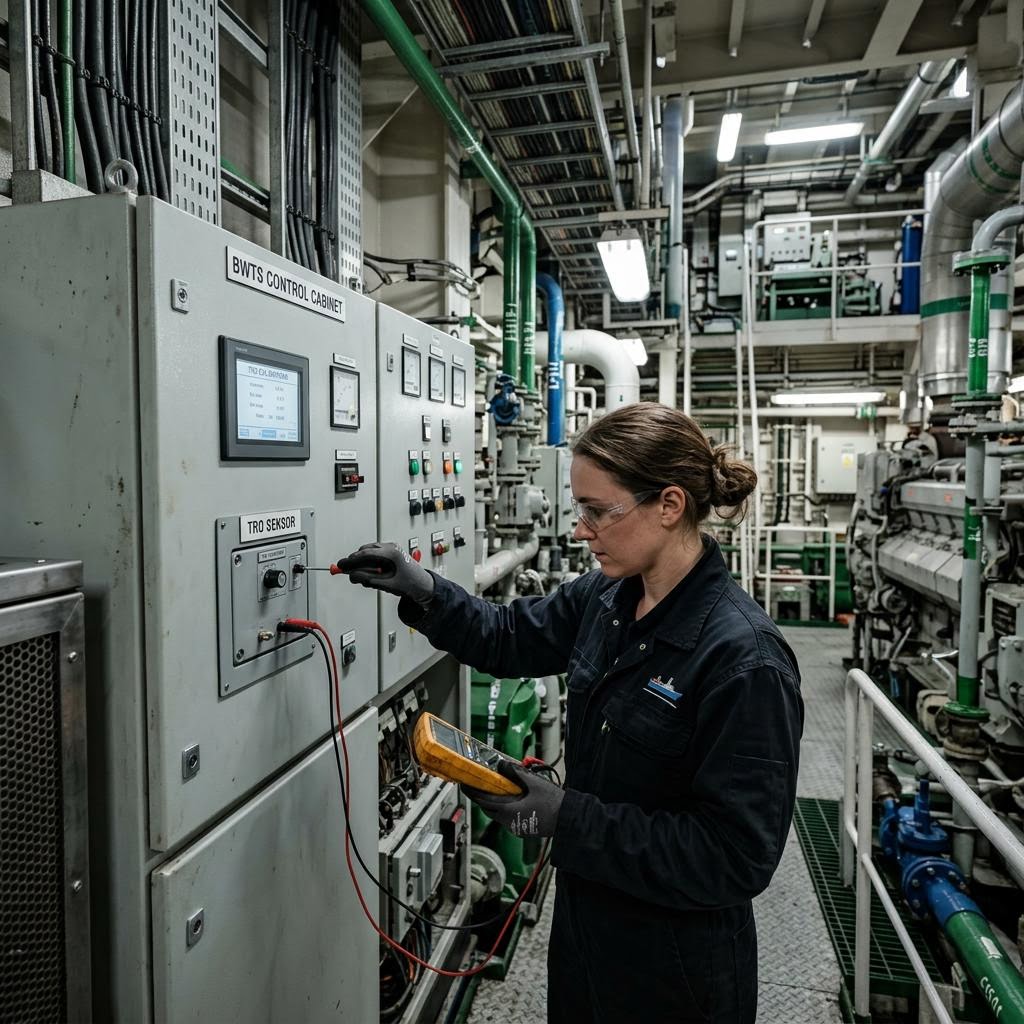
The central question is whether the fault is in measurement or in process. A starved TRO analyser, a blocked sample line or a sticking valve produces alarms that mimic a treatment failure, and confirming the supporting instrumentation first avoids replacing electrodes, elements or dosing parts needlessly.
Recording the water source, temperature, salinity and flow at the time of the alarm gives the context needed to interpret it, since low salinity and turbid water change both filtration and electrolysis behaviour. Sea Clean uses this to advise remotely or to prepare parts before attending.
Filter Differential Pressure and Backflush
High filter differential pressure is a common FIT alarm. It usually reflects sediment or biological loading in turbid water, a fouled or damaged element, or a backflush that is not clearing the screen. The first checks are the actual differential against baseline and whether backflush is initiating and completing correctly.
When backflush fails, the cause is often the backflush valve or actuator or insufficient backflush flow, rather than the element itself. A torn or wrong-mesh element raises differential pressure or passes excess material downstream, so element condition and specification are confirmed during diagnosis.
Repeated high-differential trips in dirty water can indicate the flow rate is too high for the conditions or that the maintenance interval needs shortening for that trade. Sea Clean sources elements, seals and backflush components and advises on intervals for the vessel's water quality.
Electrolysis Cell and Dosing Faults
Electrolysis-side faults show as the cell failing to reach target output, abnormal voltage or current, or power trips. Rising voltage for the same output indicates electrode scaling or coating loss; scaling may respond to cleaning, while coating loss requires electrode replacement. Low salinity stresses the cell and can expose marginal electrode condition.
On the dosing side, a pump, line or injection-point fault under-doses the main flow, so the ballast is under-treated even when the cell reads healthy. When treatment is low but the cell looks normal, the dosing pump output, line integrity and injection point are the items to check.
Sea Clean inspects the cell, advises on cleaning versus electrode replacement, sources electrodes and dosing components, and verifies treatment after work so the system returns to its operating window.
Low TRO and Analyser Issues
Low TRO is consequential because it can mean under-treatment. Before suspecting the cell or dosing, the analyser is cleared: confirm reagent is in date and fitted, the sample line is clear and flowing, the measuring cell is clean and the sensor is in good condition.
If the analyser is healthy and TRO is genuinely low, the causes include electrode wear, a dosing fault, low salinity below the unit's effective range, or excessive flow. Each is checked against the live parameters, separating an electrolysis problem from a dosing problem so the right part is fitted.
Sea Clean supplies in-date reagents and analyser consumables and, where the cause is in the cell or dosing system, sources electrodes and dosing parts. Confirming whether low TRO is analyser, electrolysis or dosing is the key diagnostic step.
Neutralisation Faults on Discharge
On discharge, residual oxidant above the permitted limit must be neutralised, usually with sodium thiosulfate. Neutralisation faults arise from empty or low neutraliser stock, a dosing pump or line problem, or an incorrect command, and discharging above the limit is both a compliance and a safety issue that must be corrected before discharge continues.
The checks cover neutraliser stock level, the dosing pump and line, and the discharge TRO reading. A discharge TRO that stays high despite neutralisation commanded points to a neutraliser dosing fault rather than a treatment problem on uptake.
Sea Clean sources neutralisation components and supplies sodium thiosulfate neutraliser, and during attendance verifies the discharge chain so the vessel can discharge within the permitted limit.
Crew Action, Escalation and Attendance
Some FIT faults are crew-clearable with guidance, such as an expired reagent, a blocked sample line, low neutraliser stock or a reset after a transient trip. Others, including electrode replacement, dosing-system repairs, power-supply faults and anything affecting D-2 validity, warrant engineer attendance and sourced parts.
A fault that risks a port state control finding or a non-compliant discharge should be escalated early so contingency measures and documentation can be arranged before arrival. Sea Clean can advise whether a reported fault is a crew item or an attendance case from the parameters provided.
From the Haugesund base, urgent Erma First attendance in Norway and the North Sea is typically within 0-24 hours subject to scheduling, and worldwide by mobilising as flights, visas and access allow. Send the FIT model, alarm history, parameters and IMO number to post@seaclean.no to begin diagnosis.
Frequently asked questions
What causes high filter differential pressure on an Erma First FIT?
Usually sediment or biological loading in turbid water, a fouled or damaged element, or a backflush not clearing the screen. Check the actual differential against baseline and whether backflush initiates and completes; the backflush valve and actuator are common culprits when backflush fails.
Why is TRO low on an Erma First system?
First clear the analyser: expired reagent, a blocked sample line, a dirty cell or a worn sensor. If the analyser is healthy, genuine low TRO can come from electrode wear, a dosing fault, salinity below the unit's effective range, or excessive flow, each checked against the live parameters to separate electrolysis from dosing causes.
How are dosing faults identified on a FIT system?
When treatment is low but the electrolysis cell reads healthy, the dosing system is the likely cause. Check the dosing pump output, line integrity and injection point. A discharge TRO that stays high despite neutralisation commanded points to a neutraliser dosing fault rather than an uptake treatment problem.
Is Sea Clean authorized by Erma First to service these systems?
No. Sea Clean provides independent service, troubleshooting and parts sourcing for Erma First and is an authorized agent for Headway only. We do not claim OEM authorization from Erma First. Where a matter genuinely requires the manufacturer, we are clear about that limit.