What Is the Difference Between Zero, Span and Calibration?
Updated
Zero and span describe parts of a measurement response; calibration describes a documented relationship to references. A routine adjustment or two-point check should not be labelled as full-range calibration unless its method and evidence justify that scope.
Request BWTS spare parts, annual calibration or ballast-water testing
Key takeaways
- Use a valid zero condition.
- Span does not prove every intermediate point.
- Adjustment changes the response.
- Preserve as-found evidence.
- Test relevant operating boundaries.
- Name the actual service scope.
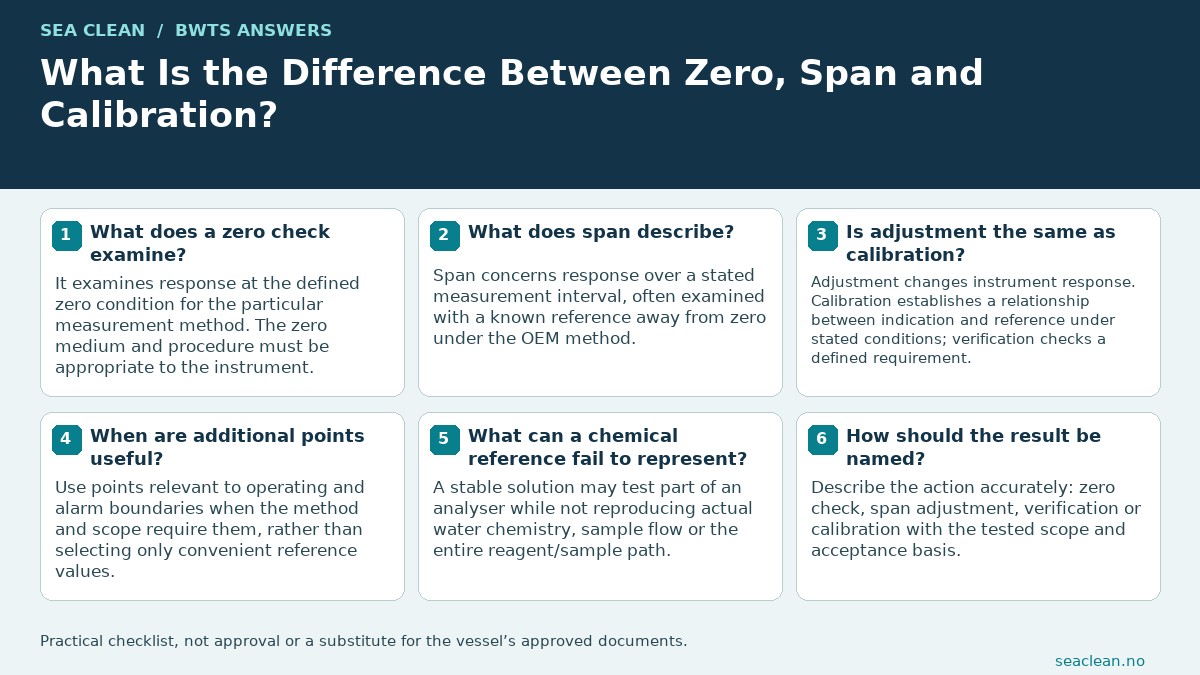
What does a zero check examine?
It examines response at the defined zero condition for the particular measurement method. The zero medium and procedure must be appropriate to the instrument.
A convenient blank may not be a valid zero reference. Sample contamination or incorrect conditioning can make the apparent offset misleading.
What does span describe?
Span concerns response over a stated measurement interval, often examined with a known reference away from zero under the OEM method.
A correct endpoint does not necessarily establish accuracy at intermediate values. Non-linearity can remain hidden between two accepted points.
Related guidance: BWTS Calibration Certificates: What Vessel Operators Should Check
Is adjustment the same as calibration?
Adjustment changes instrument response. Calibration establishes a relationship between indication and reference under stated conditions; verification checks a defined requirement.
Record these actions separately. If adjustment occurs, preserve the as-found condition and document appropriate as-left evidence.
When are additional points useful?
Use points relevant to operating and alarm boundaries when the method and scope require them, rather than selecting only convenient reference values.
Do not prescribe a universal number of points for every sensor. Range, technology, intended use and the applicable procedure determine the test.
What can a chemical reference fail to represent?
A stable solution may test part of an analyser while not reproducing actual water chemistry, sample flow or the entire reagent/sample path.
Follow the maker’s definition of what is being verified. Do not equate an electronic simulated input with analysis of a real sample.
Related guidance: What If a BWTS Calibration Falls Due During a Voyage?
How should the result be named?
Describe the action accurately: zero check, span adjustment, verification or calibration with the tested scope and acceptance basis.
Avoid a whole-system claim on a limited service worksheet. Clear terminology helps operators know which questions remain unanswered.
Frequently asked questions
Are zero and span checks full calibration?
Not necessarily. Their scope may cover only selected response points or adjustments.
Does simulated input test the wet sample path?
No. It can test electronics without testing actual sample handling and chemistry.
Must every instrument use the same points?
No. Use the instrument-specific method and intended operating range.
Why keep readings before adjustment?
They show the original error and support review of possible earlier operational impact.
Sources
- IMO — BWMS Code, MEPC.300(72) — Approval framework, monitoring, system design limitations and biological performance; not a universal maker procedure.
- NIST — Metrological traceability
- US EPA — 2013 VGP — Part 2.2.3.5.1.1.3 where applicable; verify the current VGP/VIDA transition for the voyage.
Related articles
- Is Bench Calibration Enough for an Installed BWTS Instrument?
- What If a BWTS Calibration Falls Due During a Voyage?
- BWTS Calibration Certificates: What Vessel Operators Should Check
- BWTS Metrology Scope of Work: What a Purchase Order Must Define
- What Is a Ballast Water Treatment System? Explained
- How Does BWTS Installation Work? Step by Step
Request spares, calibration or ballast-water testing
Include BWMS brand/model, vessel/IMO number, port/terminal, date/ETA and scope or part numbers. These links prepare an email draft; you must send it yourself.
- Request a parts quote — Sensors, TRO reagents, calibration kits and replacement parts. Confirm compatibility, availability and delivery for your installed system.
- Request a calibration booking — Annual instrument calibration with a calibration certificate for the work completed. OEM instructions, drift or applicable rules may require earlier work.
- Request testing coordination — Arrange sampling and testing with an appropriately qualified party for your IMO D-2, commissioning or other stated purpose.
Authorised Headway agent. Other-brand enquiries are independently reviewed; no OEM authorisation is claimed. Sea Clean is not an accredited laboratory or approving authority. Calibration does not demonstrate biological D-2 compliance. Attendance, testing scope and parts delivery are confirmed per enquiry.