What If a BWTS Calibration Falls Due During a Voyage?
Updated
A voyage schedule does not automatically extend a calibration requirement. Plan around each instrument’s applicable interval and the vessel’s intended operations, with contingency evidence ready before the due date becomes a port problem.
Request BWTS spare parts, annual calibration or ballast-water testing
Key takeaways
- Determine each instrument’s interval.
- Compare deadlines with actual operations.
- Allow installation and evidence lead time.
- Do not invent a grace period.
- Escalate overdue restrictions early.
- Set dates from completed work.
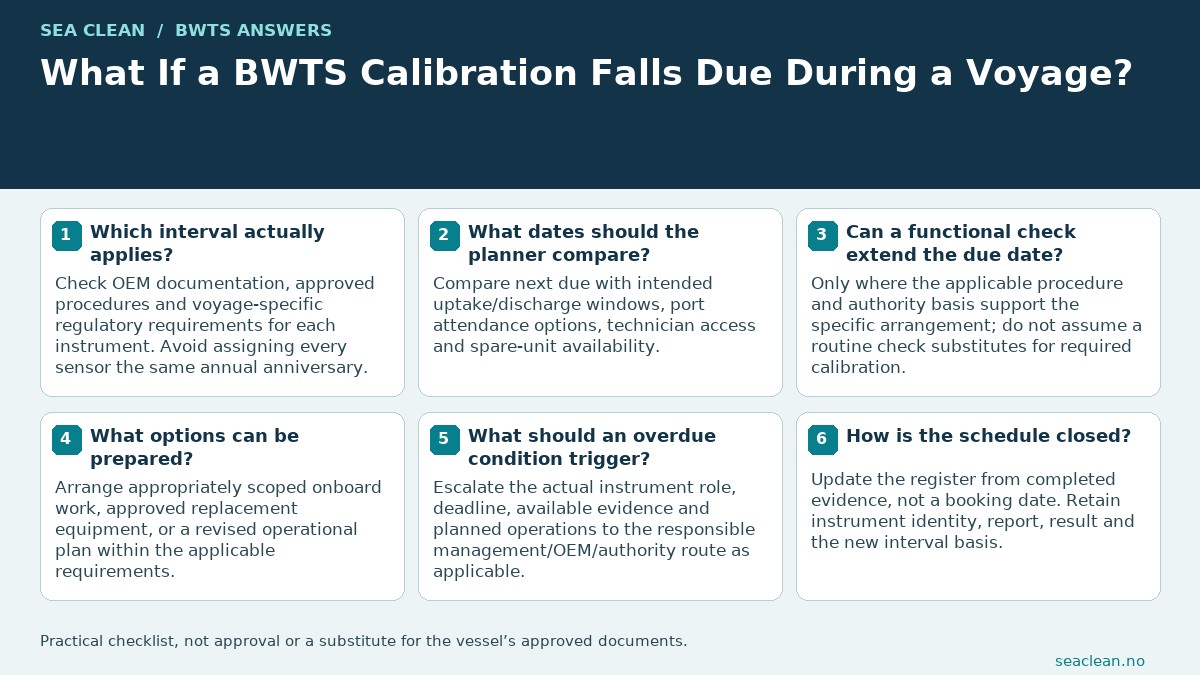
Which interval actually applies?
Check OEM documentation, approved procedures and voyage-specific regulatory requirements for each instrument. Avoid assigning every sensor the same annual anniversary.
Where the 2013 VGP provision applies, annual is a minimum; manufacturer recommendations and drift can require more frequent calibration.
What dates should the planner compare?
Compare next due with intended uptake/discharge windows, port attendance options, technician access and spare-unit availability.
Include realistic delivery and certification lead time. A part arriving before discharge is not enough if installation and verification cannot be completed.
Related guidance: BWTS Calibration Certificates: What Vessel Operators Should Check
Can a functional check extend the due date?
Only where the applicable procedure and authority basis support the specific arrangement; do not assume a routine check substitutes for required calibration.
Keep terminology accurate. A satisfactory check may provide useful evidence without changing a formal interval or resolving known drift.
What options can be prepared?
Arrange appropriately scoped onboard work, approved replacement equipment, or a revised operational plan within the applicable requirements.
Predefine evidence needed for release and who controls the decision. Do not invent a grace period based on a vendor’s commercial availability.
What should an overdue condition trigger?
Escalate the actual instrument role, deadline, available evidence and planned operations to the responsible management/OEM/authority route as applicable.
Evaluate monitoring reliability and operational restrictions. Do not claim overdue calibration proves biological failure, or that normal readings erase the overdue duty.
Related guidance: Can You Trust a BWTS Check Made with an Expired Reference?
How is the schedule closed?
Update the register from completed evidence, not a booking date. Retain instrument identity, report, result and the new interval basis.
Review why access or scheduling failed and adjust the next planning cycle. Keep outstanding limitations visible at crew change.
Frequently asked questions
Is annual calibration always sufficient?
No. OEM recommendations, drift and applicable requirements may demand shorter intervals.
Does a service booking count as calibration?
No. The work and appropriate evidence must actually be completed.
Can a normal reading justify an extension?
Not by itself. Follow the applicable procedure and authority basis.
Must an overdue result be called D-2 failure?
No. Calibration duty and biological discharge performance are distinct questions requiring separate assessment.
Sources
- IMO — BWMS Code, MEPC.300(72) — Approval framework, monitoring, system design limitations and biological performance; not a universal maker procedure.
- NIST — Metrological traceability
- US EPA — 2013 VGP — Part 2.2.3.5.1.1.3 where applicable; verify the current VGP/VIDA transition for the voyage.
Related articles
- What Is the Difference Between Zero, Span and Calibration?
- Can You Trust a BWTS Check Made with an Expired Reference?
- BWTS Calibration Certificates: What Vessel Operators Should Check
- BWTS Metrology Scope of Work: What a Purchase Order Must Define
- BWTS Flowmeter Calibration and Troubleshooting
- What Is a Ballast Water Treatment System? Explained
Request spares, calibration or ballast-water testing
Include BWMS brand/model, vessel/IMO number, port/terminal, date/ETA and scope or part numbers. These links prepare an email draft; you must send it yourself.
- Request a parts quote — Sensors, TRO reagents, calibration kits and replacement parts. Confirm compatibility, availability and delivery for your installed system.
- Request a calibration booking — Annual instrument calibration with a calibration certificate for the work completed. OEM instructions, drift or applicable rules may require earlier work.
- Request testing coordination — Arrange sampling and testing with an appropriately qualified party for your IMO D-2, commissioning or other stated purpose.
Authorised Headway agent. Other-brand enquiries are independently reviewed; no OEM authorisation is claimed. Sea Clean is not an accredited laboratory or approving authority. Calibration does not demonstrate biological D-2 compliance. Attendance, testing scope and parts delivery are confirmed per enquiry.