Is Bench Calibration Enough for an Installed BWTS Instrument?
Updated
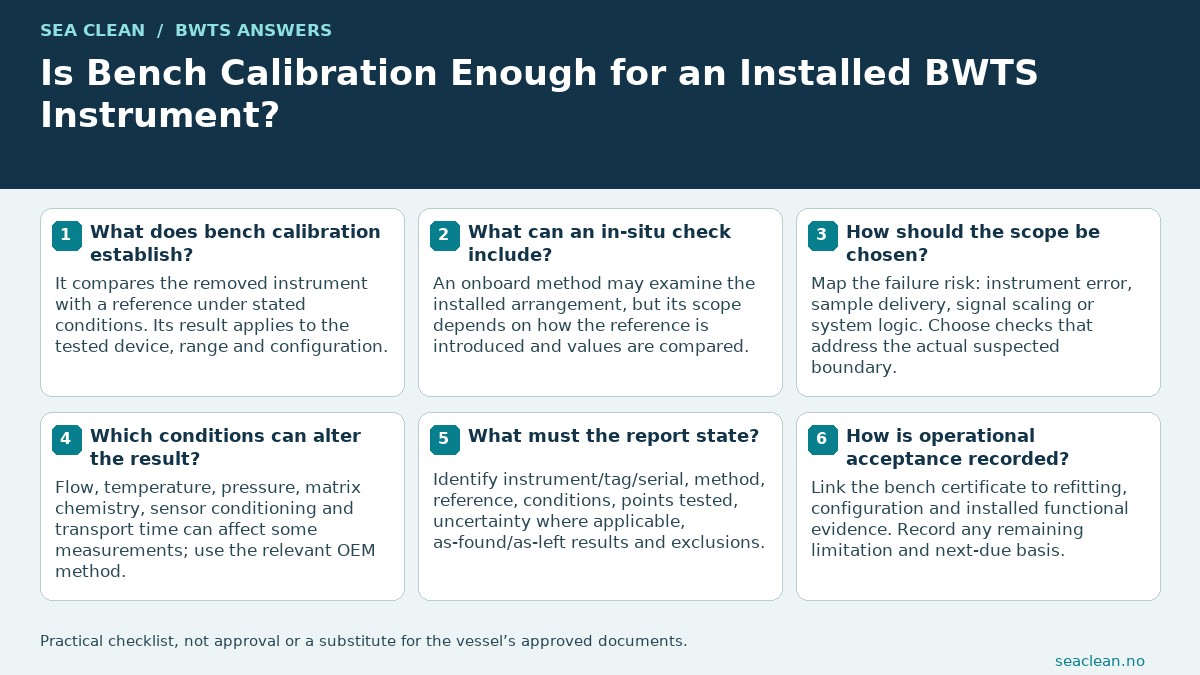
Bench work and in-situ work can answer different questions. Decide which measurement boundary must be demonstrated before purchasing the service, then ensure the report does not claim more than was tested.
Request BWTS spare parts, annual calibration or ballast-water testing
Key takeaways
- Define the measurement boundary.
- Bench evidence concerns the tested unit.
- Installed checks may cover other errors.
- Match the method to the instrument.
- Require explicit report exclusions.
- Link refitting to release evidence.
What does bench calibration establish?
It compares the removed instrument with a reference under stated conditions. Its result applies to the tested device, range and configuration.
It does not automatically include the vessel’s sample piping, installed temperature conditions, transmitter output, cabling or PLC interpretation.
What can an in-situ check include?
An onboard method may examine the installed arrangement, but its scope depends on how the reference is introduced and values are compared.
A side-by-side reading is not necessarily a full calibration. Identify reference quality, timing, representativeness and acceptance criteria.
Related guidance: BWTS Calibration Certificates: What Vessel Operators Should Check
How should the scope be chosen?
Map the failure risk: instrument error, sample delivery, signal scaling or system logic. Choose checks that address the actual suspected boundary.
If the unit is bench-calibrated, add appropriate installed checks after refitting rather than treating an off-vessel certificate as complete release evidence.
Which conditions can alter the result?
Flow, temperature, pressure, matrix chemistry, sensor conditioning and transport time can affect some measurements; use the relevant OEM method.
Do not impose chemical-method assumptions on pressure or flow instruments. The appropriate comparison depends on the measurand and device.
What must the report state?
Identify instrument/tag/serial, method, reference, conditions, points tested, uncertainty where applicable, as-found/as-left results and exclusions.
State whether the installed loop was included. A clear limited report is more useful than the unsupported phrase 'complete BWTS calibration'.
Related guidance: What Is the Difference Between Zero, Span and Calibration?
How is operational acceptance recorded?
Link the bench certificate to refitting, configuration and installed functional evidence. Record any remaining limitation and next-due basis.
Where the installed result disagrees with bench evidence, investigate the boundary difference before making repeated adjustments to the same sensor.
Frequently asked questions
Is in-situ work always better?
No. Suitability depends on the method, reference, conditions and required measurement boundary.
Can a bench certificate cover sample plumbing?
Not unless that arrangement was actually included in the documented test scope.
Is comparing two displays calibration?
Not automatically; reference traceability, method and acceptance evidence are needed.
What if installed readings differ after refitting?
Investigate sample conditions, configuration and signal paths before assuming the bench result is wrong.
Sources
- IMO — BWMS Code, MEPC.300(72) — Approval framework, monitoring, system design limitations and biological performance; not a universal maker procedure.
- NIST — Metrological traceability
- US EPA — 2013 VGP — Part 2.2.3.5.1.1.3 where applicable; verify the current VGP/VIDA transition for the voyage.
Related articles
- What Must Be Checked After Replacing a BWTS Sensor?
- What Is the Difference Between Zero, Span and Calibration?
- BWTS Calibration Certificates: What Vessel Operators Should Check
- BWTS Metrology Scope of Work: What a Purchase Order Must Define
- What Is a Ballast Water Treatment System? Explained
- How Does BWTS Installation Work? Step by Step
Request spares, calibration or ballast-water testing
Include BWMS brand/model, vessel/IMO number, port/terminal, date/ETA and scope or part numbers. These links prepare an email draft; you must send it yourself.
- Request a parts quote — Sensors, TRO reagents, calibration kits and replacement parts. Confirm compatibility, availability and delivery for your installed system.
- Request a calibration booking — Annual instrument calibration with a calibration certificate for the work completed. OEM instructions, drift or applicable rules may require earlier work.
- Request testing coordination — Arrange sampling and testing with an appropriately qualified party for your IMO D-2, commissioning or other stated purpose.
Authorised Headway agent. Other-brand enquiries are independently reviewed; no OEM authorisation is claimed. Sea Clean is not an accredited laboratory or approving authority. Calibration does not demonstrate biological D-2 compliance. Attendance, testing scope and parts delivery are confirmed per enquiry.