Why Is the BWTS Totaliser Different from the Ballast Pump Total?
Updated
Two counters can both work correctly while measuring different water. Draw the measurement boundary and identify every branch before using the difference as evidence of a faulty meter or an untreated volume.
Request BWTS spare parts, annual calibration or ballast-water testing
Key takeaways
- Locate both meters on the diagram.
- Separate gross and net quantities.
- Align the counter intervals.
- Check resets, units and direction.
- Use tank inventory as a cross-check.
- Do not scale away unexplained differences.
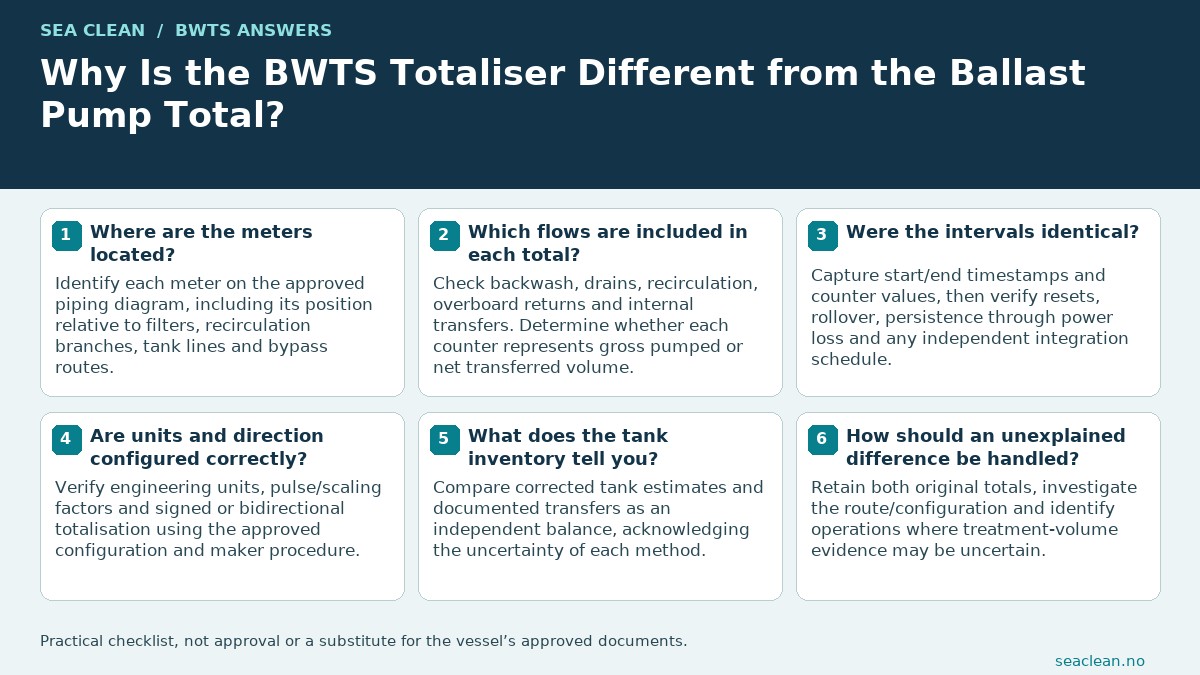
Where are the meters located?
Identify each meter on the approved piping diagram, including its position relative to filters, recirculation branches, tank lines and bypass routes.
A pump discharge meter and treatment-inlet meter do not necessarily integrate the same flow, particularly when branches open during the operation.
Which flows are included in each total?
Check backwash, drains, recirculation, overboard returns and internal transfers. Determine whether each counter represents gross pumped or net transferred volume.
Do not subtract an assumed backwash percentage. Use actual evidence and the installed arrangement rather than a generic fleet constant.
Related guidance: BWTS Sample-Line Design and Conditioning: Preventing Misleading Readings
Were the intervals identical?
Capture start/end timestamps and counter values, then verify resets, rollover, persistence through power loss and any independent integration schedule.
A daily pump counter cannot be compared directly with a BWMS counter reset at treatment start without aligning their measurement intervals.
Are units and direction configured correctly?
Verify engineering units, pulse/scaling factors and signed or bidirectional totalisation using the approved configuration and maker procedure.
A plausible instantaneous indication can coexist with an incorrect accumulated-volume factor. Do not reprogram a factor merely to force agreement.
What does the tank inventory tell you?
Compare corrected tank estimates and documented transfers as an independent balance, acknowledging the uncertainty of each method.
Inventory is not a perfect reference meter, but it can reveal large route or interval problems that a display-to-display comparison misses.
Related guidance: Why Can Two BWTS Salinity Readings Disagree?
How should an unexplained difference be handled?
Retain both original totals, investigate the route/configuration and identify operations where treatment-volume evidence may be uncertain.
Record the adopted quantity basis and limitation. A counter discrepancy is not by itself proof of biological failure, but it should not be ignored.
Frequently asked questions
Should every pump and BWTS total match?
Only when their measurement boundaries, intervals and definitions are genuinely equivalent.
Can backwash explain any difference?
No. Its actual route and quantity must support the explanation.
Does correct instantaneous flow prove total volume?
No. Integration settings, units and resets can affect accumulated volume.
Can I change the scale until totals agree?
No. Establish the correct configuration and cause using approved procedures.
Sources
- IMO — BWMS Code, MEPC.300(72) — Approval framework, monitoring, system design limitations and biological performance; not a universal maker procedure.
- IMO — BWM Convention and implementation guidelines
Related articles
- Is Low UV Transmittance Caused by the Water or the Sensor?
- Why Can Two BWTS Salinity Readings Disagree?
- BWTS Sample-Line Design and Conditioning: Preventing Misleading Readings
- BWTS Calibration Calendar and Instrument Register
- Why Do Ballast Tank Soundings and Flow Totals Disagree?
- What Is a Ballast Water Treatment System? Explained
Request spares, calibration or ballast-water testing
Include BWMS brand/model, vessel/IMO number, port/terminal, date/ETA and scope or part numbers. These links prepare an email draft; you must send it yourself.
- Request a parts quote — Sensors, TRO reagents, calibration kits and replacement parts. Confirm compatibility, availability and delivery for your installed system.
- Request a calibration booking — Annual instrument calibration with a calibration certificate for the work completed. OEM instructions, drift or applicable rules may require earlier work.
- Request testing coordination — Arrange sampling and testing with an appropriately qualified party for your IMO D-2, commissioning or other stated purpose.
Authorised Headway agent. Other-brand enquiries are independently reviewed; no OEM authorisation is claimed. Sea Clean is not an accredited laboratory or approving authority. Calibration does not demonstrate biological D-2 compliance. Attendance, testing scope and parts delivery are confirmed per enquiry.