Why Do Ballast Tank Soundings and Flow Totals Disagree?
Updated
A disagreement is not automatically a faulty meter or a false entry. Tank inventory and a flow totaliser measure different boundaries, and their comparison must account for geometry, internal transfers and diverted flow.
Request BWTS spare parts, annual calibration or ballast-water testing
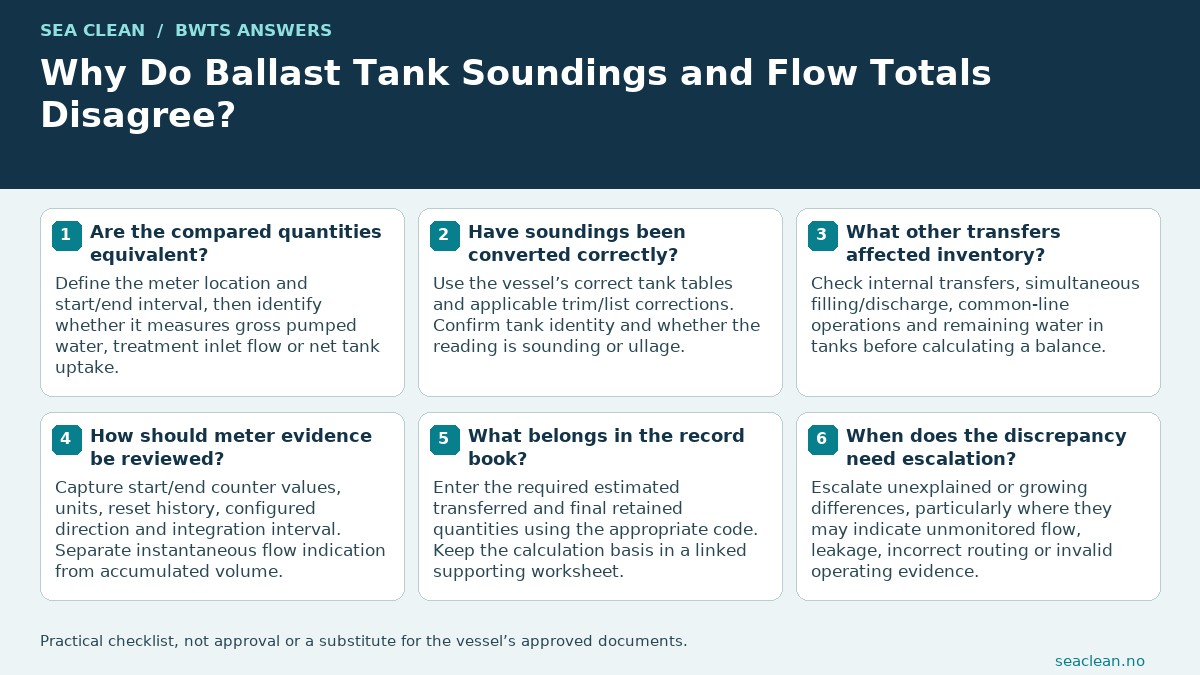
Key takeaways
- Compare the same measurement boundary.
- Correct soundings for trim and list.
- Include internal transfers.
- Check totaliser units and resets.
- Keep the estimate’s calculation basis.
- Investigate unexplained divergence.
Are the compared quantities equivalent?
Define the meter location and start/end interval, then identify whether it measures gross pumped water, treatment inlet flow or net tank uptake.
A tank sounding measures retained inventory. Backwash, drain, recirculation or bypass flows can prevent direct equality with an upstream totaliser.
Have soundings been converted correctly?
Use the vessel’s correct tank tables and applicable trim/list corrections. Confirm tank identity and whether the reading is sounding or ullage.
A table for a sister ship or an uncorrected reading can create a repeatable discrepancy even when the treatment meter is functioning.
Related guidance: Ballast Water Record Book: Printable PDF, IMO Requirements and Calibration
What other transfers affected inventory?
Check internal transfers, simultaneous filling/discharge, common-line operations and remaining water in tanks before calculating a balance.
Use starting inventory plus net inflows minus net outflows to estimate closing inventory. Do not force an unexplained balancing adjustment.
How should meter evidence be reviewed?
Capture start/end counter values, units, reset history, configured direction and integration interval. Separate instantaneous flow indication from accumulated volume.
Check configuration and calibration evidence under the OEM procedure; a correct-looking display does not prove its totalisation factor or units are correct.
What belongs in the record book?
Enter the required estimated transferred and final retained quantities using the appropriate code. Keep the calculation basis in a linked supporting worksheet.
IMO recognises estimation limitations. A declared estimate with a traceable basis is preferable to a fabricated exact figure copied across every record.
Related guidance: How Do You Record a Partial Ballast Discharge from Several Tanks?
When does the discrepancy need escalation?
Escalate unexplained or growing differences, particularly where they may indicate unmonitored flow, leakage, incorrect routing or invalid operating evidence.
Record the investigation, affected operations and uncertainty. Do not certify treatment of a volume merely because a counter increased.
Frequently asked questions
Must the quantities match exactly?
Not necessarily; estimation uncertainty and different measurement boundaries must be considered.
Does calibration remove every mismatch?
No. Routing, backwash, timing and tank-table errors can remain even with a calibrated meter.
Can I adjust the closing volume to balance?
Do not invent a balancing value. Document the discrepancy and investigate its basis.
Where should detailed calculations be filed?
In traceable supporting records linked to the relevant operation and required record-book entry.
Sources
- IMO — MEPC.369(80): revised record-book form
- IMO — BWM.2/Circ.80/Rev.1: record-keeping and reporting — The linked PDF is the revised circular dated 24 October 2024, despite its shorter filename.
- IMO — BWM Convention and implementation guidelines
Related articles
- What Water Depth Should a Ballast Record Book Entry Show?
- How Do You Record a Partial Ballast Discharge from Several Tanks?
- Ballast Water Record Book: Printable PDF, IMO Requirements and Calibration
- BWMS Hard-Copy Records and Onboard Document Control
- What Is a Ballast Water Treatment System? Explained
- How Does BWTS Installation Work? Step by Step
Request spares, calibration or ballast-water testing
Include BWMS brand/model, vessel/IMO number, port/terminal, date/ETA and scope or part numbers. These links prepare an email draft; you must send it yourself.
- Request a parts quote — Sensors, TRO reagents, calibration kits and replacement parts. Confirm compatibility, availability and delivery for your installed system.
- Request a calibration booking — Annual instrument calibration with a calibration certificate for the work completed. OEM instructions, drift or applicable rules may require earlier work.
- Request testing coordination — Arrange sampling and testing with an appropriately qualified party for your IMO D-2, commissioning or other stated purpose.
Authorised Headway agent. Other-brand enquiries are independently reviewed; no OEM authorisation is claimed. Sea Clean is not an accredited laboratory or approving authority. Calibration does not demonstrate biological D-2 compliance. Attendance, testing scope and parts delivery are confirmed per enquiry.