What Must Be Checked After Replacing a BWTS Sensor?
Updated
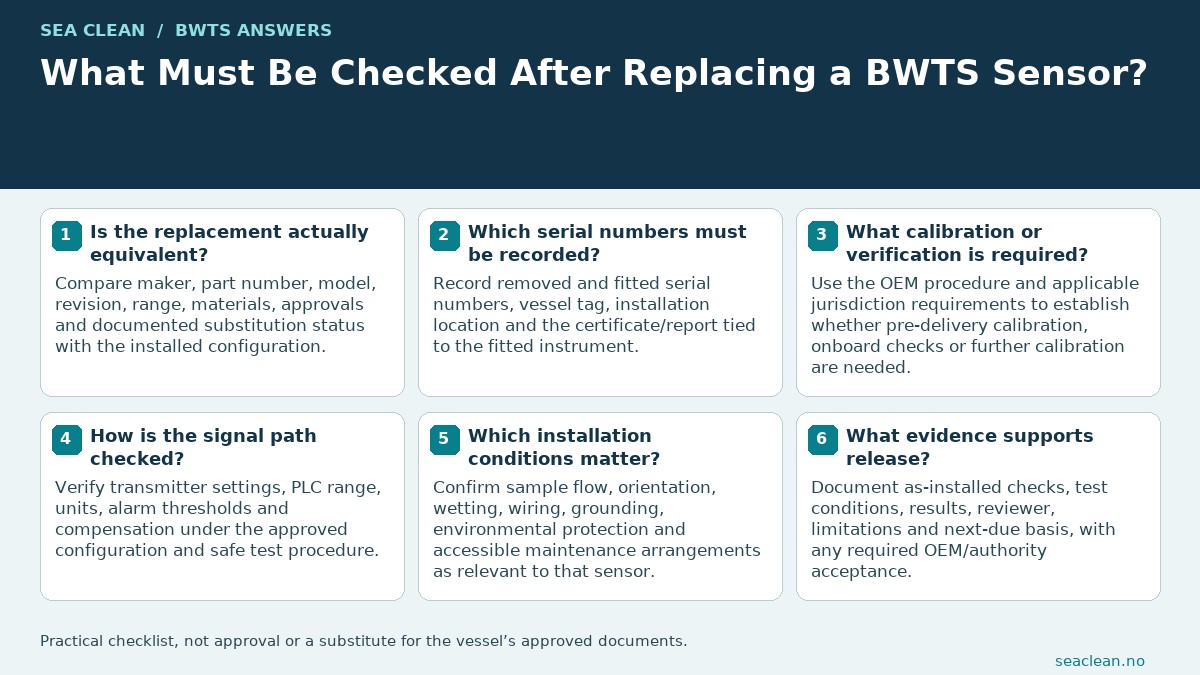
A replacement sensor is not accepted simply because its connector fits or the display becomes stable. Check the exact approved component, measurement configuration and complete signal path before closing the maintenance job.
Request BWTS spare parts, annual calibration or ballast-water testing
Key takeaways
- Confirm approved replacement identity.
- Link the installed serial to evidence.
- Verify the required calibration scope.
- Check transmitter-to-PLC scaling.
- Review installation and sample conditions.
- Release the configured system, not just the part.
Is the replacement actually equivalent?
Compare maker, part number, model, revision, range, materials, approvals and documented substitution status with the installed configuration.
A physically compatible alternative may change response, compensation or control behaviour. Route non-like-for-like changes through the required technical/approval review.
Which serial numbers must be recorded?
Record removed and fitted serial numbers, vessel tag, installation location and the certificate/report tied to the fitted instrument.
A certificate for the ordered model is insufficient if it cannot be linked to the serialised unit installed aboard.
Related guidance: BWTS Calibration Certificates: What Vessel Operators Should Check
What calibration or verification is required?
Use the OEM procedure and applicable jurisdiction requirements to establish whether pre-delivery calibration, onboard checks or further calibration are needed.
Check date, range, units and evidence scope. A factory certificate does not automatically verify the installed sample path or control-system scaling.
How is the signal path checked?
Verify transmitter settings, PLC range, units, alarm thresholds and compensation under the approved configuration and safe test procedure.
Compare measured values at appropriate points in the chain. Do not change limits to suppress an unexplained mismatch.
Which installation conditions matter?
Confirm sample flow, orientation, wetting, wiring, grounding, environmental protection and accessible maintenance arrangements as relevant to that sensor.
A correct instrument can still read incorrectly after poor installation. Keep hazards isolated and follow maker-specific handling precautions.
Related guidance: Is Bench Calibration Enough for an Installed BWTS Instrument?
What evidence supports release?
Document as-installed checks, test conditions, results, reviewer, limitations and next-due basis, with any required OEM/authority acceptance.
Update the instrument register and handover notes. Close the job only when the configured system—not just the spare part—has been checked.
Frequently asked questions
Is matching connector size enough?
No. Range, response, materials, approvals and configuration also matter.
Does a factory certificate cover the PLC?
Usually not; verify the installed signal chain separately under the approved procedure.
Can I fit a different model with the same range?
Only through the appropriate compatibility and approval review; same range alone is insufficient.
Should the old serial number remain in the register?
Retain replacement history while clearly identifying the currently installed instrument.
Sources
- IMO — BWMS Code, MEPC.300(72) — Approval framework, monitoring, system design limitations and biological performance; not a universal maker procedure.
- NIST — Metrological traceability
- US EPA — 2013 VGP — Part 2.2.3.5.1.1.3 where applicable; verify the current VGP/VIDA transition for the voyage.
Related articles
- What If a BWTS Sensor Is Found Outside Calibration Tolerance?
- Is Bench Calibration Enough for an Installed BWTS Instrument?
- BWTS Calibration Certificates: What Vessel Operators Should Check
- BWTS Metrology Scope of Work: What a Purchase Order Must Define
- How Should a BWMS Return to Service After Lay-Up?
- What Is a Ballast Water Treatment System? Explained
Request spares, calibration or ballast-water testing
Include BWMS brand/model, vessel/IMO number, port/terminal, date/ETA and scope or part numbers. These links prepare an email draft; you must send it yourself.
- Request a parts quote — Sensors, TRO reagents, calibration kits and replacement parts. Confirm compatibility, availability and delivery for your installed system.
- Request a calibration booking — Annual instrument calibration with a calibration certificate for the work completed. OEM instructions, drift or applicable rules may require earlier work.
- Request testing coordination — Arrange sampling and testing with an appropriately qualified party for your IMO D-2, commissioning or other stated purpose.
Authorised Headway agent. Other-brand enquiries are independently reviewed; no OEM authorisation is claimed. Sea Clean is not an accredited laboratory or approving authority. Calibration does not demonstrate biological D-2 compliance. Attendance, testing scope and parts delivery are confirmed per enquiry.