What If a BWTS Sensor Is Found Outside Calibration Tolerance?
Updated
An out-of-tolerance result creates two questions: can the instrument now be returned to service, and could its previous error have affected ballast decisions? A successful adjustment answers only part of that review.
Request BWTS spare parts, annual calibration or ballast-water testing
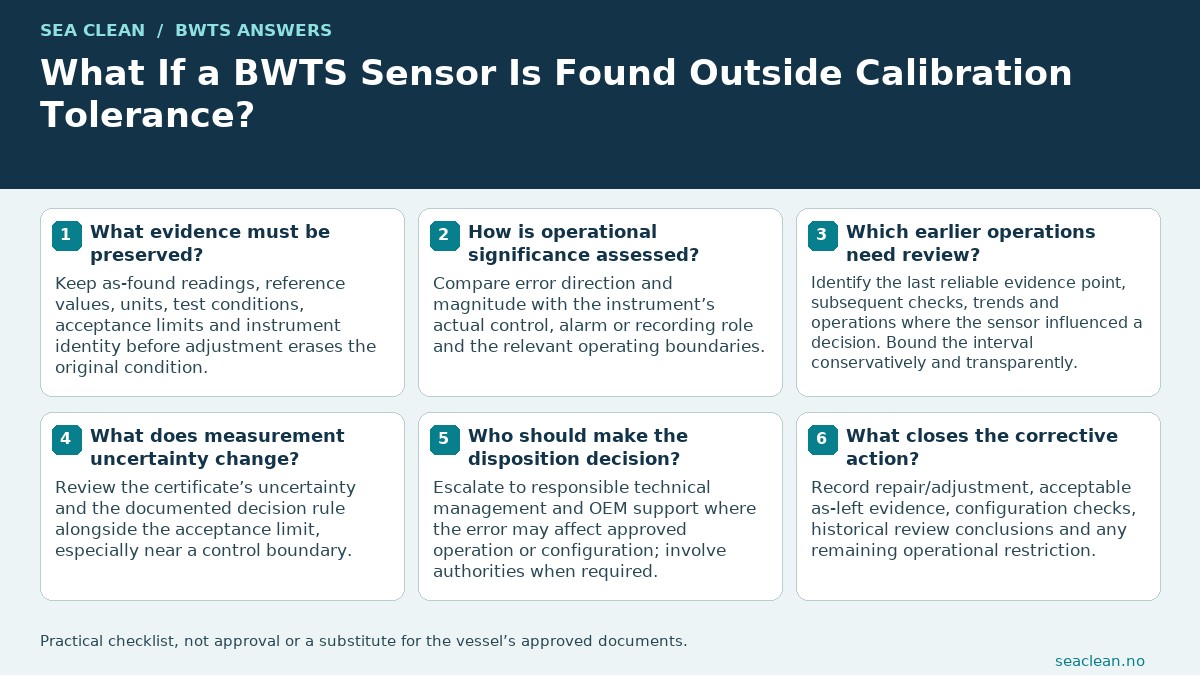
Key takeaways
- Preserve as-found results before adjustment.
- Assess error direction and magnitude.
- Bound the affected historical interval.
- Use the defined acceptance rule.
- Separate equipment and water decisions.
- Keep the retrospective review evidence.
What evidence must be preserved?
Keep as-found readings, reference values, units, test conditions, acceptance limits and instrument identity before adjustment erases the original condition.
Ask for as-left results separately. A certificate stating only 'calibrated' cannot show the direction or magnitude of the previous error.
How is operational significance assessed?
Compare error direction and magnitude with the instrument’s actual control, alarm or recording role and the relevant operating boundaries.
A positively biased residual reading can have a different consequence from a negative bias. Evaluate the real system logic rather than assuming every error is equivalent.
Related guidance: BWTS Calibration Certificates: What Vessel Operators Should Check
Which earlier operations need review?
Identify the last reliable evidence point, subsequent checks, trends and operations where the sensor influenced a decision. Bound the interval conservatively and transparently.
Do not automatically assign the entire calibration interval as proven failure or assume yesterday’s reading was valid. Explain evidence and uncertainty.
What does measurement uncertainty change?
Review the certificate’s uncertainty and the documented decision rule alongside the acceptance limit, especially near a control boundary.
Do not invent a universal percentage allowance. The OEM, approved procedure and relevant authority requirements determine the applicable acceptance basis.
Who should make the disposition decision?
Escalate to responsible technical management and OEM support where the error may affect approved operation or configuration; involve authorities when required.
Keep equipment disposition, affected-water status and notification assessment separate. Calibration personnel should not silently make a regulatory discharge decision.
Related guidance: What Must Be Checked After Replacing a BWTS Sensor?
What closes the corrective action?
Record repair/adjustment, acceptable as-left evidence, configuration checks, historical review conclusions and any remaining operational restriction.
A new due-date sticker is not enough. Preserve why the instrument was accepted and how uncertain past operations were managed.
Frequently asked questions
Does a fresh certificate clear past operations?
No. It documents a current condition; earlier operational impact requires its own review.
Can any small error be ignored?
Evaluate it against the actual role, limits, uncertainty and applicable decision rule.
What if as-found readings are missing?
Record the evidence gap and use other reliable history without inventing the missing condition.
Is an out-of-tolerance result proof of D-2 failure?
Not by itself. It may undermine monitoring evidence and requires appropriate operational and compliance assessment.
Sources
- IMO — BWMS Code, MEPC.300(72) — Approval framework, monitoring, system design limitations and biological performance; not a universal maker procedure.
- NIST — Metrological traceability
- US EPA — 2013 VGP — Part 2.2.3.5.1.1.3 where applicable; verify the current VGP/VIDA transition for the voyage.
Related articles
- Can You Trust a BWTS Check Made with an Expired Reference?
- What Must Be Checked After Replacing a BWTS Sensor?
- BWTS Calibration Certificates: What Vessel Operators Should Check
- BWTS Metrology Scope of Work: What a Purchase Order Must Define
- EC BWTS Calibration: Out-of-Tolerance Findings and Corrective Actions
- What Is a Ballast Water Treatment System? Explained
Request spares, calibration or ballast-water testing
Include BWMS brand/model, vessel/IMO number, port/terminal, date/ETA and scope or part numbers. These links prepare an email draft; you must send it yourself.
- Request a parts quote — Sensors, TRO reagents, calibration kits and replacement parts. Confirm compatibility, availability and delivery for your installed system.
- Request a calibration booking — Annual instrument calibration with a calibration certificate for the work completed. OEM instructions, drift or applicable rules may require earlier work.
- Request testing coordination — Arrange sampling and testing with an appropriately qualified party for your IMO D-2, commissioning or other stated purpose.
Authorised Headway agent. Other-brand enquiries are independently reviewed; no OEM authorisation is claimed. Sea Clean is not an accredited laboratory or approving authority. Calibration does not demonstrate biological D-2 compliance. Attendance, testing scope and parts delivery are confirmed per enquiry.